 |
| On Friday, March 28, 2025, CORPCOM celebrated its 30th anniversary with a special event attended by its members, leaders of rice producer associations, and public officials. The highlight of the evening was a recognition presented by the Municipality of Samborondón, honoring CORPCOM’s contributions to the Ecuadorian rice industry. During the ceremony, Dr. Silvia Tutiven Ortega, Vice Mayor of Samborondón, presented a special award to Juan Pablo Zúñiga, president of CORPCOM, in acknowledgment of the organization's legacy and its impact on the professional advancement of Ecuador’s rice industry. This recognition underscores CORPCOM’s role in providing technical information, training, and strategic support for the state, producers, and businesses investing in the sector. In his remarks, Juan Pablo Zúñiga stated, "CORPCOM has played a vital role as the second link in the rice value chain, serving as a source of technical information for the state, producers, and businesses interested in investing in the sector. Additionally, we have been committed to providing training for producers and industry professionals, aiming to enhance the quality and productivity of rice." The 30th-anniversary celebration not only honored CORPCOM’s achievements but also reinforced its mission to support the continued growth and modernization of the sector. Here’s to the next chapter of excellence in Ecuador’s rice industry. "We thank Juan Pablo Zuñiga and CORPCOM for the kind invitation. We regret that we could not make it, but we recognize and celebrate CORPCOM’s incredible achievements over the past 30 years," said Marcela Garcia, USRPA President & CEO. |
USDA’s Farm Service Agency is issuing up to $10 billion in direct payments to eligible agricultural producers of eligible commodities for the 2024 crop year through the Emergency Commodity Assistance Program (ECAP). These one-time economic assistance payments will help commodity producers mitigate the impacts of increased input costs and falling commodity prices.
Who Is Eligible:
To be eligible, producers must meet the following requirements:
Note: Producers who have not previously reported 2024 crop year acreage or filed a notice of loss for prevent plant crops must submit an acreage report by the August 15, 2025 deadline.
Click here to learn more and to apply.
| President Trump Announces Global Reciprocal Tariffs On April 2, during a ‘Make America Wealthy Again’ press conference in the Rose Garden of the White House, President Donald Trump signed an Executive Order (“EO”) implementing widespread reciprocal tariffs around the world. Using the International Emergency Economic Powers Act of 1977 (IEEPA), President Trump declared a national economic emergency over U.S. trade deficits, giving him the legal authority to regulate imports. Separate from the EO on reciprocal tariffs, President Trump also announced that the administration would implement a 25% tariff on all foreign-made automobiles. Taking effect beginning April 5, 2025, at 12:01 a.m. EDT, the U.S. will impose a 10% baseline tariff on imports from all countries. Additionally, President Trump has imposed individualized reciprocal tariffs at higher rates on approximately 60 countries with which the U.S. has the largest trade deficits. Pursuant to White House guidance, it is assumed that the difference between the individualized rate and the standard 10% rate will separately go into effect on April 9, 2025, at 12:01 a.m. EDT. Mexico and Canada were intentionally not included in the announcement, where the existing fentanyl/immigration IEEPA orders that were signed by the President on February 1, February 3, and March 2, respectively, will remain in effect. The EO also excludes goods that will not be subject to the Reciprocal Tariff EO. Specifically, these items include: (1) articles subject to 50 U.S.C. 1702(b); (2) steel/aluminum articles and autos/auto parts already subject to Section 232 tariffs; (3) copper, pharmaceuticals, semiconductors, and lumber articles; (4) all articles that may become subject to future Section 232 tariffs; (5) bullion; and (6) energy and other certain minerals that are not available in the U.S. Please find the Annex II which includes the full list of goods not subject to the EO here. At this time, the Administration has expressed that these tariffs will remain in place until such a time that President Trump deems the threat posed by the current trade deficit and underlying nonreciprocal treatment is satisfied, resolved, or mitigated. It is anticipated that countries subject to President Trump’s recent announcement will respond in the coming days and weeks with responsive actions towards the U.S., including, but not limited to, reducing their current duty rates or levying additional tariffs. USDA Secretary Rollins Announces International Travel Agenda to Open Market Access Last Friday, U.S. Department of Agriculture (USDA) Secretary Brooke Rollins announced her plans to visit six international markets within the year to help expand market access for American agricultural exports. Rollins is slated to visit Vietnam, Japan, India, Peru, Brazil, and the United Kingdom. During her announcement, she emphasized the USDA’s intent to expand global agricultural markets, ensuring the creation of fair-trade agreements while also strengthening existing markets. Other upcoming USDA Trade Missions sponsored by the Foreign Agricultural Service are set to include Hong Kong, the Dominican Republic, Taiwan, Côte d’Ivoire, and Mexico. USRPA plans to have a presence at most of these Trade Missions. If you're interested in learning more, please contact us. USRPA Represented in Washington USRPA representatives Vernie Hubert and Fred Clark met with House Ways and Means Committee Chair Jason Smith (R-MO) at an event hosted at Cornerstone Government Affairs on April 2 — also recognized as "Liberation Day." The gathering provided a valuable opportunity to engage in discussions on critical tax and trade issues. Chairman Smith represents Missouri's Eighth Congressional District, which covers all of Missouri rice country. |
 |
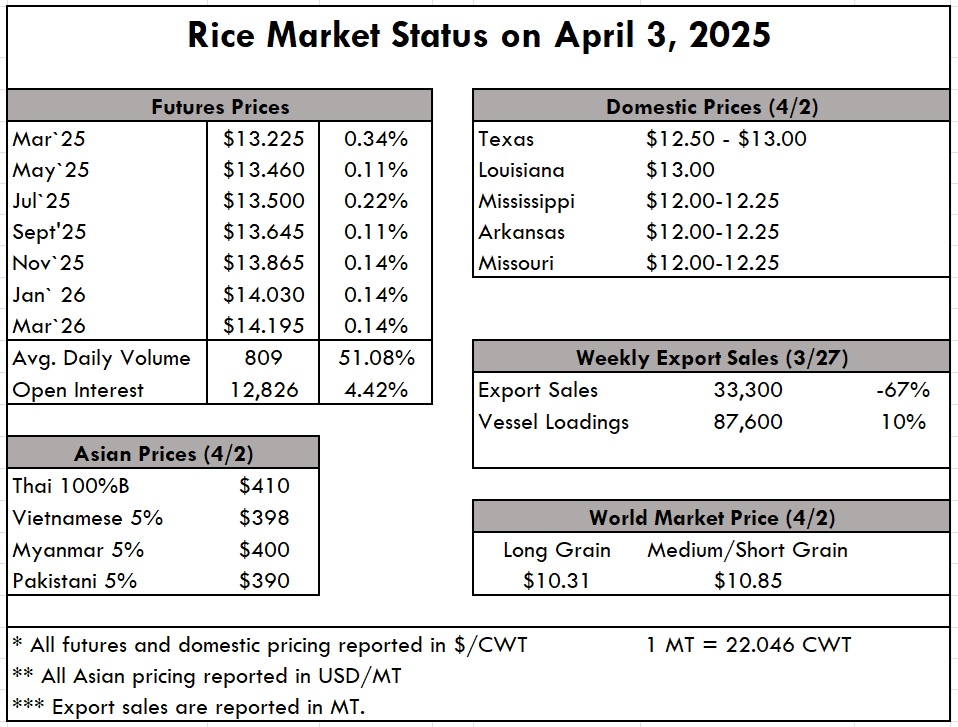
| Get your life preserver. Former USRPA CEO Dwight Roberts has said this market “isn’t just a perfect storm, it’s a tsunami.” He said this even before Trump’s Liberation Day, where tariffs will now dictate market flows, so we will focus on the rice market pre-tariff in what we know and why this is appearing more like a tsunami. This all started when India released their export ban. Since then, prices in the Far East and Middle East have dropped well over 30%, now trading in the sub-$ $400 pmt range for milled rice. There was some strong resistance in the Western Hemisphere, where U.S. long grain prices held around $800 pmt for most of last year. But with the poor milling quality, that began to weaken. Now add what is shaping up to be a very strong harvest in South America (Mercosur specifically) to a projected sizable crop and large carryover stocks (according to the USDA) in the United States. Next week’s (April 10) USDA-WASDE report should get us some insight as the March report raised carryover by 1 million cwts, putting stocks higher than the previous year. Rice farmers will likely be underwater (to keep with the tsunami theme) for another year. This week’s heavy flooding and tornadoes during planting season in northeast Arkansas and southeast Missouri, the largest long grain producing area, further complicates the situation. Might the tariffs help the U.S. farmer, though? There is a scenario in which this could be a resounding yes! In round numbers, nearly one-third of U.S. rice consumption is imported rice, led by Thai Jasmine and then Basmati. Tariffs on Thailand are 36%, and on India 26%. That could add anywhere from $200-$300 pmt in cost, making domestic U.S. products more competitive, ideally driving up domestic demand and reducing our reliance on imports. The news is doing a fine job of explaining everything that could go wrong, so we felt it prudent to inject some “hope” into what otherwise feels like a wildly chaotic situation. In the end, consumers will decide. In Asia, the low rice prices have Thai farmers in protest and Vietnamese farmers looking for relief through some sort of government or private market valve. As aforementioned, Thai prices have dipped below $400 pmt to $395 pmt, and Viet prices are just hanging on at $400 pmt. India is again the low price leader, down to $385 pmt. While this is “excellent” news for countries desperate for cheap rice in West African regions, it is wreaking havoc on rice producers at large, an unfortunate circumstance when the USTR is trying to minimize unfair subsidies in the rice market. In that vein, just this week, USTR dropped its nearly 400-page report on U.S. foreign trade barriers. This report is an annual directive and carries special prominence this year to an administration that is extremely focused on trade. USRPA has repeatedly assisted in outlining trade barriers and expressed frustration in the previous administration's lack of action. We can’t complain about any “lack of action” for this administration — especially since rice has been highlighted both by the President and his Press Secretary as an example of unfair trade tariffs that the U.S. has endured. Still, much is to be uncovered as these policies play out before all of our eyes. On the ground, paddy prices haven't changed, which in this market can be taken as a sign of softening. We look forward to next week when we have the first published Crop Progress report of the year. The weekly USDA Export Sales report shows net sales of 33,300 MT this week, down 67% from the previous week and 37% from the prior 4-week average. Exports of 87,600 MT were up 10% from the previous week and 65% from the prior 4-week average. |
 |
| Our prayers are with the people of Lake City, AR, where an EF-3 tornado ripped through the community on Wednesday. Lake City is approximately 20 miles east of Jonesboro. Photo Source: KATV |
 |
 |
| As part of an ongoing effort to promote healthy and delicious meals, we visited the Centro de formación estudiantil Emanuel col. 4 de Febrero, where students had the opportunity to learn how to prepare a flavorful and nutritious dish—Rice with Ranch-Style Beans. Under the motto "Con Arroz la vida es mas sabrosa" (With Rice, Life is More Flavorful), the event aimed to highlight the benefits of incorporating rice into everyday meals, emphasizing its nutritional value and versatility in cooking. This initiative was made possible thanks to the support of the US Rice Producers Association, which continues to encourage the consumption of rice as a staple ingredient in balanced diets. We extend our gratitude to all participants, supporters, and followers who contribute to making these educational experiences meaningful. Let’s keep working together to "Pon Tu Granito de ARROZ" in fostering a healthier future! Follow USA ARROZ Facebook page for more news. |
 |  |
From the USDA website: USDA’s Farm Service Agency is issuing up to $10 billion in direct payments to eligible agricultural producers of eligible commodities for the 2024 crop year through the Emergency Commodity Assistance Program (ECAP). These one-time economic assistance payments will help commodity producers mitigate the impacts of increased input costs and falling commodity prices.
Who Is Eligible:
To be eligible, producers must meet the following requirements:
Note: Producers who have not previously reported 2024 crop year acreage or filed a notice of loss for prevent plant crops must submit an acreage report by the August 15, 2025, deadline.
Click here to learn more and to apply.
| USDA Announces FPAC Presidential Appointments: The U.S. Department of Agriculture (USDA) recently announced several new President Trump’s appointments for key roles within the Farm Production and Conservation (FPAC) mission area. Agencies housed under FPAC include the Farm Service Agency (FSA), the Natural Resources Conservation Service (NRCS), and the Risk Management Agency (RMA). Brooke Appleton was appointed to serve as Deputy Under Secretary for FPAC. Before this role, she served as the Vice President of Public Policy at the National Corn Growers Association and worked at USDA under the first Trump Administration as Chief of Staff to the Deputy Secretary. Andrew Fisher will serve as Chief of Staff for FPAC. Most recently, he worked on the Hill for Sen. Mitch McConnell (R-KY) as a Legislative Assistant covering the agriculture portfolio. Aubrey Bettencourt was appointed as NRCS Chief. Before this role, she served as the Global Director of Government Affairs and External Affairs for Netafim and previously held the role of Deputy Assistant Secretary for the U.S. Department of the Interior under the first Trump Administration. Bill Beam was tapped to be the next FSA Administrator. Bill owns and operates Beam Farms Inc., where he farms corn, soybean, wheat, and previously served in the first Trump Administration as Deputy Administrator of Farm Programs for FSA. Pat Swanson will serve as the next RMA Administrator. Most recently, she was a Director for the American Soybean Association (ASA) and completed her term on the Federal Crop Insurance Corporation Board. Lastly, Colton Buckley was appointed Chief of Staff for NRCS. Before this role, he served as the Chief Executive Officer of the National Association of Resource Conservation and Development Councils. USRPA Signs onto Coalition Letter addressed to USTR on Chinese Shipbuilding Section 301 Remedies: This week, the US Rice Producers Association (USRPA) signed onto a coalition letter led by the Ag CEO Council regarding the Office of the U.S. Trade Representative (USTR) proposed actions associated with the Section 301 investigation of China’s targeting the maritime, logistics, and shipbuilding sectors for dominance. Other signatories of the letter included a wide breadth of the nation’s economy, including importers, exporters, farmers and agribusinesses, retailers, manufacturers, energy providers, wholesalers, and transportation and logistics providers. You can find a copy of the coalition letter here. |
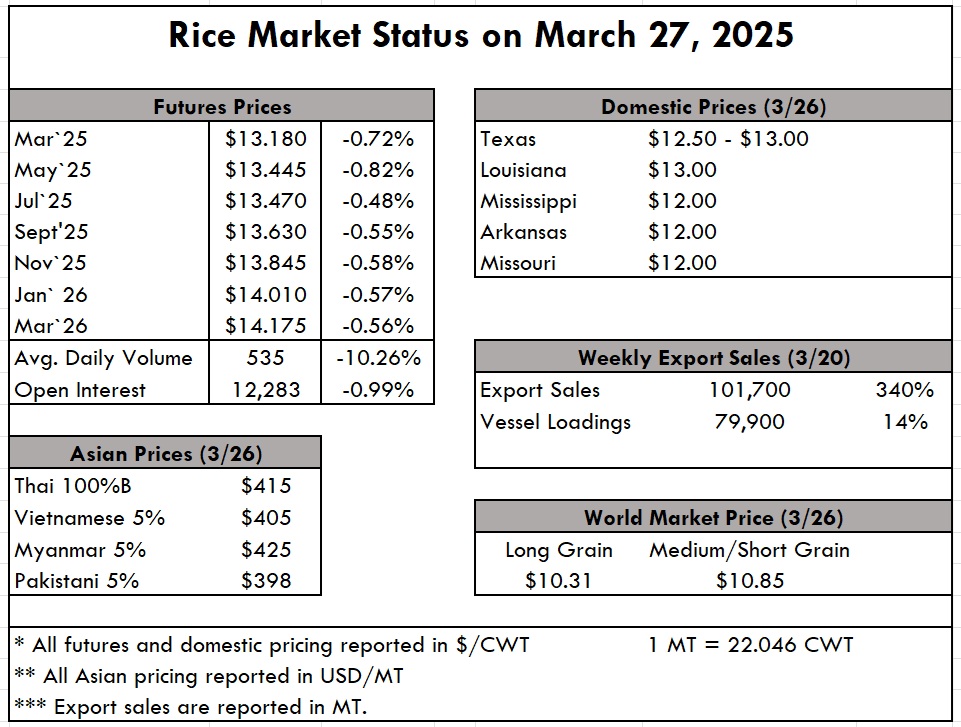
| Planting is underway in the U.S., where the expectation for planted acres is a contested issue on account of seed availability, financing, and the poor overall condition of the farm economy. While U.S. rice producers are sorting through these difficult issues, harvest is entirely underway in South America, where it is a few weeks behind schedule in Brazil and Uruguay and slightly ahead of schedule in Argentina and Paraguay. Prices in South America have been dropping like in North America, but not as severely as in Asia and India.Milled product from the U.S. is now quoted at $ 680 pmt, where Brazil is $ 630 pmt, Uruguay at $ 615 pmt, and Argentina at $ 580 pmt. Recall that the U.S. product was $800 pmt for much of last year, resulting in a 15% drop. Asian prices have seen much closer to a 30% drop over the past year on account of India’s stock release. Thailand, Vietnam, and India show prices of $405 pmt, $412 pmt, and $395 pmt, respectively, this week. Prices on the ground here in the U.S. have been flat from last week to this week. There has been so much focus on our internal politics as of late, it is refreshing to turn to Haiti to look at their next step in what we hope is the right direction. Haiti, the largest milled rice customer for the U.S., hasn’t held an election since July 2021, when President Jovenel Moise was assassinated. Earlier this month, Fritz Alphonse Jean was installed as the head of Haiti’s Transitional Presidential Council, with the express mission to ensure safe and fair elections by February 2026. This is all to say that restoring safety and stability to our largest market is key in the coming year, as Haiti imported 355,000 metric tons from the US in 2024. A recent GAIN report for Mexico, our largest paddy customer, expects rice production and consumption to increase in the coming year. Often, a government’s focus on increasing rice production can negatively impact our exports into that market, but the strong growth of the Mexican population and the acceptance of our rice into the market spells an expected increase of 2% for the coming year (assuming tariffs don’t get in the way). Over the last five years, paddy rice accounted for 85% of Mexico’s total rice imports, where the U.S. held 76% of the market share. Brazil followed with 21%, where Paraguay and Uruguay carried the balance. As for the 15% of milled rice imports, most came from Thai long grain, but that could change as there is now a 20% duty on Thai rice per the Mexican government’s anti-inflationary policy. The weekly USDA Export Sales report shows net sales of 101,700 MT this week, up noticeably from the previous week and up 39% from the prior 4-week average. Exports of 79,900 MT were up 14% from the previous week and 48% from the prior 4-week average. The destinations were primarily Nicaragua (18,000 MT), Haiti (15,300 MT), Mexico (12,900 MT), Guatemala (11,000 MT), and Honduras (10,300 MT). |
 |

25722 Kingsland Blvd., Ste. 203, Katy, Texas 77494
Phone: 713-974-7423
USRPA does not discriminate in its programs on the basis of race, color, national origin, gender identity, sexual orientation, religion, age, disability, political beliefs, or marital/family status. Persons with disabilities who require alternative means for communication of information (such as Braille, large print, American sign language, language translation, etc.) should contact USRPA at 713-974-7423. EEO.