In This Issue:
In This Issue:
On Monday, May 13th, U.S. Senators Debbie Stabenow (D-Mich.), Chairwoman of the U.S. Senate Committee on Agriculture, Nutrition, and Forestry, and John Boozman (R-Ark.), Ranking Member, announced that the Committee had voted by voice vote to advance the nomination of Dr. Jewel H. Bronaugh to serve as Deputy Secretary of Agriculture. Dr. Bronaugh may now be considered by the full U.S. Senate for confirmation. Bronaugh is currently serving as the Commissioner of the Virginia Department of Agriculture and Consumer Services. Previously, the Senate Agriculture Committee held a hearing on Bronaugh’s nomination on April 22, 2021.
Currently, there are several other nominees awaiting committee consideration:
Robert Bonnie has been nominated for Undersecretary for farm production and Conservation Programs. Bonnie served as the co-chair of the Biden Administration’s USDA transition team. Bonnie has also been the vice president for land conservation at the Environmental Defense Fund.
Janie Hipp has been nominated for USDA General Counsel. Hipp is currently the CEO of the Native American Agriculture Fund and was founding director of the Indigenous Food and Agriculture Initiative at the University of Arkansas. Hipp served in the Obama administration and served on Biden’s transition team.
Jenny Lester Moffitt has been nominated for Undersecretary for Marketing and Regulatory Programs. Moffitt currently serves as undersecretary at the California Department of Food and Agriculture. Prior to her tenure at the CDFA, Moffit was involved with a family organic walnut farm and processing operation.
Currently, Secretary Vilsack is the only Senate-confirmed Biden administration official at USDA.
Tax Reform
The House of Representatives Committee on Ways and Means held a hearing this week which included a variety of tax proposals. The House Ways and Means hearing focused on Biden’s tax proposals. According to an analysis of Biden’s tax proposals by the Tax Foundation the Biden proposal to tax capital gains at death accounts for about one-third of the revenue to pay for the Administration’s American Families Plan, a sweeping package of education, health and child care benefits. The tax on inherited assets would raise $213 billion over 10 years. The revenue impact increases by year, reaching nearly $40 billion in 2031. Three issues receiving much focus by agriculture groups are--
Stepped-Up Basis: Assets in agriculture are typically held by one owner for several decades, so resetting the basis on the value of the land, buildings, and livestock on the date of the owner’s death under a step-up in basis is important for surviving family members and business partners to ensure the future financial stability of the operation.
Like-Kind Exchanges: Allows businesses to buy and sell like assets without tax consequences, thus helping farmers and ranchers, who are typically “land rich and cash poor,” maintain cash flow and reinvest in their businesses.
Sec. 199A Business Income Deduction: Preserving Sec. 199A business income deduction in order to maintain a reasonable level of taxation for pass-through businesses.
On Wednesday, April 28, the Senate Committee on Environment and Public Works held a hearing to discuss the U.S. Environmental Protection Agency’s (EPA) discretionary funding request for Fiscal Year 2022. The discussion was largely focused on how the Agency will address water quality, contamination, and pollution issues within communities that already bear a disproportionate burden. Additionally, Committee Members raised questions about the intersection of the Agency’s priorities and Administration’s American Jobs Plan (AJP), the role of biofuels and the importance of the Renewable Fuel Standard (RFS), ways the Agency plans to address establishing Perfluoroalkyl substances (PFAS) standards, regulating methane gas emissions, and the steps the Agency is taking to reach President Biden’s climate goals.
Several Members asked what EPA is doing to meet the needs of disadvantaged communities and how EPA’s budget proposal will assist those efforts. Members also discussed the low-income communities and communities of color that bear disproportionate impacts from Superfund sites, citing that 70 percent of Superfund sites are within one mile of federal assisted housing. Mr. Regan responded that both the proposed EPA budget and the AJP are critical. The EPA’s budget proposal includes grant applications, advanced monitoring for air and water quality, and additional funding to build up infrastructure to help uplift communities through equitable opportunities.
Members also highlight the benefits of low carbon biofuels and their role in reducing greenhouse gasses. Sen. Ernst noted the lack of substantial inclusion or support in the $2.3 trillion infrastructure bill and the 2030 emissions target. Mr. Regan responded that the President has been clear that agriculture is at the table and biofuels, and voluntary ag practices, have a role in reducing carbon emissions. Mr. Regan also highlighted his conversations with Secretary Vilsack around the promising future uses of biofuels and the role of ethanol in moving the United States forward. Several Members also discussed the benefits of renewable fuels and the importance of the Renewable Fuel Standard (RFS). There was concern that officials within this administration only talk about biofuels in the context of new fuels and new markets, such as aviation and marine fuels. Mr. Regan responded that agriculture is at the forefront when talking about the promising future of electric vehicles and advanced biofuels Sen. Ernst specifically asked if corn ethanol would continue to have a role in the future. Mr. Regan said that he will continue to engage with stakeholders to determine what the evolution of ethanol will be and where the markets will lean to ensure the lowest carbon economy.
Another significant topic of discussion was the was the administration plans to meet the ambitious climate goals laid out by President Biden. Chairman Carper praised the ambitious climate goals of the Administration and asked about the importance of meeting these goals. Mr. Regan emphasized that it is crucial; not only to help the planet, but to create numerous opportunities in the job sector and allow the U.S. to be a leader in renewable energy job creation.
Sen. Inhofe raised significant concern about the Administration’s initiatives and the impact they will have on jobs across the country. Sen. Inhofe expressed his confusion as to why the Administration would push an effort that would hurt so many American jobs and encourage American companies to move overseas, while China is the largest polluter. Mr. Regan explained that the initiative of EPA and those within the AJP are not only an opportunity to mitigate the impact on the climate change, but also an opportunity to lead in technological advancement and create jobs. Mr. Regan explained that the U.S. Chamber of Commerce and other organizations are looking at regulations that pursue deep cuts in methane. Carbon dioxide capture and storage (CCS) and menthane technologies will help the U.S. make these cuts, while creating jobs. The U.S. is also poised to deploy these technologies internationally. Sen. Inhofe was also concerned about the cost of employing these initiatives. Mr. Regan responded that he, and President Biden’s AJP, do not follow China, and they both see and treat the U.S. as a leader. Additionally, EPA has developed a range in how the U.S. plays in the nationally determined contributions (NDCs) level and will use cost-benefit analysis to determine which programs would work best once EPA’s budget has been set.
Sen. Inhofe also asked how Mr. Regan saw government regulation affecting U.S. businesses, expressing concern that it would cause an outflow of companies. Mr. Regan stated that the AJP is not just trying to mitigate climate change using regulations, but also work with the industry to create new technical jobs that mirror how the market is adapting as well as help reduce methane emissions.
Dwight Roberts, President & CEO of the US Rice Producers Association and Bianka Rodriguez, Marketing & Western Hemisphere Promotions Director, participated in the Texas-Cuba Trade Alliance (TCTA) virtual meeting with Cuban Ambassador Lianys Torres on Monday morning.
The meeting was moderated by Ricardo Arias, Trade Development Manager at the Port of Houston. Lianys Torres, Cuban Ambassador to the United States, and Rodney Gonzalez, Cuban Embassy Official, updated the audience on the rollout of the COVID-19 vaccine in Cuba. Torres commented that Havana's population will be fully vaccinated by July and is expecting the whole country to be fully vaccinated by the end of the year. With such promising results, leaders are also expecting the Havana International airport to open by the end of the year. Torres also commented that Cuba will end its decades-old dual currency system and have a single unified exchange.
Among the topics discussed, an improved US-Cuba relationship was emphasized throughout, especially within the agricultural sector, saying that Texas has all the elements to continue with the agricultural relations.
Dwight Roberts, USRPA President & CEO has been an active board member of the TCTA since its inception and is considered the first organization formed to address agriculture issues with Cuba in the U.S.

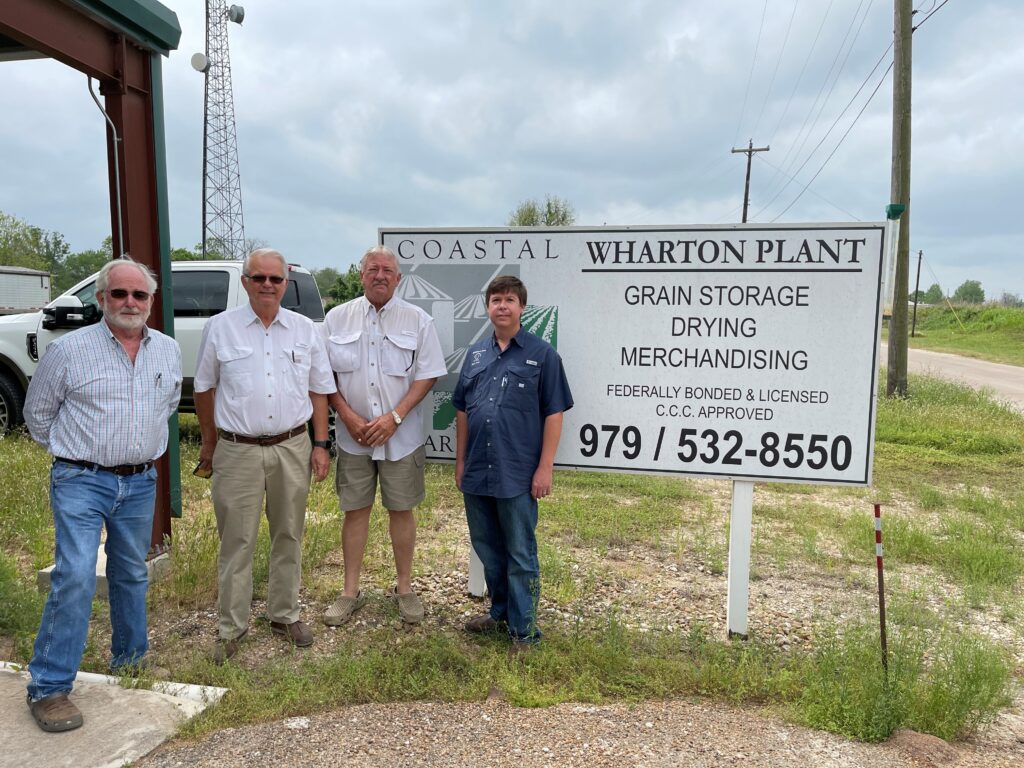
From the beginning of Coastal Warehouse in 1958, the business focus has been on agricultural infrastructure and betterment of local agricultural communities by providing storage and marketing opportunities for grain producers in Wharton and the adjacent counties. After 62 years of service to those farmers in Wharton and surrounding counties, Coastal Warehouse is proud to announce a change of ownership to Dr. J. Thomas Wynn of Egypt, Texas, effective April 12, 2021.
After over 35 years of ownership, increasing the storage capacity to over 5,400,000 bushels and developing the successful Premium Deer Corn brand, the managing partners of Coastal Warehouse, Ltd. Ronnie Wittig, William Loocke and Laurance Armour III. have elected to retire. They are very pleased that Dr. Wynn will carry on the business with a similar philosophy and dedication to serving farmers in the Upper Texas Coastal area. Dr. Wynn will keep on all current employees and will add some new, key employees to enhance the success of the business. He also looks forward to helping his customers remain successful in making informed and beneficial marketing decisions.
In embarking on this venture, Dr. Wynn is committed to maintaining and enhancing the strong reputation for service and support for agriculture that has been developed over the years. Already a partner in East Bernard Rice Marketing, Thomas will further hone and broaden the services that Coastal Warehouse can provide to farmers.
Wynn, an Aggie to the core earning his undergraduate degrees at A&M and completing his Ph. D. in International Agriculture brings a wealth of experience to his new role as the owner of Coastal Warehouse. While with the U.S. Rice Producers based out of Houston, he traveled extensively in Latin, Central, and South America and Mexico. His workplace travels have included Thailand, Cuba, Trinidad and Tobago, Switzerland, and most recently the country of Georgia in the former Soviet Union. During his tenure in the industry, he spent a great deal of time in Washington DC working with Congress and USDA on behalf of farmers and farm policy.
At the graduate level, he studied risk management techniques with clear insights being developed in futures and basis contracts, which he has mastered and employed to the satisfaction of his agricultural customers. He brings this experience into application at Coastal for its longstanding agricultural clientele.
Married with three daughters, he and his wife Mary will continue to live in their 100-year-old home enjoying the benefits of a life in the country. In addition to his responsibilities as the new owner of Coastal Warehouse, he will continue as the managing partner of M&W Farm and Ranch in Egypt, Texas.
In This Issue:
In This Issue:
This week, the National Association of Colombian Entrepreneurs (ANDI) reached out to the US Rice Producers Association for support in its fight to protect the current nutritional labeling regulations for rice and protest the proposed adjustment to the recommended portion size of rice in labeling.
Colombia notified the OMC (World Trade Organization) and other trading partners, the interest of issuing the resolution which "establishes the technical regulation on the nutritional labeling requirements for packaged foods for human consumption must comply with" in Colombia and proposes to reduce the recommended portion of rice from 50 grams to 30 grams.
Colombia's economy is the third-largest in Latin America and has continued to grow in recent years due to sound economic policies, recent reforms, and a proliferation of free trade agreements (FTAs). With an annual rice consumption of around 40 kg per capita, according to the Colombian government, reducing the recommended portion would be equivalent to having a per capita consumption of 11 kg. Such a drastic change would put the consumers and the Colombian and U.S. rice sector at great risk. The USRPA supported the efforts of ANDI through letters that outlined the nutritional benefits of including rice in the everyday diet.
In This Issue:

25722 Kingsland Blvd., Ste. 203, Katy, Texas 77494
Phone: 713-974-7423
USRPA does not discriminate in its programs on the basis of race, color, national origin, gender identity, sexual orientation, religion, age, disability, political beliefs, or marital/family status. Persons with disabilities who require alternative means for communication of information (such as Braille, large print, American sign language, language translation, etc.) should contact USRPA at 713-974-7423. EEO.