President Biden issued an Executive Order on July 9, “Promoting Competition in the American Economy”. The order specified 72 actions and initiatives by numerous federal agencies aimed at promoting competition and addressing problems identified by the White House. The order touches numerous aspects of the economy – from banking to transportation to agriculture. An Executive Order cannot change or override existing statute, but they are often used to give direction to federal agencies in exercising discretion that they have under the law. For these reasons, the order often “encourages” agencies to take an action or directs them to develop plans for further action. The White House fact sheet on the order is linked here and a the executive order is linked here. The order directs all federal agencies to use spending and procurement authorities to create more opportunities for small businesses. The US Government spends about $600B a year procuring goods.
Specifically related to agriculture, the order directs USDA to curb unfair or deceptive business practices and advantages through vigorous enforcement of the Packers and Stockyards Act. These measures include clearly defining a violation of the Act, maintaining that it is unnecessary to “demonstrate industry-wide harm to establish a violation of the Act,” prohibiting grower ranking systems, and adopting anti-retaliation protections. USDA is directed to enhance consumer transparency by clarifying which meat products qualify for the “Product of USA” label. Three reports must also be submitted to the White House Competition Council: 1) outlining steps to support “value-added agriculture and alternative food distribution systems” via model contracts and improved transparency and labeling; 2) examining the effects of retailer consolidation on competition and how funding could improve access to local/regional food markets; and 3) enumerating USDA’s concerns with how the intellectual property system enables anti-competitive behavior by seed/input producers. As discussed under the Federal Trade Commission, the order encourages the FTC to limit equipment manufacturers’ ability to restrict the use of independent shops or do-it-yourself repairs – often referred to as “Right to Repair.”
For additional background on the order, generally:
Policy Rationale
Legal Basis for EO
This section points to the relevant statutes and legislative intent that undergird the order’s rationale for renewed antitrust enforcement. It also identifies the tools at federal agencies’ disposal for protecting fair competition: policing unfair business practices, conducting oversight of mergers & acquisitions, issuing rules promoting new market entrants, and enhancing transparency.
Interagency Cooperation
The order encourages agencies to collaborate in policing anticompetitive behavior and reviewing mergers should there be overlapping jurisdictions. Suggested avenues for collaboration include coordinating antitrust investigations, sharing relevant information, and requesting input from the Attorney General or FTC Chair.
White House Competition Council
This section establishes a White House Competition Council within the EOP charged with coordinating USG efforts to address “overconcentration, monopolization, and unfair competition.” The Council will be led by the Assistant to the President for Economic Policy and chaired by the Director of the National Economic Council (Brian Deese). Standing members consist of mostly cabinet secretaries with the heads of independent agencies (FTC, FCC, CFPB, etc.) invited at the Chair’s discretion.
Financial Services
The order encourages the DOJ, Federal Reserve, FDIC, and Comptroller of the Currency to update merger oversight guidelines under the Bank Merger Act and Bank Holding Company Act of 1956.
Worker’s Rights
The order encourages the Federal Trade Commission (FTC) to issue rules prohibiting non-compete clauses or other agreements that would limit workers’ mobility.
FTC Rulemaking Authority (Data Privacy, Agriculture, Wireless Providers, Healthcare)
The order encourages the FTC to consider updating rules that would limit data collection and surveillance practices, permit the “right-to-repair,” and prohibit delayed entry of generic drugs.
Beer, Wine, and Spirits
The order directs the Treasury Department to submit a report detailing any unlawful trade practices, consolidation trends, and unnecessary regulations such as bottle sizes, permitting, or labeling that hinder competition. The Treasury is directed to consider new rules to update how the Alcohol and Tobacco Tax and Trade Bureau conducts oversight and to reduce barriers for smaller market participants.
FCC (Telecommunications)
The order encourages the FCC to:
DOT (Airlines, Railroads, Shipping)
The order directs DOT to appoint members of the Advisory Committee for Aviation Consumer Protection, publish a proposed rule requiring airlines to refund baggage fees for significantly delayed flights, and consider a rule requiring clear disclosure of baggage/change/cancellation fees upon purchase of a ticket. Further, the Surface Transportation Board is directed to strengthen regulations concerning reciprocal switching agreements and ensure that passenger rail rights-of-way are respected. The Federal Maritime Commission is encouraged to prevent shipping companies from imposing excessive “detention and demurrage” charges on American exporters.
HHS (Healthcare)
HHS is directed to consider issuing a proposed rule permitting over-the-counter hearing-aids, promote price transparency initiatives in accordance with the No Surprises Act, and provide standardized plan options in the national Health Insurance Marketplace. HHS must also submit a plan to combat high prescription drug prices and price gouging within 45 days, streamline the approval process for generic drugs, and collaborate with states and tribes to import prescription drugs from Canada.
Department of Commerce (Healthcare, Big Tech)
The order directs the Department of Commerce to consider not finalizing new provisions on “march-in rights and product pricing” that would preclude the agency from using march-in rights to possibly lower drug prices. Moreover, Commerce is directed to submit a report detailing recommendations for improving competition and user benefit in the mobile application ecosystem.
Defense
The order directs DOD to consider antitrust laws and corporate consolidation when assessing the economic forces influencing the “national security innovation base.” Further, it directs DOD to submit two reports to the White House Competition Council: 1) assessing competition in the defense industrial base and where it may be lacking and 2) outlining a plan for avoiding contract terms that complicate DOD’s ability to repair equipment in the field.
Financial Services
The order encourages the Consumer Financial Protection Bureau to consider a rulemaking permitting consumer financial data portability to ease the cost of switching banks.
Department of the Treasury (Worker’s Rights, Financial Services)
The order directs Treasury to submit two reports: 1) addressing how labor markets are affected by the absence of competition and 2) competition’s impact on Big Tech’s foray into consumer finance.
For Immediate Release
July 15, 2021
CONTACT: Dwight Roberts
(713) 974-7423
KATY, Texas (July 15, 2021) -- Last week, the US Rice Producers Association hosted the 10th annual Rice Market and Technology Convention at The Woodlands Resort in The Woodlands, Texas. After going virtual in 2020 due to the COVID-19 pandemic, nearly 200 participants from multiple countries safely came together in person from July 6 to July 8 to network and learn from leading industry experts.
“The conference provided a healthy networking environment to talk about rice marketing and production issues,” Dwight Roberts, President and CEO of the US Rice Producers Association, said. “It was good to see so many major rice companies from the United States and Latin America in attendance and reinforced all the objectives of this yearly event. We are preparing new ideas for 2022 thanks to the suggestions of many participants.”
From sustainability to the state of international trade, themes of change and evolution underpinned every session and discussion panel. The convention kicked off on Wednesday morning with remarks from Dan Hunter, Assistant Commissioner of the Texas Department of Agriculture, who noted the more conscious consumer that came out of the pandemic. Keynote speaker Dennis DeLaughter then set the tone for the conference with a presentation titled “Embracing Change: Expecting the Unexpected.” After a variety of subjects were addressed in the two days, an overall rice market outlook from industry analysts Stuart Hoetger and Dr. Thomas Wynn concluded the convention on Thursday afternoon. Throughout the week, participants also had the opportunity to connect with numerous agricultural businesses and organizations in the sold-out exhibition space.
Planning is well underway for the 2022 convention, with more details to be announced in the coming months. Visit www.ricemtconvention.com for the latest updates on next year’s event.
The US Rice Producers Association, representing rice producers in Arkansas, California, Louisiana, Mississippi, Missouri and Texas, is the only national rice producers’ organization comprised by producers, elected by producers and representing producers in all six rice-producing states.
# # #

On June 23, 2021, President Joe Biden announced his intent to nominate Homer Wilkes for Under Secretary for Natural Resources and the Environment, Department of Agriculture.
Dr. Homer Wilkes, a native of Port Gibson, Mississippi, currently serves as Director of Gulf of Mexico Ecosystem Restoration Team. He is one of the five Federal Executive Council members to oversee the rebuilding of the Ecosystem of the Gulf of Mexico after the BP Oil Spill of 2010. He served as the Acting Associate Chief of USDA/Natural Resources Conservation Service (NRCS) in Washington during the period of 2010 to 2012. Dr. Wilkes' tenure with the United States Department of Agriculture spans over 41 years. During his tenure he has served as State Conservationist for Mississippi; Chief Financial Officer for NRCS in Washington, DC; Deputy State Conservationist for Mississippi; and Chief of Administrative Staff for the South Technical Center for NRCS in Fort Worth, Texas.
Dr. Wilkes also served as Naval Supply Officer in the United States Navy Reserves from November 1984 to April 2007. Dr. Wilkes received his Bachelors, Master of Business Administration, and Ph.D. in Urban Higher Education from Jackson State University. He also successfully completed the USDA Senior Executive Service Candidate Development Program (SES CDP) through American University’s Key Executive Leadership Certificate in Public Policy. Dr. Wilkes and his wife Kim, currently reside in Ridgeland, MS. They have three sons, Justin, Austin, and Harrison. He enjoys fishing, restoring antique vehicles, and family activities.
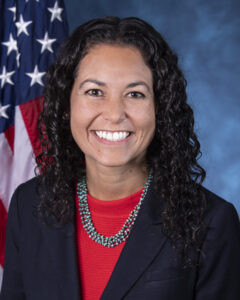
On June 18, 2021, President Joe Biden nominated Xochitl Torres Small for Under Secretary of Rural Development, Department of Agriculture. Xochitl Torres Small is the granddaughter of migrant farmworkers and grew up in the borderlands of New Mexico. In 2008, she came home from college to work as a field organizer, working in neighborhoods known as colonias, in southern New Mexico. She served as a field representative for New Mexico’s Senator Tom Udall, where she collaborated with local grassroots leaders, business owners, elected officials, and regional and state economic development officials to help communities access American Recovery and Reinvestment Act funds. Torres Small studied water law and has worked closely with rural water utilities. In 2018, Torres Small became the first woman and first person of color to represent New Mexico’s second congressional district, the largest district that isn’t its own state. Torres Small served as the U.S. Representative for New Mexico’s 2nd congressional district in the 116th Congress. Torres Small was defeated in 2020 by Yvette Herrell.
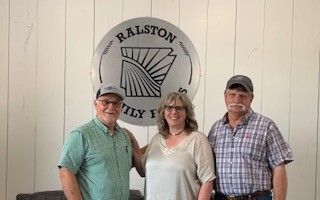
Nestled in the beautiful Arkansas River Valley, some 65 miles northwest of Little Rock, is a rice farm far away from the beaten path of the traditional Arkansas Delta rice-farming region. A multi-generational family farm, Tim and Robin Ralston are carving their place in America’s rice industry as they grow, harvest and mill both traditional and aromatic varieties. Rice at Ralston Family Farms is a quality consumer product, not a commodity as evidenced by their successful marketing efforts to numerous retailers and supermarkets. These efforts are due to their mission: to provide the best tasting and highest quality rice available through sustainable farming practices that improve the land while giving back to help end the fight against food security across the United States.
A growing preference among consumers is Ralston’s system to grow sustainably for future generations and be good stewards of the land, a practice that has always been important to the family. Ralston Family Farms not only produces their own seed, farms, harvests, and mills their rice, they also brand it in patented, recyclable packaging with an easy pour spout. The revolutionary, eco-friendly packaging is completely unique to the market.
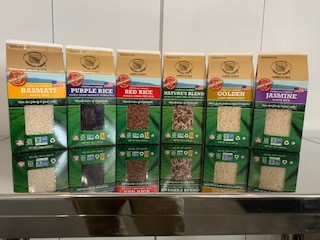
Earlier this month Dwight Roberts, President & CEO of the US Rice Producers Association visited Ralston Family Farms located just south of the town Atkins on the Arkansas River.
“I have visited rice farms and milling operations in numerous countries around the world but I don’t believe I have ever seen anything as unique as Ralston Family Farms and their attention to so many details,” Dwight said. “This is a real model for the future and I sincerely congratulate the Ralstons on their success through very hard work."
Visit www.ralstonfamilyfarms.com to learn more about the varieties and the uniqueness of Ralston Family Farms.
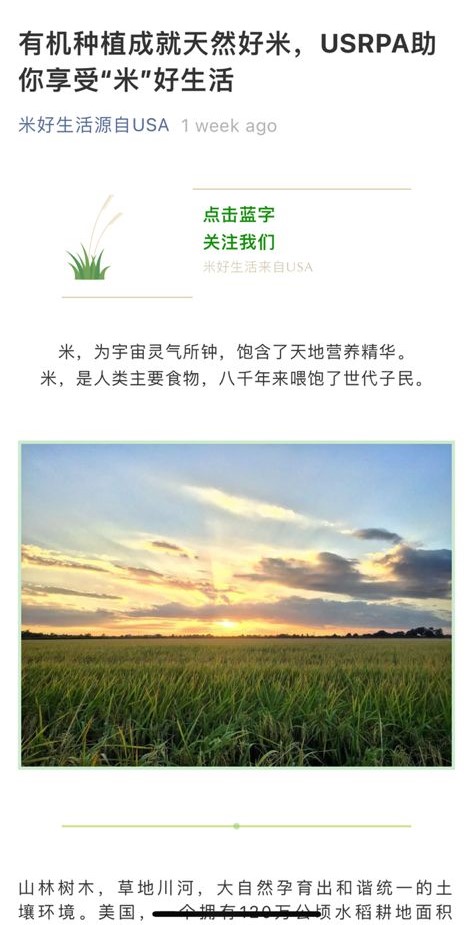
The social media campaign has received positive feedback and attention as the campaign China continues to promote U.S. rice. A translation of the positive marketing message used to educate and reach to Chinese market reads as:
Rice is clocked by the aura of the universe and is full of the essence of heaven and earth.
Rice is the main food of mankind and has fed the people for generations for eight thousand years.
Mountains and trees, grasslands and rivers, nature bred a harmonious and unified soil environment. The United States, a large agricultural country with 1.2 million hectares of rice arable land, cultivates about 10 million tons of rice every year. It has a variety of varieties, including all common long-grain and medium-short-grain varieties on the market. It is of high quality, non-GMO, environmentally friendly, clean, and consistent appearance, and has uniform rice grains. The rice is light in taste, full and chewy kernels, and will not lose quality when reheated. This is a solution to the homesickness of Chinese living overseas? Who is it to have inherited the bright fruits of Chinese civilization?
This week on Tuesday, June 15, the Senate Appropriations Subcommittee on Agriculture, Rural Development, Food and Drug Administration, and Related Agencies held a hearing to discuss the F.Y. 2022 budget request for the U.S. Department of Agriculture (USDA). Testimony from USDA Secretary Tom Vilsack focused on ways in which USDA can address climate change and severe weather events, highlighted agriculture research and relief initiatives, and outlined a number of efforts to fight food and nutrient insecurity, water and air contamination, and cyber-attacks. For more detailed information a memo is attached.

US Rice Producers Association is proud to welcome Mollie Landers Buckler as the new Coordinator for Delta Producer Relations effective June 7th.
A native of the Missouri Bootheel, Mollie’s agricultural roots run deep on both sides of her family including rice production. With a Master’s Degree in Educational Leadership and Policy Analysis from the University of Missouri, she will focus her efforts on representing the interests of rice farmers from throughout the delta while based in Southeast Missouri.
“We are excited to bring Mollie on board and therefore strengthen our rice promotional, marketing and farmer relation efforts in the delta” according to Dwight Roberts, President & CEO of the USRPA while adding “she has the skills, approach and energy that our rice farmers will appreciate.”
Mollie’s past experience includes important relationship building as the Assistant Director of Alumni Engagement at the University of Missouri, a role that covers a wide variety of constituents including legislators and partners of the Missouri Extension Service. Her skills of event planning and coordination for a variety of events combine well with her ties in agriculture.
In This Issue:
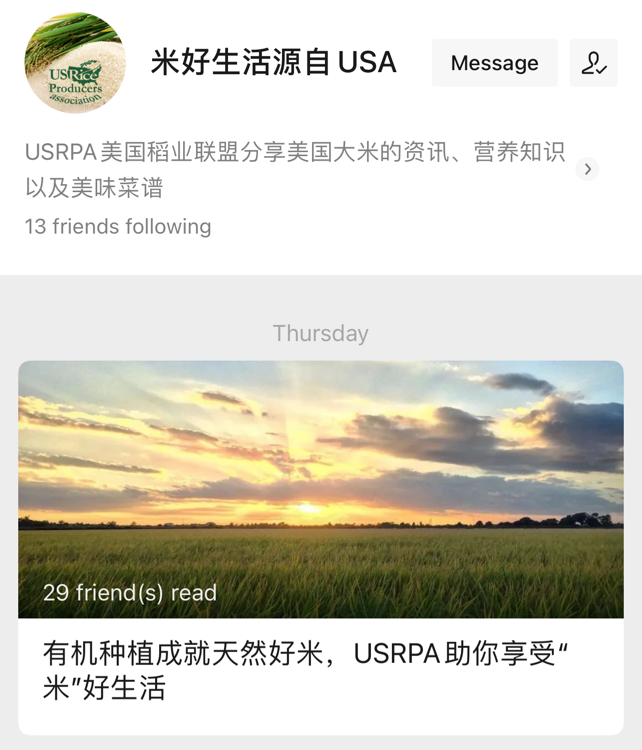
The first post of U.S. rice on China’s top social media networks, WeChat and Weibo, went live last week. Social media platforms Weibo, China’s version of Twitter, and WeChat, with almost a billion monthly users, have become China’s top social media platforms. Implemented with USDA/FAS ATP program funding, USRPA manages official accounts on both platforms, allowing the U.S. rice industry to target China’s masses in a cost-effective manner, with the potential to achieve exposures in the millions. The account name is created with a catchy phrase in Chinese which literally means “Beautiful life originated from USA,” as the word "rice" is pronounced very similarly to “beautiful/good” in Mandarin.
Bi-weekly posts will continue for the rest of the year, which will entail key product characteristics, such as U.S. rice growing cycles, farming practices, health benefits, and applications as well as recipes to engage with potential consumers across China.
On June 9, 2021, the Environmental Protection Agency and Department of the Army (the agencies) will be announced their intent to establish a new definition of “waters of the United States.” The agencies are seeking to better protect vital water resources that support public health, environmental protection, agricultural activity, and economic growth. In addition, the Department of Justice is filing a motion requesting a remand of the 2020 Navigable Waters Protection Rule (NWPR) in the District Court of Massachusetts today.
Executive Order 13990 on “Protecting Public Health and the Environment and Restoring Science to Tackle the Climate Crisis” directs EPA and the Army to review and, as appropriate and consistent with applicable law, take action to revise or replace the NWPR defining “waters of the United States.” EPA and the Army have completed this review and determined that they have concerns with the NWPR, including that it is causing significant, ongoing, and irreversible environmental damage.
The agencies’ new regulatory effort will be guided by:
The agencies intend to pursue a new rulemaking process to replace the NWPR with a durable definition of “waters of the United States.”In the interim, the NWPR is still in effect across the country. Further details of the agencies’ plans, including opportunities for public participation, will be conveyed in a forthcoming action later this summer.
For more information about the definition of “waters of the United States,” visit https://www.epa.gov/wotus. Please contact CWAwotus@epa.gov with any questions.
This information is provided by the EPA and the Army Corps of Engineers regarding their intention to revise the definition of Waters of the US (WOTUS) rule issued in 2020.
It is not clear what changes to the current rule the agencies will be proposing. A new rulemaking process is intended. This announcement is associated with the agencies requesting courts that are currently confronting various legal challenges to the 2020 rule to remand the rule to the agencies for revision.
This week the Congressional Research Service issued the following report: EU Agricultural Domestic Support: Overview and Comparison with the United States.
The Report highlights several policy trends that have emerged in the EU and the United States, including the following:
Traditionally, the United States uses less overall trade-distorting support (OTDS) than the EU, although the EU has made substantial reductions in the volume of OTDS. Since 2011, OTDS outlays (as notified to the World Trade Organization [WTO]) for the EU and United States have been near parity.
In both the EU and the United States, support for less-distorting noncommodity-type programs (e.g., conservation, rural development, agroforestry, nutrition, and climate) has increased substantially.
When measured by producer subsidy equivalent (PSE) as a share of total gross farm receipts, support has been trending lower for both the EU and the United States. As of 2019, the EU’s share (19%) remained above the U.S. share (12%).
U.S. consumers have received net benefits from agriculture-based support programs (including domestic food aid), whereas EU consumers generally have transferred more support to agricultural producers than they have received in offsetting benefits—that is, the EU’s consumer subsidy estimate (CSE) is negative— although the net transfer has been declining over time as a share of gross farm receipts.
The report is intended to provide information to policy makers because the United States and the EU figure prominently in the development and use of global agricultural policy. Information comparing their farm support programs may be of interest to Congress as the United States considers reauthorization of the domestic farm bill by 2023 and engages in international trade negotiations.
25722 Kingsland Blvd., Ste. 203, Katy, Texas 77494
Phone: 713-974-7423
USRPA does not discriminate in its programs on the basis of race, color, national origin, gender identity, sexual orientation, religion, age, disability, political beliefs, or marital/family status. Persons with disabilities who require alternative means for communication of information (such as Braille, large print, American sign language, language translation, etc.) should contact USRPA at 713-974-7423. EEO.