July 1, 2022
In This Issue:
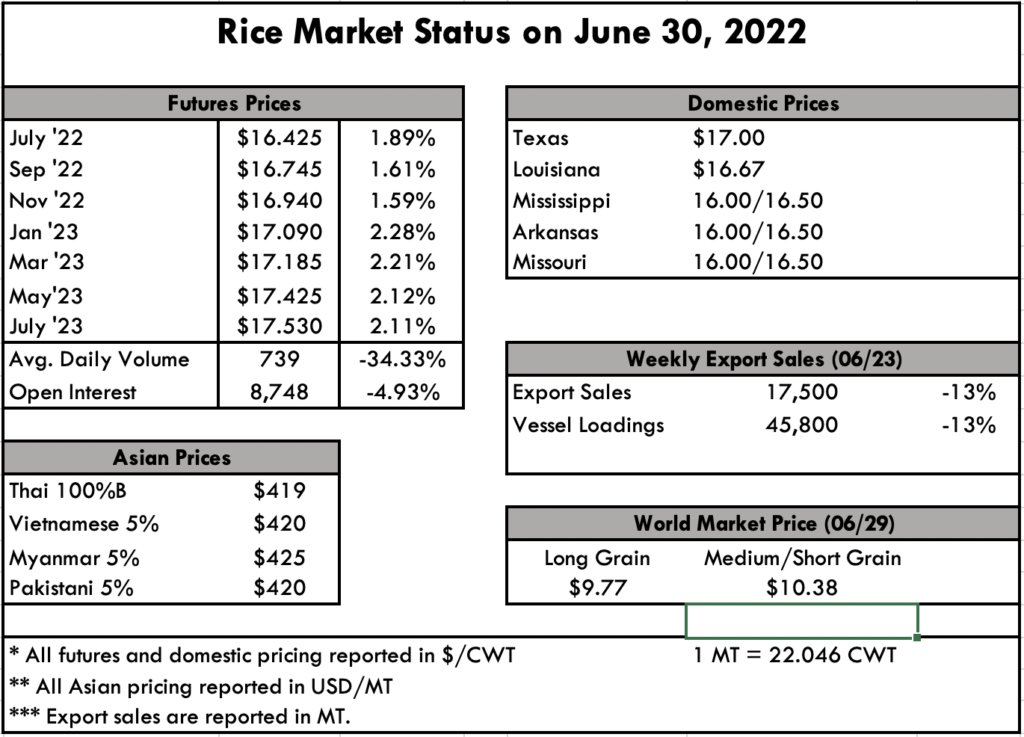
The market continues to plod along, but this week with a shot in the arm from the USDA planted acres and rice stocks reports. As all expected, acres were down from last year, registering in this report total drop of 189,000 acres, split 70,000 acres of long grain and 106,000 acres of medium grain. This is perhaps less than some were expecting, so at this point we will keep an eye on weather to determine how much of the planted crop makes it to a healthy harvest. To that point, higher than normal temperatures in Texas are stressing the rice crop already, causing crop experts to warn of lower yields. The triple digit temps on the backs of a drought are not boding well for a strong crop at this point.
The Stocks report paints a decent picture — one that helps support the higher paddy prices that have been sustained on the ground. Total rice stocks were reported down 10% from this time last year; long grain rough down 11%, long grain milled down 5.5%. Crop Progress is right on track, except in California where cool weather during planting has all but stunted the rice plants, slowing their growth to maturity. And while Texas is experiencing dangerously high temps, cooler weather patterns in Arkansas and Louisiana bode well for harvest.
A recent GAIN report on Mexico published this week shows an increase in expected production in the region, up to 291,000 MT (rough), which is up 6.2% or 17,000 MT over USDA’s original estimate of 274,000 MT. This equates to approximately 200,000 MT of milled rice, correspondingly up from the 188,000 MT estimate. The increase is a result of increased plantings, and a higher yield projection, however local sources temper this expectation with concerns about water availability in Campeche to finish the crop.
In Asia, Thai prices dropped again, down to $410 pmt from $420 pmt las week. This is coming much more in line with the prices from three months ago before Iraq stepped in and tightened supply up a bit. Vietnam held constant at $420 pmt, as did India at $350 pmt.
The weekly USDA Export Sales report shows net sales of 17,500 MT, down 13% from last week’s dismal report, and 45% from the prior 4-week average. Exports of 45,800 MT were down 13% from the previous week and 25% from the prior 4-week average. The destinations were primarily to Haiti (15,100 MT), Japan (12,000 MT), Honduras (8,800 MT), Canada (3,400 MT), and South Korea (2,700 MT).
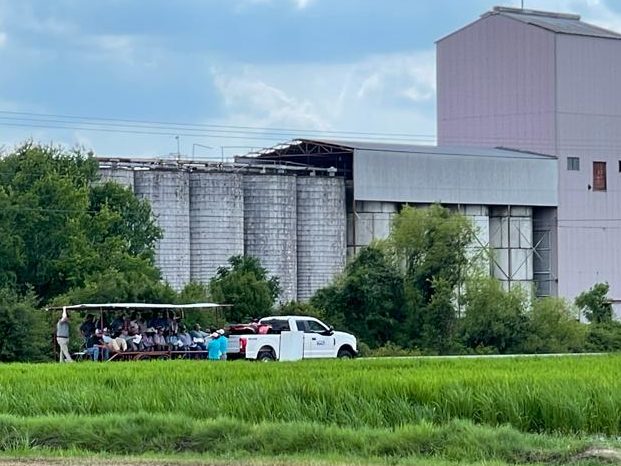
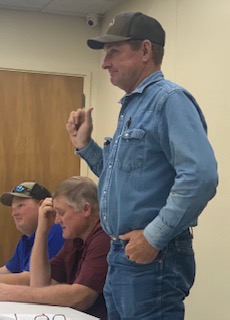
Rice farmers gathered at the David R. Wintermann Rice Research Station this week to the annual rice field day organized by the Texas A&M AgriLife Extension Service and the Colorado County Rice Committee. The event including an evening program was sponsored by area agri-businesses including the US Rice Producers Association and the Texas Rice Council. An extensive list of Texas A&M scientists presented research developments on a range of subjects while Dr. Ted Wilson (Center Director) introduced economist George Knappe who updated the audience on the rice economy and farm policy issues. Grace Wang, Eastern Hemisphere Director for the USRPA attended along with Dwight Roberts (market & policy advisor), visited with individual farmers and scientists.
Prior to the field day, the Texas Rice Producers Board met where Josey Dishman of Beaumont was named the new President and farmers Neal Stoesser (Dayton) and Barrett Franz (Bay City) were both sworn in by the Texas Department of Agriculture as new board members for Districts 2 & 7. Congratulations to those gentlemen for their leadership on behalf of the Texas rice farming industry.



This week, President Biden traveled to Germany to meet with global leaders at the annual Group of Seven (G7) summit. G7 leaders invited President Zelenskyy to discuss actions they can take to support Ukraine in its war against Russia. Following the meeting, President Biden issued new sanctions against Russia, including raising tariffs on Russian imports. Leaders committed to taking action to reduce dependency on Russian oil and energy. They also discussed food shortages and price hikes and made commitments to combat global food insecurity.
Domestically, Colorado, Illinois, New York, Oklahoma, and Utah held primaries in advance of November’s midterm elections. In Illinois, redistricting pitted Reps. Rodney Davis and Mary Miller against each other in the Republican primary for the 15th district. Rep. Miller defeated Rep. Davis, both of whom currently serve on the House Agriculture Committee. In New York, Antonio Delgado won the Democratic primary for lieutenant governor. He stepped down from Congress in May after being appointed lieutenant governor. While in Congress, he served as the Chair of the House Agriculture Subcommittee on the Commodity Exchanges, Energy, and Credit.

To continue with the US Rice Producers Association promotional program in Mexico funded under the FAS/MAP budget, USRPA has recently hired Mercalimentos Consulting firm, located in Mexico City and led by Raul Caballero and Violeta Picazzo. Through their company, Raul and Violeta have represented various U.S. trade associations that promote U.S. products into Mexico and Latin America since the beginning of NAFTA, now USMCA. For over 20 years Mercalimentos Consultores has represented the US Dry Bean Council, the USA Dry Pea and Lentil Council, the National Sunflower Association, the US Popcorn Board, and the Food Export Association Midwest and Food Export Association Northeast, helping hundreds of companies facilitate business relationships. Mercalimentos has the experience to manage FAS-USDA programs such as the MAP, FMD, EMP, GBI programs, having an excellent relationship with the FAS-USDA offices in Mexico and the majority of Latin America. In the development of this new relationship with USRPA, Mercalimentos has been given the task to develop the new Spanish logo “USA Arroz” (US Rice), as well as a new website. They also oversee the social media program management for the Facebook and Instagram pages Consume Arroz USA, with the inclusion of content development through popular local chefs in Mexico, as well as a program of posts that promote the nutrition qualities and advantages of consuming U.S. rice.
 |
| During the month of May, Raul and Violeta had the opportunity to attend the Rice Market & Technology Convention in Cancun, to initiate connections in person with the USRPA staff and membership. They will share more about their attendance experience in their next article. US Rice Producers Association is excited to welcome Mercalimentos to the team! |
June 24, 2022
In This Issue:
- Market Update: Growing Focus on U.S. Rice Crop's Yields & Quality
- Washington, D.C. Update
- Remembering Dr. Charlie Bollich
- RiceTec Appoints Karsten Neuffer as New CEO
The refrain continues—a quiet market with little change. This isn’t a bad thing considering the convulsions the greater economy has experienced in recent weeks. While U.S. rice farmers have taken direct fire resulting from fertilizer and fuel costs, the market has somehow dodged much of the battle, with prices—albeit high—holding steady. The milled market remains quiet, focused solely on domestic foodservice customers, as milled exports are a distant hope given price disparities from other origins. Haiti, the primary milled customer, is in such disarray, it is difficult to bank any business in the short term.
Paddy exports are a different story though, as U.S. long grain remains competitive in this arena. Brazil has come on strong since Mexico and other Central American customers have reduced or removed import duties to fight food inflation, gobbling up nearly 400,000 metric tons of business in the last four months. In the first quarter, Mexico imported roughly 300,000 metric tons of rice, with the U.S. accounting for 225,000 metric tons, or about 75%. This is significantly lower than the same time last year, largely because U.S. prices have increased approximately 13% over the same time period.
On the ground, paddy prices remain firm on account of short supply. These supply driven markets, while favorable to farmers in the short term, often have a whipsaw effect when increased supply returns, as the only way to gain customers back is with price drops. We still have a long crop year to discover before we can make any educated guesses on crop size next year, but the lack of demand on the milled market doesn’t exactly balance with the price of product in the paddy market. Texas is still holding firm at $17/cwt, with Louisiana just below at $16.67/cwt. Mississippi, Arkansas, and Missouri are all $16.75/17.50, similar to last week.
In Asia, prices softened quite significantly in Thailand, dropping back down to the $430 pmt range, down nearly $10 pmt from last week. This would make sense given the currency valuation has been in flux with the Baht falling to 34.82 baht/$1.00, which is its weakest point since 2017. Thai prices have been outpacing Viet prices and Indian prices for weeks now. It would appear the higher prices were a reaction to Iraq gobbling up so much supply from this one origin—the market has now adjusted to that relationship, and prices are settling down a bit. It is also being reported that port congestion is easing, help grease the wheels to additional exports as well. Viet prices are down near $420 pmt, and India remains at $350 pmt.
The weekly USDA Export Sales report shows net sales of 20,100 metric tons, which is 74% from the previous week and 41% from the prior 4-week average. Increases primarily for Mexico (9,900 MT), Saudi Arabia (5,600 MT), Japan (2,100 MT), Canada (1,700 MT), and El Salvador. Exports of 52,700 MT were down 49% from the previous week and 3% from the prior 4-week average. The destinations were primarily to Haiti (15,200 MT), Japan (12,200 MT), Guatemala (10,000 MT), El Salvador (8,900 MT), and Canada (2,500 MT).
In the futures market, Average Daily Volume was down 18% to 1,126, and Open Interest was down 5.65% to 9,202.


| President Biden Calls for Gas Tax Holiday On Wednesday, President Biden called on Congress to suspend the federal gas tax through November to help alleviate high fuel costs. The current federal gas tax is 18 cents per gallon. The President also called on state and local governments to provide additional relief to households by implementing gas and sales tax holidays. Congress Continues FY2023 Appropriations Work This week, the Senate held a hearing to discuss the budget request for the US Trade Representative (USTR). During the hearing senators questioned Ambassador Katherine Tai on the fertilizer shortage. The Ambassador noted the USTR’s limitations on acting in this space but assured senators the USTR was working with the Department of Agriculture to mitigate the fertilizer shortage. In the House, the full Appropriations Committee marked up the Agriculture Appropriations bill on Thursday. It was voted out of committee on a 31-26 vote and will now move to the House floor for consideration by the full chamber. In addition, report language to accompany the Agriculture Appropriations bill was also released this week. It can be found here. Congress Continues 2023 Farm Bill Preparation Last Friday, Senate Agriculture Committee Chair Debbie Stabenow (D-MI) and Ranking Member John Boozman (R-AR) traveled to Jonesboro, Arkansas to solicit industry input as it prepares the 2023 Farm Bill. Rice farmer Jennifer James discussed how rice has not seen price increases to offset rising input costs and called for the reference prices in the Price Loss Coverage Program to be reconsidered to protect domestic rice production. In the House, the Agriculture Committee announced a Farm Bill listening session scheduled to take place July 7th, in Fresno, California. The Committee will hold an additional listening session on Saturday, June 25th in Coolidge, Arizona. House Agriculture Committee Sees Membership Changes On Friday, House Agriculture Committee Chairman David Scott (D-GA) announced Rep. Sean Maloney (D-NY) as the new Chair of the Subcommittee on Commodity Exchanges, Energy, and Credit. He succeeds Rep. Antonio Delgado (D-NY) who retired to become New York’s lieutenant governor. In addition, Ranking Member Glenn Thompson (R-PA) welcomed Rep. Mayra Flores (R-TX) to the House Agriculture Committee. She was sworn into Congress on Tuesday after being elected to fill the seat held by Democrat Filemon Vela, who resigned from office in March. Rep. Flores won the special election in the 34th Congressional District, which has traditionally been a Democratic stronghold. Lawmakers File Amicus Brief in WOTUS Case Last Friday, 165 current and former Democratic members of Congress filed an amicus brief in the Supreme Court case, Sackett v. U.S. Environmental Protection Agency (EPA), which centers on the definition of the scope of the Clean Water Act in defining Waters of the United States (WOTUS). The brief expresses support for the EPA and its broadened interpretation of navigable waters. The Supreme Court is set to hear the case this fall. The amicus brief can be found here. |
June 17, 2022
In This Issue:
The good news is that the crop is progressing well it looks solid across all regions. Producers can take solace in that fact after a bumpy planting season plagued with volatile prices and uncooperative weather. Now that the crop is in the ground, the exporters and marketers are left to deal with an extremely difficult market environment. Export sales reports in recent weeks have been dismal, and while this week is better than previous, it is unlikely to be a new trend. Iraq has found its trading partner in Thailand for milled rice. With prices of U.S. Long Grain far outpacing that of the competition, there is not an easy path forward in the near term.
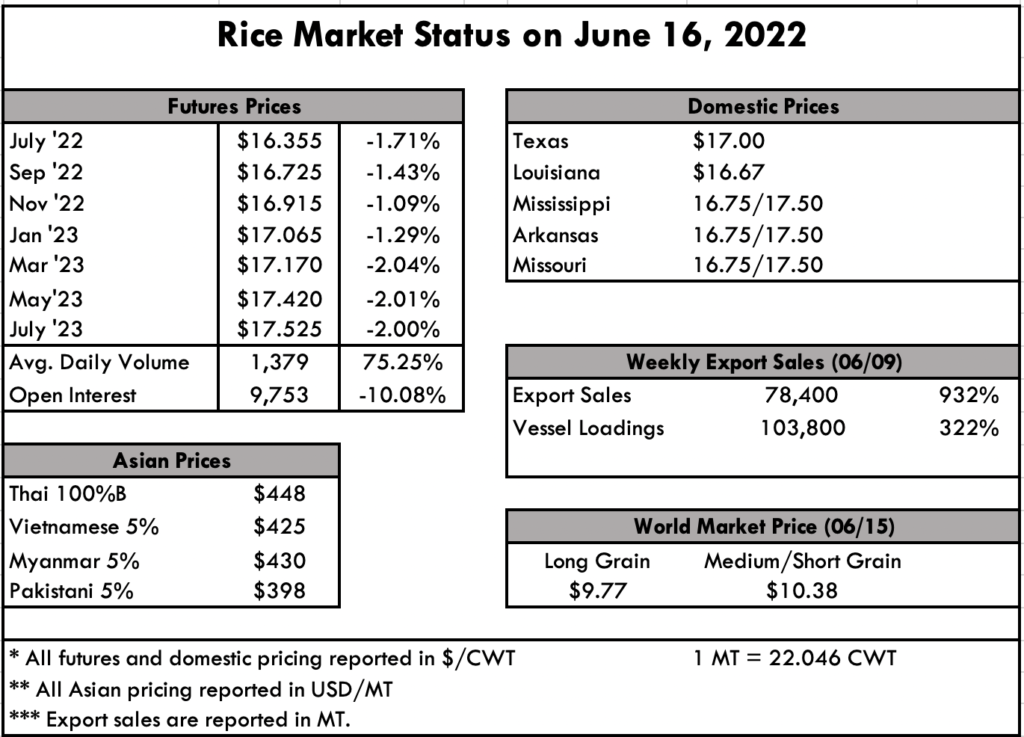
On the ground, new crop bids in Texas still lead the way at $17/cwt, but they are all out of old crop, so new sales won’t surface until we get closer to harvest. Louisiana is indicating bids of $16.67/cwt but doesn’t seem to be attracting much attention at this point in time from sellers. Mississippi is still struggling through planting in some regions, and old crop is all gone. Bids are expected to be in the $16.75/17.50 range. The crop in Arkansas is looking solid, notching 24% excellent and 55% good, which is higher than normal. Missouri is in a similar situation.
In Asia, prices held firm in Vietnam at $425 pmt, while they softened a bit in Thailand largely based on currency fluctuations. Indian rice continues to be the lowest at $350 pmt, and their exports outpace all others.
All in all, the market is relatively quiet despite the wild fluctuations in the stock market and interest rates. The value of the dollar could have a significant impact on the price of the coming crop, as well as its exportability based on currency fluctuations at harvest. Because the price is currently so high, stocks have the potential to build beyond expectation, which could result in more competitive pricing in the months ahead as the crop progress becomes clearer.
The futures market is likely reflecting the slow milled, barge, and paddy business right now. Average daily volume was 4,379, up 75% from last week, and Open Interest was 9,753, down 10% from last week.
The USDA Export Sales report shows net sales of 78,400 MT which is up noticeably from the previous week and from the prior 4-week average. Increases primarily for Mexico (24,400 MT), Haiti (22,400 MT, including decreases of 100 MT), Colombia (17,700 MT, including decreases of 100 MT), Panama (9,900 MT), and Canada (2,500 MT), were offset by reductions for Saudi Arabia (900 MT). Exports of 103,800 MT were up noticeably from the previous week and from the prior 4-week average. The destinations were primarily to Mexico (27,000 MT), Colombia (26,900 MT), Japan (12,100 MT), Panama (9,900 MT), and Nicaragua (9,500 MT).

25722 Kingsland Blvd., Ste. 203, Katy, Texas 77494
Phone: 713-974-7423
USRPA does not discriminate in its programs on the basis of race, color, national origin, gender identity, sexual orientation, religion, age, disability, political beliefs, or marital/family status. Persons with disabilities who require alternative means for communication of information (such as Braille, large print, American sign language, language translation, etc.) should contact USRPA at 713-974-7423. EEO.