August 12, 2022
In This Issue:

John Browning Alter
January 10, 1948 – August 8, 2022
John B. Alter was one of those rice farmers who didn’t hesitate to speak his mind. He always spoke as if a thousand rice farmers were sitting over his shoulder and heard every word he had to say in a meeting. He was their guy, a one of a kind man, a real gentleman. He worked tirelessly for fair farm prices and equitable spending of the farmers’ check-off money. We are saddened by the news of the passing of John this week, ending his long battle with cancer. Growing up on the family rice farm that was founded in 1886, John lived a full life. His impressive and extensive accomplishments included his being named Rice Farmer of the Year in 2000. Appointments by Arkansas Governors Huckabee and Beebe to the Arkansas Rice Research and Promotion Board reflected his talents whether in the field, in Little Rock, in Washington D.C., or in the international marketplace. He served tirelessly as a member of the board of directors of the US Rice Producers Association even while his health was declining. Our most sincere thoughts and prayers are with his family.
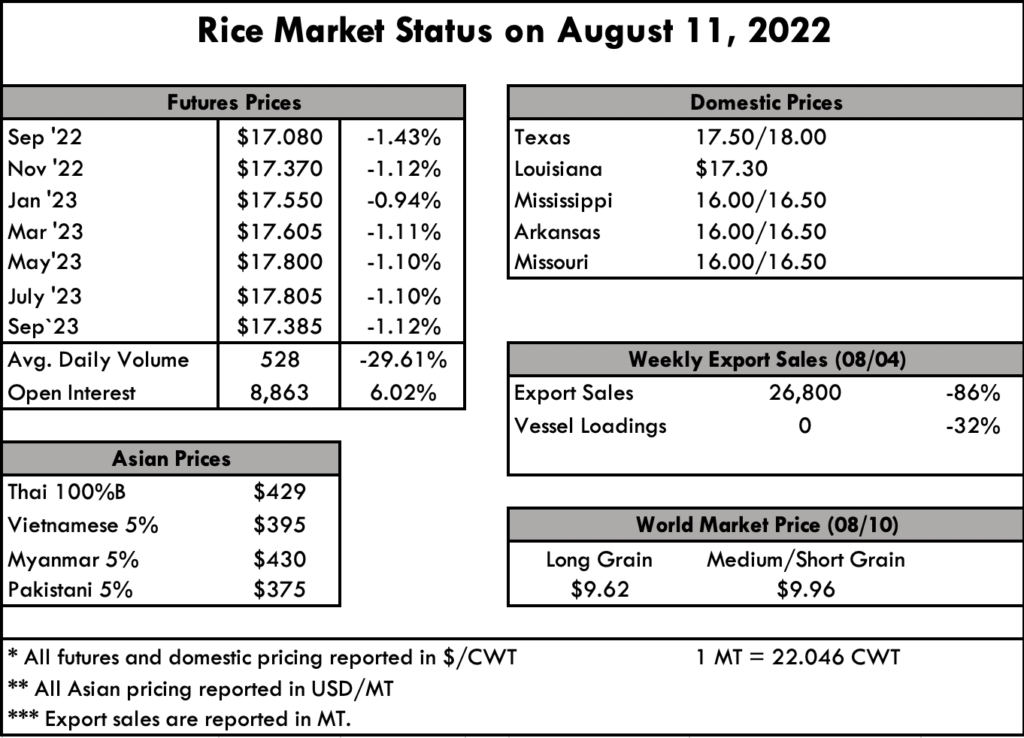
Harvest is in full swing now, and seeing rice come into the barn is a great success. Texas and Louisiana have reached what most agree is the halfway point, and the market has remained fairly quiet through this point at the $17.50/cwt mark. Arkansas farmers are optimistic about the way their crop looks and are excited to get in the field in the coming days to begin recording their qualities and supplying new crop to the mills and paddy exporters.
On the milling side, Iraq has helped generate business, Haiti orders continue to be filled, and domestic customers remain strong. There isn’t any storm front in the news at the moment that should drop the market, nor is there a wildly optimistic horizon either. Steady as she goes would be an easy way to put it, though things may look different after our harvest is complete here domestically, and the effects of the weak Indian monsoon are realized in production, exportable supply, and pricing in the months ahead.
We have had several conversations in the past week with folks who were interested in more details about the situation regarding the Indian monsoon and its impact on the global rice market. While the potential for a significant crop reduction is real, we need to point out that the monsoon is presently affecting planting. There is still time for weather to change, and then overall production numbers won’t surface until the crop begins to mature — therefore the reports from last week are more of a “warning bell” of what could be, and the time horizon is months out for any official reporting.
That being said, India remains the low-cost leader at $355 pmt, the same as last week and the same it’s been for months now, give or take 5%. Same goes for Thailand, where fluctuations have been minor compared to previous this year, this week with prices reported at $415 pmt. Vietnam prices did drop due to local factors, down to $400 pmt this week, where they were closer to $410 pmt last week.
The August FAO Rice Price Update shows the all rice price index averaged 108.4 points in July, down 2.1% from June, but up 7.2% compared to this time last year. Notably, the July decline is actually the first drop of the year. Rice is certainly the outlier when it comes to inflation compared against other commodities out there because of the tight band in which the price has remained, particularly when one considers the increased cost of inputs like fuel and fertilizer to bring the crop to fruition. We shall see next week what new information the USDA’s Rice Outlook Report might contain on August 16.
The weekly USDA Export Sales Report shows of 26,800 MT to kick off the marketing year. We did log in 18,000 MT for Haiti and 6,300 MT for Mexico. A total of 216,700 MT in sales were outstanding on July 31 and carried over to 2022/2023. Accumulated exports in 2022/2023 totaled 2,749,200 MT, which were down 14% from the prior year’s total of 3,195,900 MT. The destinations were primary to Panama. Exports for August 1 of 1,700 MT were primarily to Canada (1,000 MT), Japan (200 MT), Poland (100 MT), Jordan (100 MT), and Guam (100 MT).
Senate Votes on Reconciliation Bill
On Sunday, the Senate approved the Inflation Reduction Act on a 50-51 party-line vote, with Vice President Harris casting the tie-breaking vote. The reconciliation package includes a $369 billion investment climate programs and $500 million for biofuel infrastructure.
The bill includes an additional $18 billion for existing Farm Bill conservation programs such as the Environmental Quality Incentives Program (EQIP), Regional Conservation Partnership Program (RCPP), Conservation Stewardship Program (CSP), and Agricultural Conservation Easement Program (ACEP). These programs provide assistance to private landowners to voluntarily implement conservation practices on agricultural land.
The bill also provides $2.2 billion for underserved farmers, ranchers, and landowners who experienced discrimination before 2021 in USDA farm lending programs and $3.1 billion for debt modifications for distressed borrowers or guaranteed farm loans for borrowers with at-risk agricultural operations.
The House is expected to take up the bill on August 12. The bill can be found here.
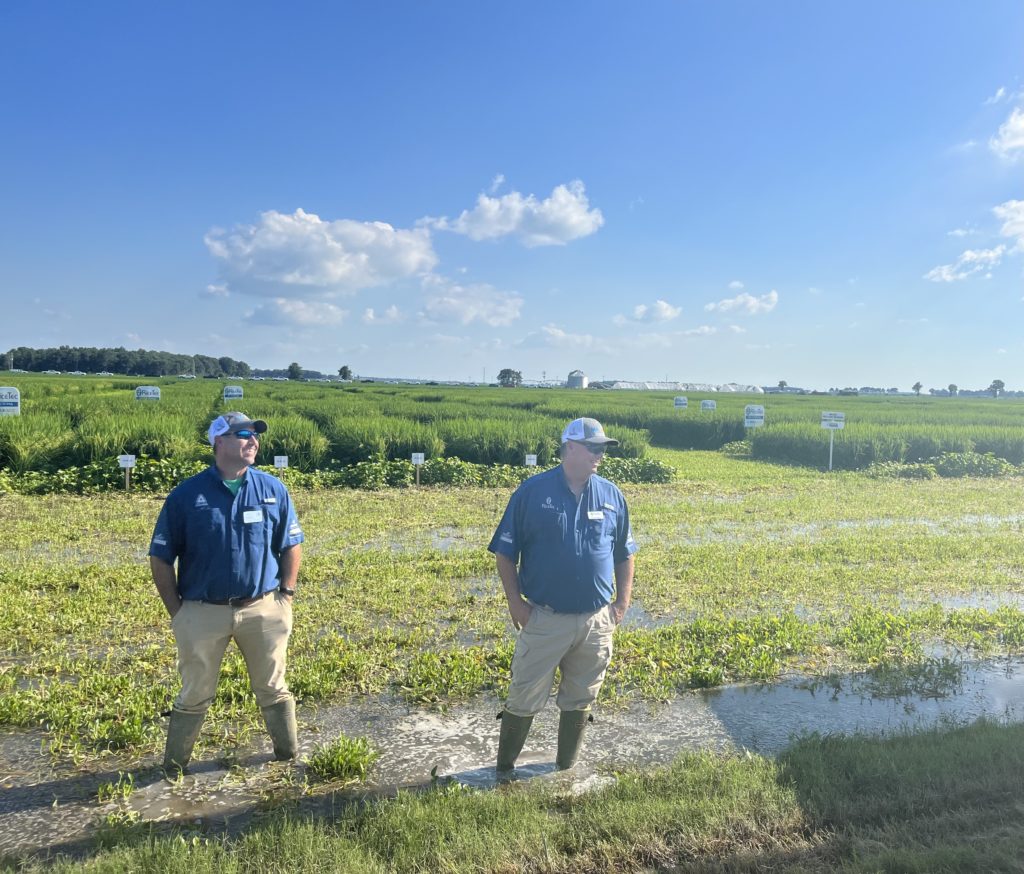
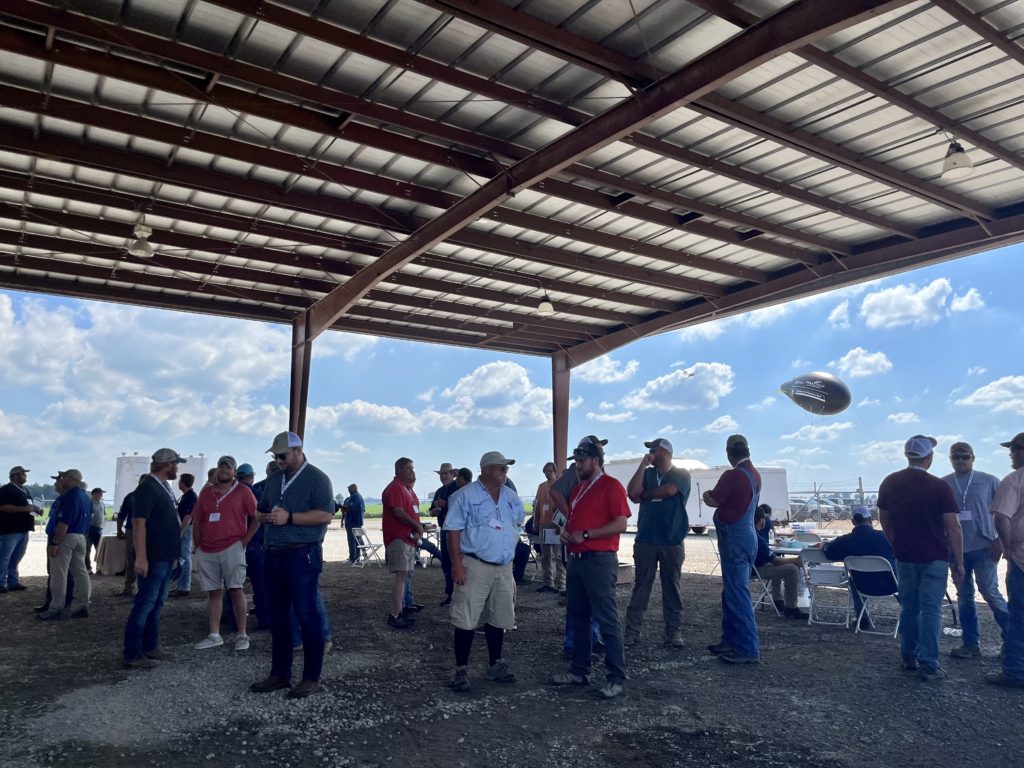
RiceTec held its annual Field Day in Harrisburg, AR on Thursday afternoon. Mollie Buckler, Coordinator for Delta Producer Relations, represented USRPA at the event. The picture-perfect weather made for great attendance.
August 5, 2022
In This Issue:
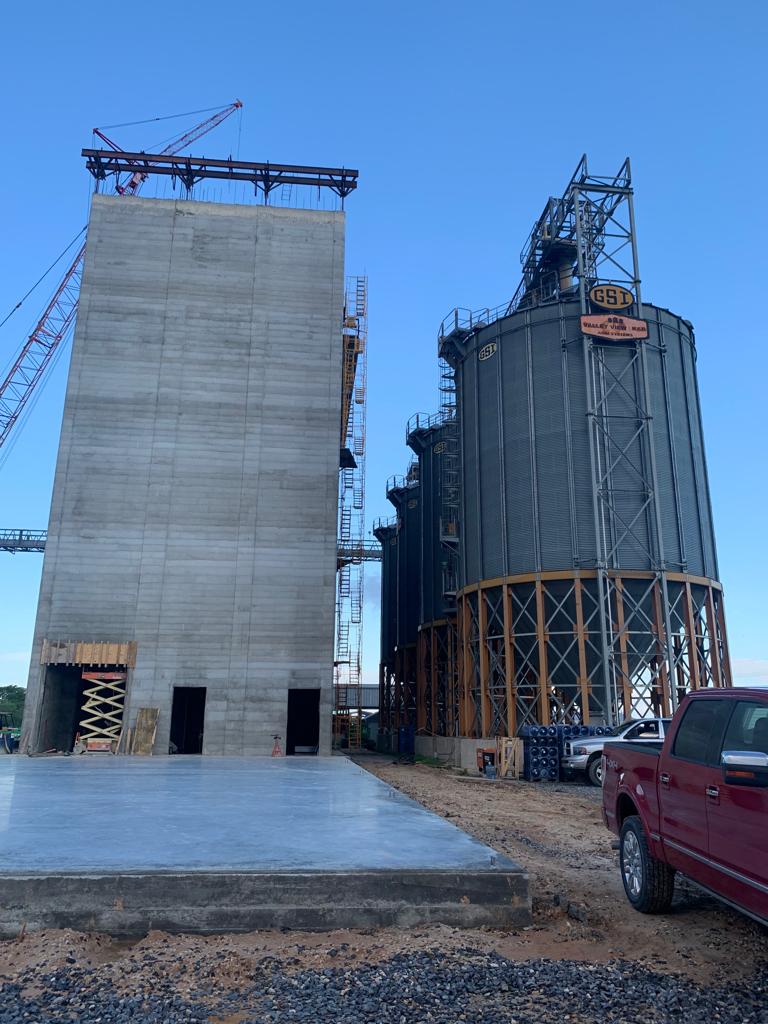
Ten years ago, a group of southwest Louisiana and Texas rice farmers began a grassroots effort that today appears to be a long way from slowing down. Beginning with the construction of a new rail facility to give farmers access to the Mexican market and the formation of the “SLRF," that initiative then led to exporting rough rice by vessel out of the Port of Lake Charles through the IFG terminal.
Always looking for more alternatives in the marketplace, in 2020 they announced a partnership with Agreeta USA for a new rice mill to be built at the rail site near Lacassine, Louisiana. With a groundbreaking event led by Governor John Bel Edwards in November 2021 and area officials, today driving down Interstate 10 you can’t ignore seeing the on-going construction of the modern Buhler equipped rice mill, a global leader in milling technology. The Agreeta-SLRF mill is expected to be complete before Christmas and will be milling new crop rice currently under harvest.
But why stop here? The SLRF recently announced the acquisition of the “Turning Basin” currently under development that will serve as a site for loading barges and ocean vessels to be owned and operated by the SLRF. The Turning Basin is a six-acre site located on the Port of Lake Charles channel near the inter-coastal waterway. A new Brock (Lemar Industries) transport belt conveyer system is already in place with a loading capacity of 25,000 bushels per hour. A grading lab is in place and truck scales will be installed in a few days. Not only have these efforts given rice farmers access to the largest U.S. market in Mexico, but literally to the world with sales made to Honduras, Brazil, and Venezuela to date, while also expanding opportunities in the U.S. domestic market. The relationship building throughout the Western Hemisphere was generated through the farmers’ partnership with the US Rice Producers Association and the USDA’s Foreign Agricultural Service with support from their Market Access Program. These efforts have had a dramatic impact on the region’s rice farmers, influencing and supporting price in Texas, Louisiana, and into the delta region. Plans are in place for a number of new endeavors, so stay tuned!


With harvesters in the field and Iraq in the market, it feels like progress. Of course, there is always hope that there will be more business from Iraq in the near future, but the mills in Arkansas are happy for the opportunity to connect on this 40,000 metric tons. By way of harvest, most reports are strong so far. There have been a few bouts of wet fields and lodging throughout the harvesting regions, but overall there is muted optimism on initial reports. In Texas, the market seems to be hovering in that $17.50/cwt range; however, since the drought has curtailed all second crop canal water, farmers not on wells are going to need a bit more than that to make ends meet this year. Some 15,000 acres of second crop estimated to be affected.
New reports are surfacing this week about a weak monsoon in India that is resulting in at least 13% decreased production. India has been the lowest cost supplier and largest exporter for a long time, and as a result of three record crops, has largely kept a lid on rice inflation relative to the other baskets of commodities. While that has been good for some poor and developing countries, it has hit other regions, like the U.S., hard and made it difficult to be competitive in a global market. There is now talk surfacing that an Indian drought and the resulting reduction of acreage could result in a significant shift in the price and exportable supply of Indian rice. While nothing is written in stone at this point, it will be important to watch in the coming weeks as price volatility is becoming a key factor in every decision.
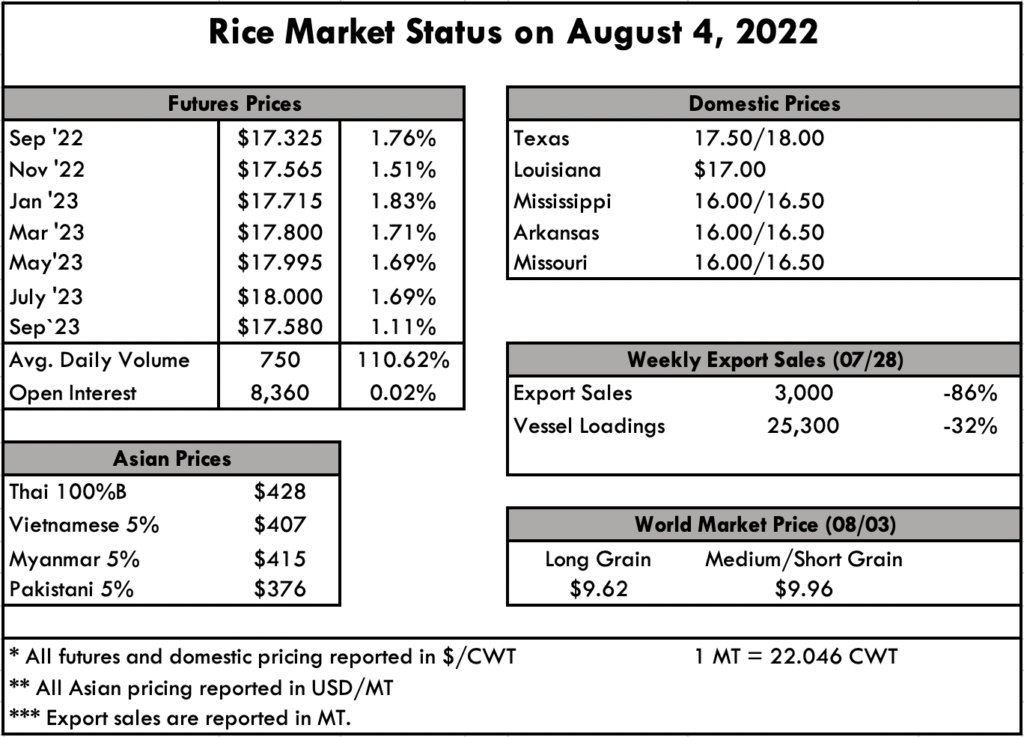
In Asia, Thailand had a small bounce in price, from $400 pmt last week to about $410 pmt this week. Prices in Vietnam have held steady at just over $410 pmt, as have those in India and Pakistan, at $355 pmt and $375 pmt, respectively. The market here is described as stable, but could be shaken if India’s monsoon continues to be light.
On the ground, paddy prices in Texas are at the $17.50/cwt number mentioned above. Louisiana would be quoted at $17/cwt, while Mississippi, Arkansas, and Missouri would be at $16/cwt and $16.50/cwt. This would be translated to indicative pricing of approximately $700 pmt for exportable milled 5% rice.
In the futures market, we saw an average daily volume of 750, up significantly from last week. We saw open interest of 8,360, which is right in line with last week.
The weekly USDA Export Sales report shows net sales of only 3,000 MT—a marketing-year low—which is down 87% from the previous week and 88% from the prior 4-week average. Exports of 25,300 MT were down 32% from the previous week and 33% from the prior 4-week average. The destinations were primarily to Japan (12,000 MT), Honduras (5,500 MT), South Korea (3,000 MT), Canada (2,700 MT), and Mexico (1,600 MT).
Stabenow selects new Committee Staff Director
Last week, Senate Agriculture Committee Chairwoman Debbie Stabenow (D-MI) announced Erica Chabot would replace Joe Shultz as majority staff director. Chabot has spent the last ten years as Appropriations Committee Chairman Patrick Leahy’s (D-VT) legislative director and deputy chief of staff. As legislative director, Chabot led agriculture and nutrition-related initiatives for Leahy, for the 2014 and 2018 Farm Bills.
House Agriculture Republicans Call for EPA Oversight Hearing
This week, House Agriculture Committee Republican leadership sent a letter to Committee Chairman David Scott (D-GA) requesting a hearing with Brendan Regan, Administrator of the Environmental Protection Agency (EPA). The letter noted the EPA’s role in regulating crop protection tools and argued the EPA has weaponized these tools, harming farmers and exacerbating inflation and supply chain disruptions. The members called for Chairman Scott to hold a hearing with the EPA Administrator prior to September 30. The letter can be found here.
This week in Miami the COL-RICE Committee (Colombia Rice Export Quota, Inc.) met for their regular meeting to discuss the market and production conditions of both Colombia and the U.S., auctions, import needs, policies and related supply/demand issues. USRPA board member Dennis DeLaughter, an original member of the committee, participated in the meeting, and also met with Sandra Avellaneda, Executive Director for InduArroz (Colombian Rice Millers Association). USRPA Board Member Justin Landers of Missouri also currently services on the committee.
Formed in 2012 by the rice industries of the two countries, the COL-RICE Committee administers the Tariff Rate Quota for rice established under the Free Trade Agreement. COL-RICE conducts open-tender auctions for duty free imports into Colombia. The USRPA has a long history with these issues going back to 1997-98 with the European TRQ, when U.S. rice farmers were going to be left out of the rebate funds. After extensive efforts, they were able to force a division of the funds to be fairly distributed to all rice farmers. That same format was used for the U.S.-Colombian FTA. The next auction will he held on October 6, 2022. www.col-rice.org

25722 Kingsland Blvd., Ste. 203, Katy, Texas 77494
Phone: 713-974-7423
USRPA does not discriminate in its programs on the basis of race, color, national origin, gender identity, sexual orientation, religion, age, disability, political beliefs, or marital/family status. Persons with disabilities who require alternative means for communication of information (such as Braille, large print, American sign language, language translation, etc.) should contact USRPA at 713-974-7423. EEO.