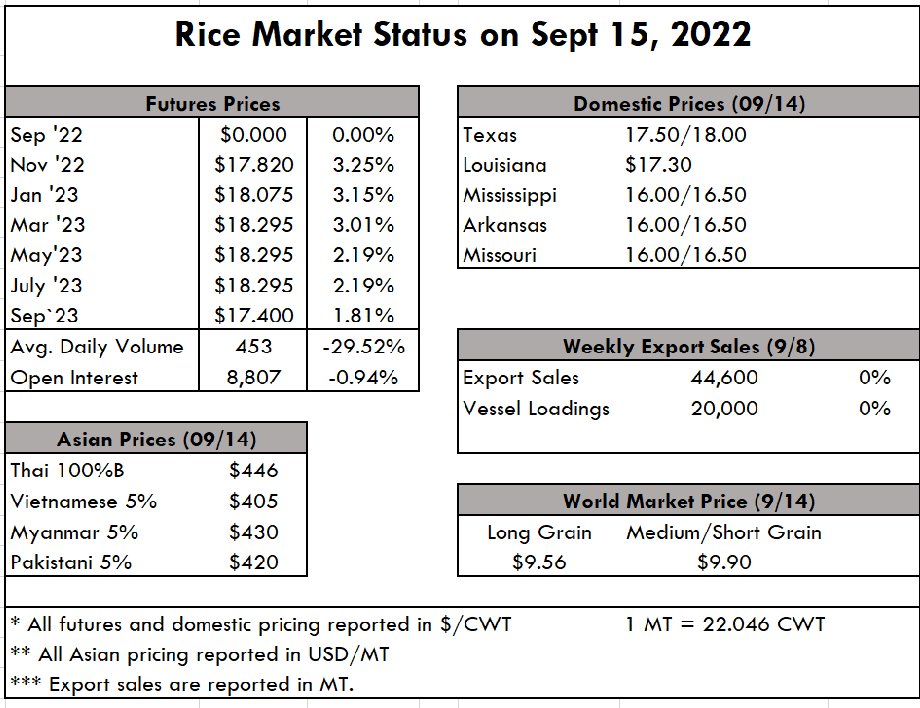
With the Indian tariff situation, a rail strike that is temporarily averted, and harvest in full swing, there is much to consider this week in the rice market. To follow convention, we’ll start first with a harvest update, where Arkansas is at 24% harvested as of September 11, but slightly behind the five-year average of 33%. Mississippi is now right on track with historical norms, crossing the 50% threshold as of writing. Texas is all but complete, and Missouri and California are just getting underway this week.
Despite all of the flux in the news, the price has been relatively constant for milled and paddy prices in the U.S. In Arkansas, prices remain in the $16/$16.50 per cwt for hybrid and conventional respectively, and the same goes for Mississippi and Missouri as well. Texas still leads at $17.50/$18 per cwt, and Louisiana is holding firm at approximately $17.30/cwt. The export business continues to feed Haiti and Iraq, while domestic millings keep churning. Export prices have firmed slightly in recent weeks, perhaps on account of India’s tariff, or perhaps because of decreased supply overall; in either case, USA 5% was quoted at $710 pmt at the beginning of September, and is now closer to $720 pmt.
The problem is, if there is not a permanent solution with Union Pacific and the railroad, and a shut-down of rail cars does in fact ensue in the middle of harvest, the price won’t matter because it won’t get delivered, period. The impacts would be devastating, swift, and severe to the entire supply chain. Some reports state that the U.S. economy could lose as much as $2 billion/day as a result. We haven’t heard numbers like this since the “Ever Given” was lodged in the Suez canal when over $9 billion was lost globally for the six-day obstruction. The temporary agreement with the railroad is positive news in light of such potential disruption, but even a solution will contribute to increased costs in an already blazing inflationary market. The tentative agreement provides rail employees a 24% wage increase from 2020-2024, including a payout of $11,000 to happen immediately. In the meantime, the availability of rail cars continues to be extremely scarce even to lease or purchase.
And now India; the world’s top exporter has completely banned the exports of brokens, which means China has been sourcing and will need to find a new supplier for their animal feed. As mentioned last week, basmati is excluded, and the 20% tariff will put the price much more in line with Vietnam and Thailand. Rumors of India’s current crop being as much as 10% off from last year’s record could also be a contributing factor. The bottom line for the US industry here is that USA long grain is already priced so much higher than Indian rice, the impact will be minimal.
The most recent Grain: World Markets and Trade report published by the USDA highlights that world rice production will decrease this month for the first time since 2015/16 because of decreased supplies in India (monsoon weakness), China (drought), and Pakistan (drought). With the population continuously on the rise, as expected, this production shock ripples down the line into decreased global stocks, hitting the lowest level since 2017/18. In the U.S., USDA is reporting the lowest rice production since the early 1990s, as long grain is down 8 million cwt to 132 million cwt, and medium grain is down 2.9 million cwt to 32.8 million cwt.
Rail Deal
Early Thursday morning, the White House announced the freight rail companies and labor organizations had reached a tentative deal to prevent a national railroad strike. Negotiations began months ago as the existing labor agreement was set to expire on September 16. As the deadline neared, precautionary steps were taken, including pausing rail shipments of ammonia for fertilizer, as the likelihood of a strike increased.
Climate Grants
On Wednesday, Department of Agriculture (USDA) Secretary Tom Vilsack announced $2.8 billion in awards through the Partnerships for Climate-Smart Commodities funding opportunity. Seventy projects will receive funding, including $65 million for the Texas Climate-Smart Initiative, of which USRPA was a major partner. This project, led by the Texas A & M Agrilife Research, will support a transition to climate-smart agriculture and forestry and help develop new markets for climate-smart commodities within the state. A list of all projects can be found here.
New Member Joins House Committee on Agriculture
On Wednesday, September 13, Ranking Member Glenn (GT) Thompson (R-PA), announced the addition of Representative Brad Finstad (R-MN) to the House Committee on Agriculture. Rep. Finstad joins the Committee as a current operator of his family’s farm and as a former State Director for USDA Rural Development in Minnesota. Rep. Finstad fills the seat of a former member, Rep. Jim Hagedorn, who passed away of cancer in February of this year.
USRPA Signs onto Letter in Support of Doug McKalip’s Expeditious Confirmation
USRPA joined commodity groups in signing a letter in support of the expeditious Senate confirmation of Doug McKalip to be Chief Agriculture Negotiator within the Office of the United States Trade Representative. Last week, the Senate Committee on Finance favorably reported McKalip’s nomination out of committee on a unanimous vote. McKalip has previously served in a variety of positions at the United States Department of Agriculture, most recently as a senior advisor to the Secretary of Agriculture. The letter goes on to explain how McKalip’s confirmation would benefit American agriculture by finally having a dedicated negotiator working to push for new agricultural markets and removing barriers to growth in existing marketplaces.
Are you following USRPA’s social media campaign in Mexico? If you are not, please do! The Instagram and Facebook accounts are @consumearrozusa Links below.
Our 2022 Mexico campaigns began on April 1 and May 3, respectively. The USRPA team has worked with Raul Caballero, an in-market representative in Mexico, to develop a campaign that includes quick one-minute video recipes, written recipes, GIF-style recipe posts, and other informative posts.
ONE-MINUTE VIDEO RECIPES
To make these video recipes, we’ve collaborated with three renowned chefs: Chef Melissa Morelos, Chef Carlos Leal, and Chef Alfredo Oropeza. Cumulatively, they have published 39 video recipes thus far. This type of content has the best reach with consumers with likes and comments. As of today, the videos have more than 453,000 views.
WRITTEN RECIPES
As part of the campaign, we’ve also posted complete recipes that include the listing of ingredients, preparation instructions and photos of the final recipe. With these types of posts, consumers have the opportunity to print the entire recipe and prepare it in the traditional manner.
GIF STYLE GRAPHICS AND RECIPES
GIF style recipes differ from "traditional" recipes in the form and style in which they are published. The GIF includes an attractive picture or element that has some moving components, taking the attention of the consumer. These posts tend to be attractive to consumers as well.
U.S. RICE NUTRITION AND QUALITIES POSTS
Last but not least, the campaign includes curated posts that will inform consumers about the different nutrients that the U.S. long grain rice offers. We also provide relevant information about the health benefits of consuming rice on a regular basis, as well as tips for a better use of U.S. long grain rice through cooking recommendations.
RESULTS
From April 1 to August 31, the campaign has reached a total of 1,881,668 viewers with a total of 2,206,289 impressions. Metrics have accounted for 12,286 likes, 1,294 comments and 418 shares.
Some of the videos have reached interesting organic high audience numbers. For example, Chef Carlos Leal had a total of 14,442 views for his U.S. Rice with Grilled Octopus video. Another successful example was from Melissa Morelos with a total reach of 25,592 views for a Spinach Crepes recipe made with U.S. rice flour.
Follow Consume Arroz USA on Facebook & Instagram


In This Issue:
In the latest crop progress report released by the USDA, Louisiana was pegged at 75% complete which lags the historical average by 5%. Mississippi and Texas are both on pace with their 5-year norms at 23% and 81%, respectively. Missouri and California are taking samples and preparing for harvest which should begin to pick up soon. Moisture levels in Arkansas are still a bit high at 23-25% and the recent dip in temperatures and lower humidity aren’t helping to bring the crop to final maturity. For the 11% of the crop that has been harvested, yield reports have been strong, but there is still a long way to go.
According to various market reports and brokers, cash markets were unchanged throughout the southern United States and even California. The easiest explanation for this is harvest. Currently, growers are fixated on bringing in their rice and determining yields and quality and are participating very little in cash trades. Since this is a seasonal norm, buyers are slow to fuel the market and are also waiting until more crop information comes to light before revising their cash bid.
South American prices have reportedly slid over the past two weeks with Uruguayan rice now trading at $520 FOB or even lower, and Argentine rice trading as low as $480 FOB. Meanwhile, prices in the far east are relatively unchanged, despite India announcing a 20% duty on rice exports and a ban on brokens. This is an attempt to combat soaring food inflation and low rice prices domestically. Considering India accounts for more than 40% of global shipments, this protectionist policy can’t be overstated. World prices have yet to respond, but there is concern that this may be a catalyst for higher grain prices across the board, as China, the largest recipient of India brokens will be forced to import more corn for feed purposes. A duty of 20% would put Indian rice right on par with Thai prices, and above Viet prices by about $20 pmt if prices in both Vietnam and Thailand hold.
The futures market has continued to be a little volatile due to several factors in Asia, not to mention the lack of export data domestically. Reports of heat and flood damage in key rice growing regions in both China and Pakistan has spooked importers; however, some traders believe the loss will be offset by a large global carry over. Considering beginning stocks are up 61.5 million tons since 2013/14 and global consumption is only up 44.8 million tons, it stands to reason that the recent bumper crops and subsequent larger supplies may alleviate some supply concern moving through the new marketing year.

Senate Committee Favorably Reports McKalip Nomination
On Wednesday, the Senate Committee on Finance favorably reported the nomination of Doug McKalip to serve as Chief Agricultural Negotiator within the US Trade Representative on a unanimous vote. This nomination will now go to the full Senate for confirmation.
Senator Boozman Sends Letter to Secretary Vilsack
This week, Sen. Boozman (R-AR), a ranking member of the Senate Agriculture Committee, sent a letter to Secretary Vilsack of the Department of Agriculture (USDA) expressing concern over recent issues within the Foreign Agriculture Service Export Sales Reporting and Maintenance System. He emphasized the importance of this system to American producers, especially given high inflation and supply chain challenges. In the letter, he called on USDA to prioritize day-to-day functions over political goals. The letter can be found here.

Mollie recently visited with University of Missouri Extension Specialists Dr. Justin Calhoun and Dr. Justin Chlapecka to discuss the work of the US Rice Producers Association and the Missouri Rice Council.

HARRISBURG, ARKANSAS (Sept. 9, 2022) – From elite Clearfield® varieties redefining yield expectations versus hybrids to how the Provisia® Rice System is the most effective herbicide system for controlling weedy rice, the large gathering of rice farmers and consultants who attended the recent Horizon Ag Arkansas Field Day here heard firsthand how CLL16, new CLL18 and PVL03 enable farmers to make higher yielding, better quality rice.
Horizon Ag CLL16, an Arkansas-bred variety that has been a standout since its commercial release last season, was the center of attention, as attendees viewed field plots and listened to farmer experiences with a variety that has established itself as “the complete package” due to its consistent, high-end performance and agronomics.
Bernie, Missouri, farmer Zack Tanner told field day attendees that CLL16 has become his “go-to” variety on his fields not under contract for seed production. “We’ve had some great yields with CLL16 over the four years we’ve planted it,” said Tanner. “Even when I’m thinking about furrow irrigated rice, it’s a variety I like to plant because of its consistency, blast tolerance, height, vigor and yield.”
Nolan Evans, a Weiner, Arkansas farmer, said he grew CLL16 last season for the first time after confirming its potential with University of Arkansas rice specialist Jarrod Hardke. “He said it was a good variety, so, instead of planting a few acres in it, I planted half my farm in CLL16,” said Evans. “I really like it and probably have a little over a third of my farm in CLL16 this year.”
One of the unique benefits of CLL16 is that it is broadly adapted to perform across the southern rice region. From the Missouri bootheel to the west of Houston, Texas, CLL16 has consistently shown that it can yield with or better than top-performing varietals and even hybrids.
“This is a variety yielding 200-plus bushels per acre consistently across a wide range of geographies while offering the advantages of a Clearfield variety at a lower seed cost than hybrids,” said Dr. Tim Walker, Horizon Ag general manager. “You’ve heard us say that CLL16 is the complete package. We can always make improvements, and we continually strive to be better, but CLL16 is truly as close to the complete package as we’ve seen in a pure-line variety. It’s got high yield potential, good milling package quality, rice export quality, good disease tolerance, good standability, good early season vigor and herbicide tolerance.”
When it comes to “continually striving to get better,” there is also a lot of excitement about the yield potential of new Horizon Ag variety CLL18, which will have a limited launch in 2023. CLL18, a University of Arkansas bred variety, consistently outyielded CLL16 by about 5% in Arkansas trials, according to Hardke. CLL18 does not offer the level of blast resistance of CLL16, however, and should be planted in areas not prone to blast.
Tanner, who has CLL18 at a very low seeding rate in seed production fields this season, says the variety looks “really good, with prominent heads. It seems like it has excellent vigor. I planted it on May 11 and was at 30%-50% heading on August 8. It’s a showy rice, with a good, dark color and the ability to make a very large panicle.”
Dr. Walker says that in addition to “taking it up a notch in terms of yield potential, CLL18 should fit well with CLL16. “CLL18 is a little earlier maturity, so we can start planting CLL18 early and then follow with CLL16 and stretch out harvest,” he says.
Provisia Rice System and PVL03
In the Provisia Rice System, PVL03 had another strong year, showing it offers a significant improvement over early Provisia lines. In many fields, it rivals the top-performing Clearfield varieties in yield potential while enabling farmers to achieve outstanding control of weedy rice and resistant red rice and grasses. Considering PVL03’s potential, Dr. Walker says that farmers can add the Provisia system to a recommended rotation system that includes Clearfield rice, with the goal of keeping both systems effective for years to come.
Many South Louisiana farmers no longer have that option because, after years of planting Clearfield rice, they face severe resistance issues with outcrosses and hybrid volunteer rice, Dr. Walker says. Moving forward, he says that practicing good stewardship of both Provisia and Clearfield rice is essential.
“There is another ACCase technology system out there that is not the same as the Provisia Rice System,” says Walker. “That system has a safener in the herbicide because the trait in the variety is not as strong as what we have with the Provisia Rice System. When you safen a herbicide, you safen its efficacy. It’s essential that we get control and prevent escapes to keep this important technology.
To that end, Horizon Ag is participating in the Provisia Working Group, made up of university, retailers and industry leaders like LSU and BASF. With outcrosses already being seen in Provisia rice, the Working Group will develop and provide recommendations for growers to best manage the system in the coming seasons. “Instead of avoiding this issue, our goal is to come together and be part of the solution,” says Dr. Walker.
More information about Provisia rice and Horizon Ag elite Provisia and Clearfield® varieties is available at www.horizonseed.com.
In This Issue:
| Harvest continues to produce solid results as we begin the new month. Texas is heading into its final stretch with Louisiana just behind, with perhaps 10% and 15% left to go respectively. This week will be the official “kick-off” of the Arkansas rice harvest where yields are looking to be at least average, hopefully, better. The USDA Crop Progress report is showing Arkansas at 4% harvested as of August 28, and we expect by this time next week to see a significant jump. Mississippi is on the same schedule as Arkansas, with 2% harvested to date, but a busy September is anticipated. California will see its first harvesters in the fields just after the Labor Day holiday and expects to be in full swing by the middle of September. Cash prices remain strong on the ground, with Texas showing staying power at $17.50-18.00 per cwt. Louisiana is showing much the same as last week at $17.30 per cwt, which is welcome news considering the price disparity in milled prices when compared to competitors. Arkansas will be the one to watch as harvest gets underway to see if being awash in new crops affects futures prices or deliveries in any way. The general sentiment is that it won’t be positive, as futures prices are pressing the upper range of domestic purchases, and there’s resistance against any further price growth. Tracking these changes has been difficult in recent weeks because of a problem with the USDA’s Export Sales reporting system. The USDA Export Sales reporting system was scheduled to roll out a new interface two weeks ago, but there was a technical glitch instead of the big reveal. A communication from the FAS Administrator states the industry can expect to be without Export Sales reports until at least September 15. This is an extremely important tool to help track S&D fundamentals and compare against previous years, as well as aid in price discovery for the coming year. However, not having access to the reports may save us the dismal news of poor sales since the start of the marketing year. Outside of the boost from the second tranche of rice procured by Iraq, the export business has been light. To that note, U.S. Long Grain 5% is quoted at $710 pmt. Compare that to prices of $580 in Brazil, $540 in Uruguay, and $500 in Argentina. The industry remains extremely fortunate for its steady domestic business, and in this case, another crop that was down 15% from historical norms at 1.755 million acres of long grain is expected to actually be harvested this year. The high cost of inputs has ravaged the economics of rice production this year for farmers, just as inflation has ravaged the checkbooks of consumers. Asia is holding steady as well, and the lack of volatility is a nice reprieve in the midst of so much global chaos. Thai 5% is steady around $425 pmt, Viet rice steady at $395 pmt, and Indian rice at $355 pmt. There was initial speculation that prices in Thailand could cool as they finish harvest, but the strong demand from Iraq for milled rice and demand from China for broken (for animal feed) has helped prop up prices even with flush supplies. The futures market has been surprisingly strong, but showed a drop in average daily volume of 42%, down to 1,149. Open interest was fairly steady, registering a 2% bump up to 9,043. |
 |

25722 Kingsland Blvd., Ste. 203, Katy, Texas 77494
Phone: 713-974-7423
USRPA does not discriminate in its programs on the basis of race, color, national origin, gender identity, sexual orientation, religion, age, disability, political beliefs, or marital/family status. Persons with disabilities who require alternative means for communication of information (such as Braille, large print, American sign language, language translation, etc.) should contact USRPA at 713-974-7423. EEO.