| The Texas Rice Council held a board of directors meeting on October 7th, at Midway Bar-B-Q, in Katy, Texas. The Rice Council is entrusted with the producer’s check-off dollars earmarked for promotion, education, and market development. Leaders from Academia, Government, and the U.S. Rice Industry spoke on topics essential to bettering the Texas Rice Industry. |
 The new Directors of AgriLife Research and Extension discuss how to improve outcomes from research dollars, and better communication of those outcomes to producers. Left to right: Dan Hunter, Assistant Commissioner for TDA; Dr. Rick Avery, Director of AgriLife Extension; Dr. Cliff Lamb, Director of AgriLife Research, and Galen Franz, Chairman TRRF. |
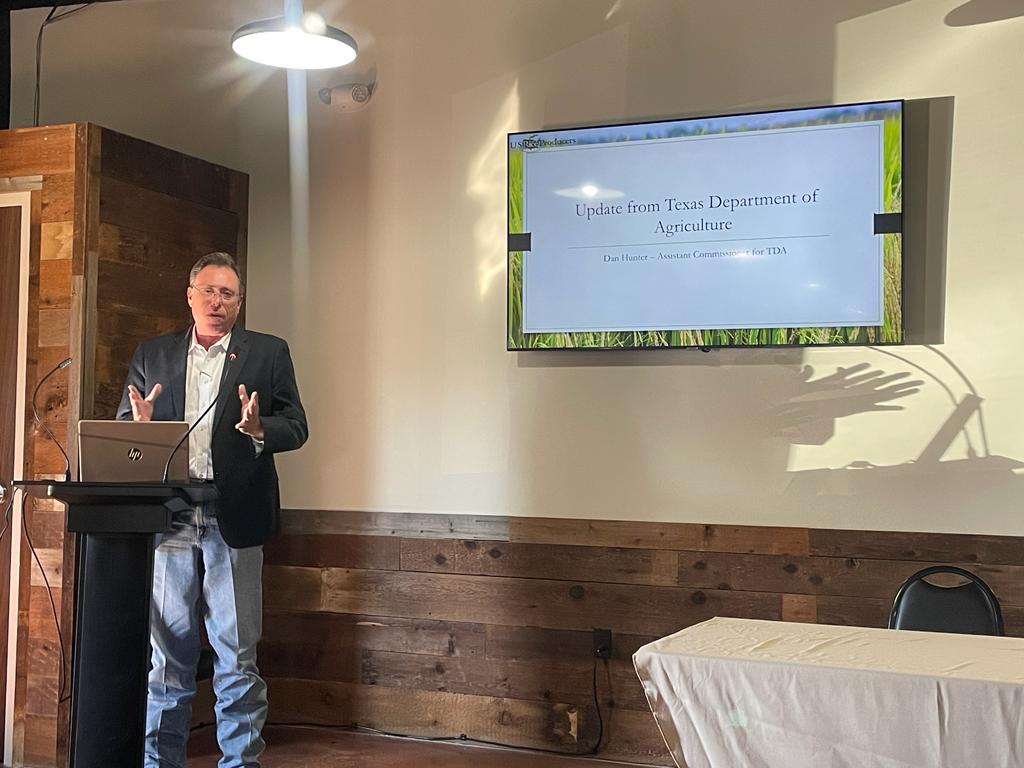 Dan Hunter discussed current agricultural affairs, legislative matters, and marketing opportunities with the Texas Rice Council. Picture: Dan Hunter, Assistant Commissioner for TDA |
 Dr. Tim Walker discussed trends in U.S. Long Grain production and marketing over the last twenty years. He gave his perspective on what the U.S. Rice Industry needs to do to regain market share in Western Hemisphere markets traditionally dominated by U.S. Long Grain rice. He also discussed opportunities in the domestic aromatic market. Left to right: Tommy Turner, President of Texas Rice Council; Dr. Tim Walker, CEO of Horizon Ag; and Marcela Garcia, President & CEO of USRPA. |
| Senators Send EPA Letter on RFS On Wednesday, a bipartisan group of senators sent Environmental Protection Agency (EPA) Administrator Michael Regan a letter requesting EPA establish robustly and expanded blending volume obligations in its forthcoming “set” rule under the Renewable Fuel Standard (RFS). The letter argues increasing biofuel blends will support both domestic producers and the environment. The senators also called for EPA to take additional supportive action to increase regulatory certainty and opportunities for biofuel producers. The letter can be found here. USAID Responds to Crisis in Haiti This week, the U.S. Agency for International Development (USAID) deployed a Disaster Assistance Response Team to Haiti to respond to the humanitarian crisis brought on by political instability. Unrest has led to a month-long nationwide port blockade preventing food and fuel from being imported into the country. Haiti, one of the largest foreign markets for U.S. rice, has not received a shipment of US rice since late August. Earlier this month, Sen. Bill Cassidy (R-LA) penned an op-ed noting the importance of the Haitian market for rice producers and calling for the deployment of the Inter-American Peace Force in Haiti. The United Nations estimates that 4.7 million Haitians are currently facing acute hunger. USDA Provides $800 Million to Distressed Borrowers On Tuesday, the Department of Agriculture (USDA) announced it has provided $800 million in debt relief payments to distressed borrowers of Farm Service Agency loans. This amount is part of a total of $3.1 billion allocated through the Inflation Reduction Act (IRA) for assistance to agricultural producers. USDA estimates this assistance will benefit approximately 35,000 borrowers. Senate Agriculture Committee Plans for Farm Bill HearingsSenate Agriculture Committee Chairwoman Debbie Stabenow (D-MI) announced her plan to hold multiple farm bill hearings before the end of this year. Sen. Stabenow has stated the upcoming hearings would include different farm bill titles but declined to discuss exact details. The Committee has held two listening sessions on farm bill issues this year, one in Michigan and the other in Arkansas. |
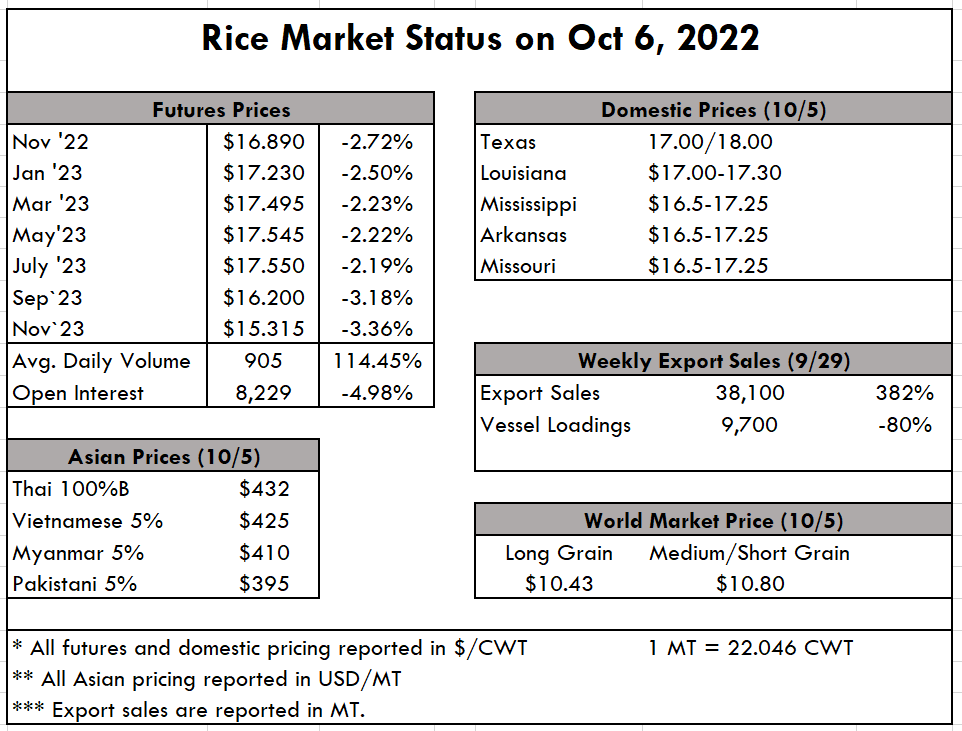
| With harvest now almost complete, the long grain industry finds itself on a precipice and is not entirely sure where to go next. Paddy prices remain firm, but the spot market is not as active as most producers expected it to be post-harvest. That’s because the largest milled market for U.S. rice is getting worse with each passing day, as it’s nearly impossible to unload a vessel in Haiti right now—even for NGOs trying to help the people in crisis. If we look at paddy exports as a bright spot, the U.S. continues to lose market share in Mexico to other origins from South America, namely Brazil. The 80,000 metric tons of Iraq business that has been keeping mills busy was for old crops, and the milling is winding down. The domestic market has been the steady savior, but with both Haiti and Iraq in the wings and prices that are significantly higher than the competition, it will be an interesting year marketing this crop. After considerable delay and debate in Mexico, the federal government published details of their recent Anti-Inflationary Program that has been reported previously in the Rice Advocate. However, it remains unclear as to the treatment for rice and in the meantime, the length decree (link below) is being interpreted as no real change. Any Mexican company with importing history can access the license while the duty exemption is valid only for paddy rice. The Mexican federal government decree that exempts the payment of import tariff and administrative facilities are granted to various goods of the basic basket and supplies that are indicated. The decree can be found here. A new USDA Gain report on the decree is forthcoming. These are the factors that don’t even take into account the rising value of the dollar making U.S. exports more expensive, which further depresses our ability to be price competitive with our Western Hemisphere counterparts. Trade is not a focus of the current White House Administration, therefore significant headwinds prevail in developing new markets and sustaining existing ones. On the ground, Texas prices are holding firm at $17/$18, however with limited activity. The same goes for Louisiana where prices are at $17. Mississippi, Arkansas, and Missouri are all competing for barge space that is limited by low water on the Mississippi River, with prices at $16/$17. In Asia, the market is holding steady as well. It continues to be an anomaly that rice prices have not experienced the same wild volatility that most other food grains have. Thai 100% B is quoted anywhere from $415-$425 pmt this week, right in line with previous weeks. Vietnamese 5% is pegged at $430 pmt, which is also in line. India remains at $380 pmt, which has been the “new” price since making their tariff announcement. The weekly USDA export sales report shows net sales of 11,200 mt this week, down 13% to Colombia (10,400 MT), Canada (400 MT, including decreases of 200 MT), Mexico (200 MT), the Netherlands (100 MT), and Micronesia (100 MT). Exports of 7,100 MT were dismal as well, down 87% and headed primarily to Canada (2,400 MT), Mexico (1,900 MT), Jordan (1,000 MT), the United Kingdom (900 MT), and Saudi Arabia (500 MT). The futures market was active this week, with average daily volume jumping 16% up to 1,448. Open Interest also bumped 4.22% up to 8,289. |
 |
In This Issue:
Supreme Court Hears Arguments on Waters of the United States
The Supreme Court heard oral arguments on defining waters of the United States (WOTUS) and its application to wetlands under the Clean Water Act (CWA). In Sackett v. Environmental Protection Agency (EPA), the justices will determine the scope of the EPA’s authority to regulate wetlands without a continuous surface water connection to WOTUS. A final ruling will be released in spring 2023. The U.S. Army Corps of Engineers is developing a new rule to clarify the definition of WOTUS. The rule has been sent to the Office of Management and Budget for review and is intended to be released before the end of 2022.
Department of Labor Releases H-2A Final Rule
The Department of Labor has issued updated regulations for hiring H-2A workers strengthening standards for housing, meals, and wages. The new rule states housing and public accommodations must meet health and safety standards, including minimum square footage per worker. Meals also must be provided in a sanitary manner and with adequate nutritional value. The new rule also expands the ways wages are determined by requiring farms to offer prevailing wages for jobs they wish to fill with H-2A workers. The Department reiterated agricultural associations can be held liable for rule violations by individual farmers. The new regulation will take effect on November 14, 2022. The final rule can be found here.
Department of Labor Increases H-2B Cap
This week, the Department of Labor announced it will issue a regulation to increase the number of H-2B visas available by 64,716 for the fiscal year 2023. These will supplement the 66,000 H-2B visas normally available each fiscal year. The H-2B program permits employers to temporarily hire migrant workers for nonagricultural purposes.
| Harvest has finally caught up or passed the 5-year average for all states. Arkansas is 90% done, California 50%, Louisiana 97%, Mississippi 86%, Missouri 78%, and Texas 99% harvested. This would mean rice harvest should be wrapped up nationwide before Halloween, except for a few possible stragglers. Field yields continue to improve from the earliest announcements, but there are few reports of any bumper crops out there in the South or in California. Cash prices remain firm because the milling remains steady despite the chaos in Haiti and weaker-than-normal exports. We can give credit to a strong domestic market that has answered the call to keep mills busy, as the 80,000 metric tons to Iraq won’t last forever. Texas holds firm with cash prices at $17/$18 per cwt, Louisiana with $17-17.30 per cwt, while Mississippi, Arkansas, and Missouri all fall within $16.50-1$7.25 per cwt. The strong U.S. prices, the largely unresolved issues surrounding rice grain quality for foreign markets along with the phase-in of the Central American Free Trade Agreement – DR are resulting in a major drop in exports. The inability of the U.S. rice industry to renegotiate the CAFTA-DR agreement with its customers in Central America is having and will have a negative effect on U.S. farmers as the US Rice Producers Association and the Central American Rice Federation (FECARROZ) began pointing out back in 2017. The U.S. rice industry continues to ignore and as one important industry representative mentioned last week, “we have red flags everywhere but not enough folks want to talk about the critical issues.” Global Markets: Rice – Rising Competition in Core / U.S. Market, Mexico Complete report here The announcement last week from the President of Mexico, Lopez Obrador regarding a new Anti-Inflationary Program continues to be met with strong resistance from throughout Mexico on every level whether the agricultural sector or consumer advocates. Several members of the Mexican congress are also protesting. It certainly should be on the radar of the US agricultural trade as it calls for the elimination of all import procedures and permits administered by the country's regulatory authorities including the service of SENASICA, the National Service of Agro-Alimentary Health, Safety, and Quality and the Federal Commission for the Protection Against Sanitary Risks (COFEPRIS). As of this writing, this new program has not been published in the Federal Register of Mexico. The October WASDE report raised the 22/23 ending stocks from 20.9 million cwt up to 23.2 million cwt. Supplies were increased slightly because rice yields were expected to be 7,599 lbs/acre. U.S. export forecast was lowered by 2 million cwt to 75 million. If the current pace holds, this would be the lowest total exports since 1991/92. World rice stocks dropped because of shorter crops from both India and Pakistan. Remember that last year was India’s third record crop in a row, and Pakistan’s largest crop on record as well. Global exports dropped by just .4 MMT to 53.2 MMT. Global ending stocks decreased to 171.2 MMT, which would be the lowest level in the past 5 years. In Asia, Thai prices held steady again, while Viet prices bumped slightly, at $430pmt and $435pmt respectively. Indian prices remain at $390pmt, helping bring some parity to the far east and middle east markets. The Western Hemisphere prices still far outpace these prices with the USA leading the way at $720pmt, Brazil at $565pmt, and Uruguay at $540pmt. The news was dominated a few weeks ago by the potential Railroad worker’s strike, but it was abated with a temporary fix by the current White House administration. The strike discussion is back on the table, and the timing is still bad. Railroads comprise 40% of the United States freight traffic, and the relative percentage of food in that traffic is at its highest during harvest, ie: right now. To make matters worse, this would come right during the holiday season when goods and materials for heat generation are heavily utilized. The battle continues to be over-paid time off/paid sick time for Union workers. There is no easy solution here, but the hope was that the “temporary” fix would last more than four weeks; that hope did not hold. In the futures market, average daily volume jumped 37% up to 1,245, while open interest dropped slightly 3%, down to 7,953. Overall, the markets finished with lower volume trading and were a bit weaker than a week prior. The market seems to be testing a band with a low of $16.50 and a high of $16.85 with no direct evidence pointing to a breakout in the near term, but that can change in an instant. |
 |
In This Issue:
The purpose of the Rice Education Exhibit was to further the influence of the festival's continuing education program. It was a great event to educate youth on all things RICE! Participation in community educational events has allowed USRPA to raise awareness of rice and promote rice consumption and education.

Continuing Resolution Passes
Last week, Congress avoided a government shutdown by passing a continuing resolution before the September 30 deadline. The bill will fund the government at FY22 levels and extend authorizations for programs including the National Flood Insurance Program, Food and Drug Administration user fees, and Temporary Assistance for Needy Families. It also provides supplemental funding, including $12.3 billion for Ukraine, over $20 billion for natural disaster recovery, $1 billion for the Low Income Home Energy Assistance Program, and $20 million for Army Corps water and wastewater infrastructure improvements. The continuing resolution expires on December 16.
Mexico Announces Agreement to Address Inflation
This week, the government of Mexico announced an agreement with 15 private companies to address food price inflation. The Opening Agreement against Inflation and Scarcity pledges to reduce the costs of 24 basic goods, including rice, by 8%. As part of the agreement, the 15 companies are exempted from Mexico’s import requirements for food and food packaging. The agreement extends through February 2023.
Senate Agriculture Committee Leaders Advocate for Crop Protection Tools
This week, Senate Agriculture Committee Chairwoman Debbie Stabenow (D-MI) and Ranking Member John Boozman (R-AR) sent a letter to Department of Agriculture (USDA) Secretary Tom Vilsack and Risk Management Agency (RMA) Administrator Marcia Bunger advocating for the expansion of margin protection tools. In the letter, the Senators cited the increased risk producers face due to elevated input costs. They called for RMA to increase the commodities eligible for RMA insurance policies and improve producer awareness of available programs. The letter can be found here.
House Republicans Voice Concern for Foreign Ownership of U.S. Farmland
In the House, 130 Republican members sent a letter to Comptroller General Gene Dodaro requesting the Government Accountability Office (GAO) review the impacts of foreign investment in U.S. farmland. The letter noted foreign landownership has increased significantly in recent years and cited concerns about the effects this has on national security, trade, and food security. The members of Congress requested GAO conduct a study to assess and improve current measurement practices. The letter can be found here.
Senate Confirms Agricultural Nominees
Last week, the Senate confirmed two agricultural nominees. The Senate approved by voice vote the nominations of Dr. Jose Emilio Esteban for USDA undersecretary for food safety and Vincent Garfield to be on the board of the Farm Credit Administration. The Senate has yet to take up votes for Alexis Taylor, nominee for USDA undersecretary for trade and foreign agricultural affairs, or Doug McKalip, nominee for chief agricultural negotiator at the Office of the U.S. Trade Representative.
Drought is not only a California problem; lack of water is plaguing barge traffic on the Mississippi river as well. Low water levels are inhibiting the flow of goods right at the harvest of corn, soybeans, and rice. Tows moving barges has decreased by 31% because of the low water levels, and the current rate of unloading grain barges is 39% below the five-year average. The below-average rainfall is rationing the supply of barges, further increasing costs along the supply chain to deliver a final product to processors and consumers. In a year where inputs have skyrocketed, this climate-induced cost increase is not a welcome complication in the food matrix. The conditions could not come at a worse time and the forecast calls for continued dry weather. Lack of rail availability and with trucks largely booked, “you are going to see people in dire straights” says Lucy Fletcher of AGRIServices of Brunswick.
Harvest in Arkansas is approaching 80% complete, with Mississippi just ahead of them. Missouri is only approaching 60%, which is close to the five-year average. California is only reported to be 30% complete, which is in line with normal but will likely finish more quickly since only half of the state got planted. Late-harvested millings continue to impress, which will help balance out some of the weaker milling yields from the start of harvest. This rings true in CA as well, where the earliest rice was cut in nearly 110-degree weather; the rice cut in this heat will be counted as an outlier by the time the year is finished.
In Asia, prices have remained flat this week despite the expectation that the Indian tariff would put upward pressure on Thai and Viet rice. Perhaps the delay in any increase is a result of India announcing multiple extensions of their tariff and extending the date on which the ban of brokens will kick in. Right now it’s business as usual, despite the ominous expectation of volatility ahead. Thai prices are reported to be $420 pmt this week, Viet $425, and Indian up to $390pmt.
There is a bipartisan bill to expand USDA funding to promote exports that are gaining traction. There is support from both sides of the aisle to put more money in the hands of farm groups, including the rice industry, to double the Market Access Program and Foreign Market Development Program. The thrust of the bill is to be considered part of the farm bill and is needed to expand the presence and sale of US agricultural products. A large reduction in rice exports to Mexico and Central America is the result of high prices caused by strong domestic demand, high production costs, and the smallest rice crop since 1993/94.
The weekly USDA Export Sales report shows net sales of 38,100 MT this week, primarily for Japan (13,000 MT), Canada (9,500 MT), Guatemala (5,000 MT, including decreases of 1,000 MT), Nicaragua (4,400 MT), and Jordan (3,900 MT). Exports of 9,700 MT were primarily to Canada (2,800 MT), Mexico (2,300 MT), Saudi Arabia (1,700 MT), South Korea (1,600 MT), and Austria (700 MT).

25722 Kingsland Blvd., Ste. 203, Katy, Texas 77494
Phone: 713-974-7423
USRPA does not discriminate in its programs on the basis of race, color, national origin, gender identity, sexual orientation, religion, age, disability, political beliefs, or marital/family status. Persons with disabilities who require alternative means for communication of information (such as Braille, large print, American sign language, language translation, etc.) should contact USRPA at 713-974-7423. EEO.