In This Issue:
In This Issue:
The Export Sales Reporting (ESR) Program is mandated by Congress and U.S. exporters are required to submit their export sales and export data weekly into the Export Sales Reporting and Maintenance System (ESRMS).
The U.S. Department of Agriculture-Foreign Agricultural Service (USDA-FAS) began upgrading the close to 30-year-old ESRMS in 2019. As USDA-FAS moves closer to launching the new ESRMS 2.1, U.S. exporters reporting under the ESR Program have been invited to participate in ESRMS 2.1 Outreach Sessions.
These outreach sessions provide U.S. exporters the opportunity to see the ESRMS 2.1 user interface; the updated data entry screens and processes for manually entering or electronically uploading their weekly data submissions; and to provide feedback or suggestions on how ESRMS 2.1 can be improved before launching the system.
USDA-FAS scheduled six outreach sessions beginning in January 2023. Three outreach sessions remain. USDA-FAS strongly encourages those U.S. exporters who have not taken attended an outreach session to signup for one of the three remaining sessions at the following site: https://forms.office.com/g/NGucGyH3PC Please fill in the required information and indicate which session(s) you plan on attending.
In addition, USDA-FAS will be providing information on ESRMS 2.1 virtual training sessions as well as user acceptance testing (UAT) in the next several months. We appreciate that everyone’s schedules are very busy, but ensure you that participating in the ESRMS 2.1 Outreach Sessions, virtual training, and UAT, will prove very beneficial when ESRMS 2.1 is launched.
Finally, for easy reference, USDA-FAS is posting all ESRMS 2.1 Outreach Sessions and virtual training classes online at the following site: USDA Foreign Agricultural Service ESRMS Announcements.
USDA-FAS looks forward to a smooth transition to ESRMS 2.1. Please reach out to Amy Harding ESR Team Lead at amy.harding@usda.gov or 202-641-4935 should you have any questions or concerns.
House and Senate Agriculture Committees announce subcommittee leadership
Last Friday, both the House and Senate Agriculture Committees announced their subcommittee membership and leadership for the 118th Congress. Below are the top Democratic and Republican members for each subcommittee.
Senate Agriculture Committee
The full rosters for the Senate Agriculture Committee’s subcommittees can be found here.
House Agriculture Committee
The full rosters for the House Agriculture Committee’s subcommittees can be found here.
Senate Agriculture Committee holds hearing on nutrition programs
On Thursday, the Senate Agriculture Committee held a hearing to discuss nutrition titles as it prepares for the upcoming farm bill. Members of both parties noted the importance of the Supplemental Nutrition Assistance Program (SNAP) and child nutrition programs in ensuring families and children have access to healthy affordable food. Republican members noted USDA updates to the Thrifty Food Plan drastically increased the costs of nutrition programs, raising concerns about the possible implications of passing a farm bill this year.
Senate Agriculture Committee requests input for the 2023 Farm Bill
This week the Senate Agriculture Committee opened a form for stakeholders to submit feedback about the current farm bill and proposals for the upcoming farm bill. Interested parties can provide submissions here or email FarmBill2023@ag.senate.gov
House Agriculture Committee announces first hearing
On Thursday, House Agriculture Committee Chairman Glenn “GT” Thompson (R-PA) announced the committee’s first hearing for the 118th Congress. The hearing will be titled “Uncertainty, Inflation, Regulations: Challenges for American Agriculture” and will occur on Tuesday, February 28.
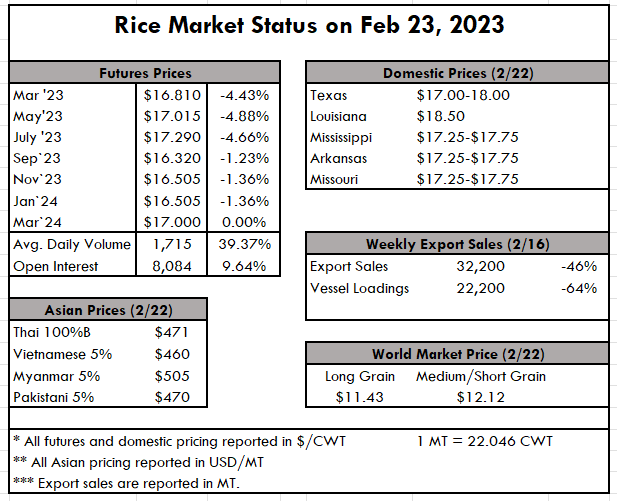
| The long-grain rice market remains on auto-pilot for a few more weeks as the industry awaits planting decisions. While it results in rather lackluster stories for reporting, the steady market is wonderful for producers and millers alike. The consecutive years of decreased supply have largely matched the reduced demand for milled rice out of Haiti and other key export markets, keeping prices stable for several months now. A recent USDA report revised U.S. exports sharply downward, now projected to be at the lowest level in 37 years. While this can be attributed in part to the acreage loss in California, the lion’s share of the decrease is the result of the loss of U.S. long-grain market share in Mexico and Central America. While the decrease in Calrose exports is entirely supply-driven (hence record high medium grain prices) the loss in the southern U.S. is more trade policy driven. A phasing out of longstanding trade agreements that increased market access in Central America, and with Mexico’s opening to alternative origins, is wreaking potentially longer-term havoc on the long-grain industry. Both rough and milled rice buyers in Mexico and Central America have the attention of Mercosur suppliers as the new harvest in that area is moving ahead. However, like elsewhere very unusual weather continues to affect and it gives the feeling that the crop is getting smaller by the day. “Until it’s cut, dried, and stored, we don’t know what we have”, said one Brazilian farmer. The changes in government policies for importing countries in an effort to maintain food prices are causing a change in buying habits. Costa Rica today must import 70% of long grain rice consumption needs. Brazilian rough rice currently hovers around $400/ton FOB. New crop sales for April deliveries are underway. You will notice in the January 2023 Brazilian Foreign Trade Report that the U.S. has become an important market for milled rice and we are told this is largely on the East Coast. In Asia, prices continued to soften slightly. Thailand dropped from $465 pmt last week down to $460 pmt this week, now directly in line with Vietnam which is also priced at $460 pmt. With these two origins now in concert, the market dynamics are very interesting and will largely boil down to currency valuations and logistical costs. The second crop harvest in Thailand is on the approach, which could source additional demand; in any case, having parity in these two regions, while not unheard of, is a rare occurrence. The volatility in the futures market this last week would indicate a divergence of thought in the carryover quantity for the current crop. It would seem that the ups and downs are largely on account of the current cash business at hand, attributed to the domestic milled business. That has to be the case, as the export sales numbers are so dismal it’s difficult to attribute much activity to that at all. The story of carryover will come to light soon, but it’s being worked out in the futures market now. One thing is certain, and that’s that if there is a carryover, it won’t be a large one. |
 |
In This Issue:
 |
| Lance Nicholas, 2022 Ray Stoesser Memorial Scholarship recipient, shares highlights from his visit to Washington, D.C. with USRPA as part of his scholarship prize. |
| As the recipient of the Ray Stoesser Memorial Scholarship, I had no idea how many doors this would open for me. I thought I was getting money to go to college but little did I know there was a new world at my feet. I am not a rice farmer. I am a rice advocate, and this is mainly due to the numerous amounts of opportunities USRPA has given to me. As an undergraduate at Texas Tech University studying agricultural education, I cannot say I am as surrounded by the rice industry as I was back home in Katy, Texas. The second I walk off campus, I see endless cotton fields and numerous cattle operations. However, I often find myself advocating for the U.S. rice industry whenever I find the opportunity when I am away from home. I do not do this strictly because of the scholarship. I do this because I believe rice is the sole crop essential in every country across the globe. Going to Washington, D.C., to advocate for the industry has left me with countless feelings of emotion, a new way to network, and very beneficial experiences. When I found out that I was going to go on this trip, I was scared. I had zero ideas what I was getting myself into. I am just a college student; how could I make a change by talking to these important people? This was something that I had to step out of my comfort zone for. I remember driving to the hotel, passing through all the landmarks, and being overwhelmed by the fact that I was there. As the week progressed, all the emotions of fear started to fade. By the end of the trip, I felt confident in my ability to bring change to the industry. The various USRPA members that attended helped me think I played a valuable role in this trip. Galen Franz, a rice farmer in Victoria, TX, was a great individual I interacted this week. Whether we were having a simple conversation or riding Lime scooters through the city, he made me feel that my voice had value. More importantly, interacting with him made me understand that the only difference between the other members was that I was not a rice farmer. We were all there with the same mission, and knowing this helped me feel confident in my abilities throughout the week. While the beginning of the week was stressful, by the end, all of those bad feelings left and brought in feelings of confidence, happiness, and contentment. I felt good knowing I was helping advocate for rice farmers in America. During this week, I got to network with some significant people. In addition, I got to understand the value of networking throughout this visit. Overall, I was glad I got to network with Vernie Hubert and Maggie Linden, from Cornerstone that worked with us throughout the week. I remember Tommy Turner, President of the Texas Rice Council, telling me to connect with Mr. Hubert as much as I could this week. In turn, that is precisely what I tried to do. By having beneficial conversations with him and asking him numerous questions, I felt that I was able to build a good relationship with him. Networking has always been important to me, but this trip brought me a new value behind the principle. Even outside the Cornerstone office, I found myself having meaningful conversations with people who worked on capital hill, whether it was legislative assistants or members of Congress themselves. I seek out those opportunities to build a connection with someone new because I never know when I will have the chance to meet these individuals again. Overall, speaking face-to-face with these individuals was a great experience, but it felt more meaningful for me to build a connection with them to network with a greater purpose. This was by far the best experience I could ever have asked for. I always knew that I wanted to go into teaching agricultural science, but this trip has made me rethink my future career. After talking to Dennis DeLaughter, a retired rice farmer, he made me realize that this is a unique experience most people do not get to have. I got to see American politics in a new light and from an entirely different viewpoint. I got to participate in meetings I never saw myself sitting in. I can take this chapter and put it into action as I begin a professional career. This brought up much reflection for me to understand what I could do. While my desired career is surrounded by agriculture, I could see myself taking what I learned and potentially going into agricultural policy, lobbying, or even working on a congressional or senate staff team. I can’t know what my future holds, but the experiences I got to have through these interactions will have me considering different options. I owe plenty of thanks to USRPA for this opportunity to advocate on the federal level. They are working towards the future of the U.S. rice industry and agriculture as a whole. By supporting college students, they are empowering them to be a part of some great things. This is only the beginning. To think about how many students they will impact makes me feel comfortable knowing that they are building the industry's future. This trip is something that I will take for granted. It would be foolish not to implement what I learned at the end of my life. USRPA is constantly pouring into today’s youth in the hopes of better-preparing students for a better future in agriculture. We look forward to Lance sharing more in future editions of The Rice Advocate as part of our new "Agriculture Tomorrow" series! |
 Blake Davis, MO Rice Council; Representative Jamie Burger; Mollie Buckler, USRPA; Rance Daniels, MO Rice Council; and David Martin, Missouri Rice Council Chairman. Members of the Missouri Rice Council spent the day in Jefferson City on Wednesday, educating and advocating on behalf of the state's rice industry. In addition to meeting with legislators, the group had the opportunity to visit with MO Department of Agriculture Director Chris Chinn and our friends at Missouri Farm Bureau. The beautiful murals in the background of the photo with Representative Jamie Burger were created entirely out of rice by students from Neelyville. The school group also visited the Capitol yesterday and had their artwork displayed in the Capitol Rotunda. The day ended with Senator Jason Bean's inaugural Taste of the South event, a fantastic event bringing together legislators with the great folks of SEMO and featuring favorite dishes from the bootheel. |
 |
| Thanks to Missouri Department Agriculture Director Chris Chinn and the Ag Business Development team for taking the time to visit. |
House Agriculture Democrats Announce New Members
On Thursday, Rep. David Scott (D-GA), the ranking member of the House Agriculture Committee, announced Reps. Salud Carbajal (D-CA), Angie Craig (D-MN), Chellie Pingree (D-ME), and Darren Soto (D-FL) would be joining the Committee for the upcoming congressional session. He also announced Del. Stacey Plaskett (D-VI) would no longer be serving on the Committee. Del. Plaskett served as the Chair of the Subcommittee on Biotechnology, Horticulture, and Research in the previous congressional session.
House Transportation and Infrastructure Holds a WOTUS Hearing
This week, the House Transportation and Infrastructure Committee held a hearing regarding the Environmental Protection Agency’s waters of the United States (WOTUS) rule. Witnesses, including the president of the Missouri Farm Bureau on behalf of the agricultural sector, explained how the current rule creates uncertainty and increases costs for farmers. They also argued the current rule is an overreach of the federal government.
| The conundrum persists: How does the U.S. long-grain industry compete in the export market when prices are still so high? News of Haiti returning and higher-than-normal export sales are encouraging, but very few of those sales are actually to Mexico, and cheaper rice from our competitors is likely to find its way into Haiti. Perhaps the only cure to this problem will be a significant increase in acres, but with the water problems in Texas, it is unlikely to see a rebound significant enough to bring prices back into a balance that will result in competitive pricing. We shall see, but for the time being, the market has learned to function in its current form, and domestic business is strong enough to support prices. On the ground, the market has remained fairly quiet in most places, namely Mississippi. Barge movements are light with little export business on the books. The story on medium grain is consistent across most states — if seed is available, it’s going to be planted. The expectation is that Arkansas is going to see a resurgence in long grain, but the magnitude of this expected return to “normal” is yet to be decided. In a few more weeks and we will have a much better direction on where the planting will go. A GAIN report on Argentina this week highlights the persistent drought in South America. With approximately 10% of the harvest complete, it is expected that farmers have been forced to abandon approximately 50,000 acres of rice on account of the drought in Corrientes and Entre Rios. Rainfall in 2022 was only half of the annual average, so producers who planted hoping for rain and surface water were sorely disappointed. This will ultimately result in a shorter exportable supply, with key export markets like the EU, Brazil, and Chile competing for the product. These dry conditions are having a significant impact on early-planted corn in the region as well. In Asia, we are seeing some price softening in Thailand, likely a result of the second crop supply about to hit the market. Prices have adjusted from approximately $485pmt last week to $470pmt this week. Adjustments in Vietnam were less severe, though a slight reduction is noted from $465pmt last week to $460pmt this week. While China will remain the world’s largest importer in 2023, the Philippines will soundly hold the second spot. They have historically sourced the majority of their 3.7 MMT from Vietnam, but because of reduced acreage this year, exports from Thailand are expected to double this year, reaching as high as 20% of total imports to the Philippines. Net sales of 59,400 MT for 2022/2023 were down 47% from the previous week, but up 36% from the prior 4-week average. Increases were primarily for Mexico (51,200 MT), Guatemala (5,000 MT), El Salvador, Saudi Arabia (800 MT), and Canada (300 MT). Exports of 61,700 MT were up 82% from the previous week and 56% from the prior 4-week average. The destinations were primarily Mexico (25,100 MT), Honduras (19,200 MT), Guatemala (10,000 MT), Canada (2,800 MT), and El Salvador (2,600 MT). |
 |
25722 Kingsland Blvd., Ste. 203, Katy, Texas 77494
Phone: 713-974-7423
USRPA does not discriminate in its programs on the basis of race, color, national origin, gender identity, sexual orientation, religion, age, disability, political beliefs, or marital/family status. Persons with disabilities who require alternative means for communication of information (such as Braille, large print, American sign language, language translation, etc.) should contact USRPA at 713-974-7423. EEO.