WASHINGTON, March 7, 2023 – The U.S. Department of Agriculture's Under Secretary for Trade and Foreign Agricultural Affairs Alexis M. Taylor will lead a delegation of 26 agribusinesses and farm organizations to Panama City, Panama, from March 19 to 23. The mission highlights export opportunities in Panama and throughout Central America and the Dominican Republic Free Trade Agreement (CAFTA-DR) region. Exports of agricultural products to Panama and CAFTA-DR countries reached a record $8.8 billion in 2022, up 57 percent from 2018.
Click here to read the complete press release.
White House Releases President’s Budget
On Thursday, the White House released President Biden’s budget request for the fiscal year 2024. The budget included $30.1 billion in spending across the Department of Agriculture (USDA), an increase of 14% from the fiscal year 2023. The largest increases at USDA were for nutrition and climate programs. The full budget can be found here.
USDA Provides Update on Assistance to Rice Farmers
USDA previewed its plans to provide $250 million in assistance to rice farmers. USDA announced once the official notice is published later this year, the Farm Service Agency (FSA) will mail prefilled applications to producers. These applications will use the information on file with FSA or the Risk Management Agency. USDA believes this will streamline and simplify the application process. USDA will provide more information when FSA announces the signup period in the coming weeks. The funding for this program was included in the Consolidated Appropriations Act of 2023. Read the press release here.
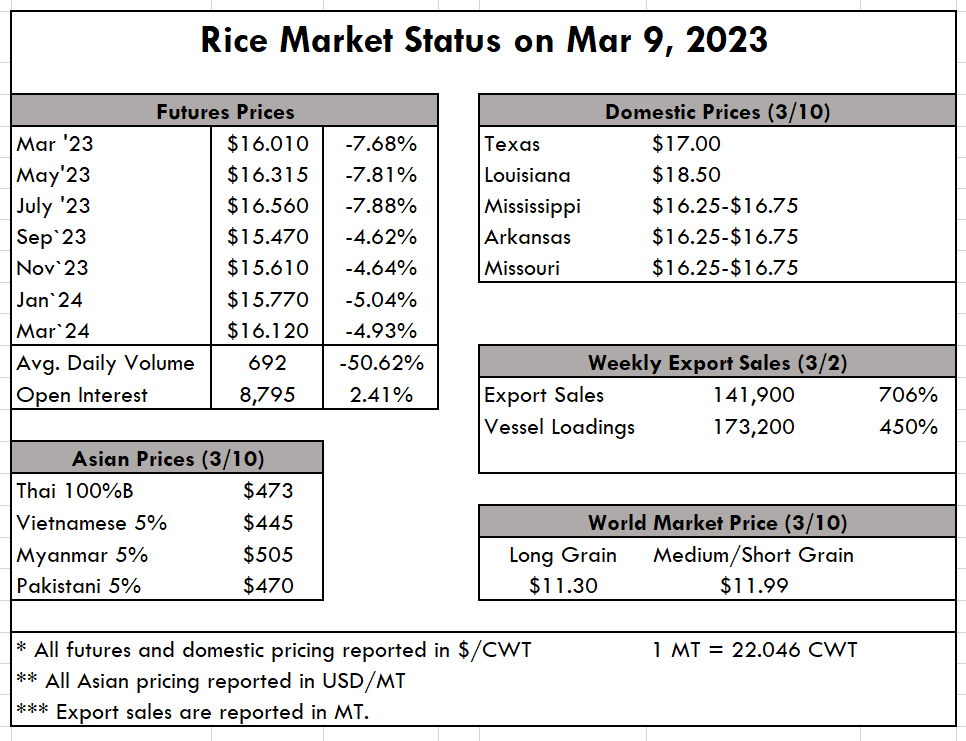
| The USDA World Agricultural Production report had a headline story this week, reporting that because of India’s larger-than-expected Rabi crop, the world’s largest exporter has notched yet another record crop for its third consecutive year. The Rabi crop typically accounts for approximately 30% of India’s total production, however this year it increased by 25%, offsetting losses that occurred during the primary kharif growing season. This doesn’t change the system matrix by any significant margin, but it is still stunning to see a recovery of such magnitude given the dry conditions seen in the earlier part of the year. Harvest of the Rabi crop will begin this month and end in late April where actual yield numbers will be derived. The supply and demand report for us here in the U.S. didn’t have terribly significant changes. The one thing that is being circulated in our conversations, but hasn’t made its way to the balance sheet yet, is the expectation that carryover is significantly higher than the reports are showing. It’s been week after week of dismal export sales reports (except for this week which set a marketing year high), and it’s well known that even with the strength of the domestic market and shorter crop these last two years, it’s not enough to offset the lean exports of rough and milled rice. There is potential for more Iraqi business, as well as the long shot for the Panamanian tender, but those are far from being baked into our calculations. The USDA Grains report corroborates the above news on India, showing that global rice production is now up because of the larger-than-expected Rabi crop being harvested in India. As a result, we anticipate exports will increase out of India, and regions like China, Nigeria, and Vietnam will import. While global consumption is expected to increase slightly, U.S. exports are at their lowest levels since 1985 on account of lost market share in Mexico and other countries in the Western Hemisphere. The below chart taken from the USDA report helps to visually explain why U.S. exports have been so low—it’s a simple function of a high price. And without favorable trade agreements, it is extremely difficult for the U.S. to compete in the current market. 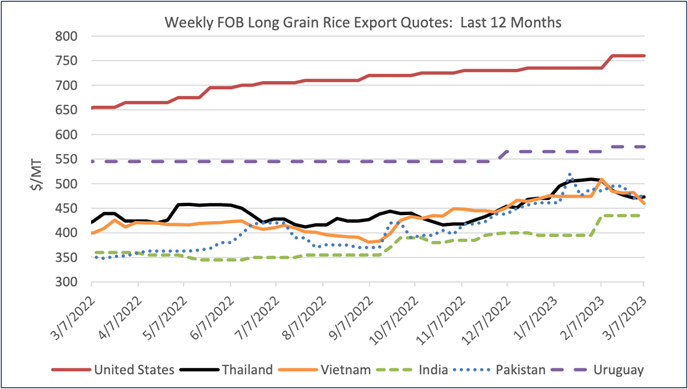 The FAO Rice Price update shows that the All Rice Price Index average dropped 1% this month down to 125.1. This is 22% above its level last year, where last month was the All Rice Price Index’s highest price in the last 12 months. 2022 was also the highest price year, with 2018 coming in second in the last five years. This would indicate that inflation is finally finding its way to rice where it has appeared to have a delayed effect. A small slowdown in demand had the largest impact in Thailand, where prices slid nearly 5%, further influenced by the depreciation of the baht against the U.S. dollar. The weekly USDA Export Sales report shows net sales of 141,900 MT this week, a marketing-year high, which is great news and up significantly from last week and the prior 4-week average. Increases were primarily for Colombia (65,000 MT), Haiti (41,300 MT), Mexico (24,800 MT), Iraq (4,000 MT), and El Salvador (2,500 MT). Exports of 173,200 MT, also a marketing-year high, were up noticeably from the previous week and from the prior 4-week average. The destinations were primarily Colombia (59,000 MT), Iraq (44,000 MT), Mexico (26,300 MT), Haiti (22,200 MT), and Guatemala (12,100 MT). |
 |
Robert “Bobby” Little lived his life serving his Creator, Community, Family, and the Western Rice Belt of the Texas Rice Industry," reminisces Tommy Turner, President of the Texas Rice Council who considered Bobby a dear friend.
"He would always go the extra mile to help someone and give the shirt off his back to someone in need. We miss you Bobby, but we know you are in Heaven, and in that we rejoice."
Donations in memory of Bobby Little may be made to St. Philip School, El Campo, TX.
In This Issue:
In This Issue:

The Missouri Rice Research & Merchandising Council hosted their 40th Annual Meeting this week at The Gathering in Dexter, MO. The program included updates from Dr. Justin Chlapecka, Missouri Rice Extension Specialist; John Hensley of Missouri Department of Agriculture's Ag Business Development team; Mollie Buckler, USRPA Chief Operating Officer and staff liaison to MRRMC. USRPA consultant Stuart Hoetger provided a market update virtually.
At the end of the event, MRRMC Outgoing Chairman David Martin recognized the council's incoming officers and recognized outgoing council member Justin Landers, who served MRRMC and USRPA for 16 years.


House Agriculture holds a hearing on challenges facing American agriculture
On Tuesday, the House Agriculture Committee held a hearing to discuss the challenges facing American agricultural producers and consumers. Members of Congress and witnesses discussed regulatory challenges regarding pesticides and waters of the United States, high input costs, impacts of global markets on domestic producers, consolidation within the agricultural industry, and challenges in the transportation sector. This was the first hearing in the House of the 118th Congress. A recording of the hearing can be found here.
Senate Agriculture holds a hearing on conservation and forestry
On Wednesday, the Senate Agriculture Committee held a hearing on forestry and conservation programs as it prepares for the upcoming farm bill. Members of the committee and witnesses from the Department of Agriculture discussed how the programs are currently operating and provided feedback on improving access in the future. During the hearing, Committee Ranking Member John Boozman (R-AR) noted the importance of flooded rice fields in providing habitat for migratory waterfowl and advocated for protecting both wildlife and rice farmers through farm bill conservation programs. A recording of the hearing can be found here.
House Transportation & Infrastructure votes to overturn WOTUS rule
On Wednesday, the House Transportation & Infrastructure Committee voted to advance a resolution overturning the Biden Administration’s WOTUS rule. The Committee voted on a party-line 30-22 vote to approve the Congressional Review Act resolution of disapproval. The resolution will now move to the House floor for full chamber consideration.
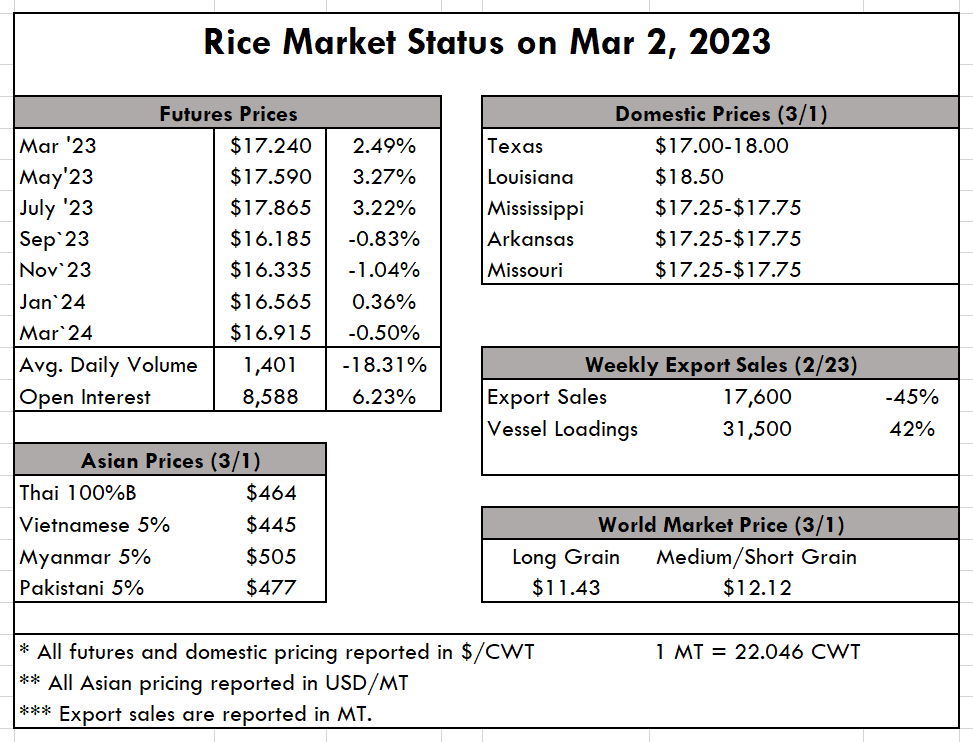
| It’s the moment we’ve all been waiting for — we are far enough into the year that we can put some numbers around the expected acreage this year. The good news is it is expected to be up from last year. The bad news is that it’s still far short of normal, and likely not enough to garner significantly more exports all things being equal. All acreages are estimates, and could still vary quite a bit in the coming weeks and months, but this will at least help offer some context as we move into next year’s intentions. To kick it off, we expect Arkansas to have increased its long grain acreage by 13%, up to approximately 1.15 million acres from 1 million acres last year. Medium grain acres are expected to increase by almost 15%, up to 150,000 acres from 106,000 acres last year. In all discussions medium grain related, save for California, acres are limited by seed availability this year. In Louisiana, long grain acres are looking to decrease about 5%, down to 350,000 acres, while the medium grain is expected to jump 25% up to 75,000 acres from 55,000 acres a year ago. So overall, Louisiana will produce the same acreage, just more of it will go to medium grain. Mississippi looks to be rebounding this year, expected to increase about 25% up to 115,000 acres from only 85,000 acres last year. All are expected to be long-grain. Missouri is expecting a significant bump in acres as well, to the tune of a 20% increase. All of that will come in the form of long-grain rice, moving from 150,000 acres last year up to 190,000 acres this year. Texas is the stand-alone reduction of all the rice-producing states but on account of drought. It’s expected that the Lone Star State will decrease by nearly 30%, down to 145,000 acres from last year’s number of 190,000 acres. And moving to the west coast, the rain and snow in California have finally arrived, and expectations are that medium grain acres will reach at least 425,000 acres this year, with many optimistic it will be even more than that. In summary, total long grain acreage is expected to be about 1.9 million acres in the coming year, up 8% from last year’s 1.8 million acres. Medium grain acres are expected to be 660,000 acres, up 35% from last year’s 420,000 acres. And in total, all acres are looking to be 2.6 million acres, up 15% from last year’s 2.22 million acres. In 2020 when long grain acres were 2.33 million, the average farm price was $12.60, and in 2021 when long grain acres dropped to 1.97 million, the average farm price bumped a dollar up to $13.60. In the current marketing year with 1.8 million acres of long grain, the average farm price sits at $16.90. The 2023 estimates of 1.96 million acres of long grain look most like the 1.97 million acres of 2021 when the average farm price was $13.60; however, a lot has changed since then with inflation and cost of inputs, so it is difficult to gauge with accuracy specific pricing. What we do know is that exports have reached all-time lows, and we need additional supply, trade servicing, and strong trade relationships to see a re-energized export market. The weekly USDA export sales report shows net sales of 17,600 MT for this week, down 45% from the previous week and 69% from the prior 4-week average. Increases primarily for Japan (13,200 MT), Canada (3,400 MT), Saudi Arabia (600 MT), and Austria (300 MT), were offset by reductions for Honduras (100 MT). Exports of 31,500 MT were up 42% from the previous week, but down 14% from the prior 4-week average. The destinations were primarily Japan (26,000 MT), Canada (2,400 MT), Mexico (2,100 MT), Austria (300 MT), and Saudi Arabia (300 MT). |
 |

25722 Kingsland Blvd., Ste. 203, Katy, Texas 77494
Phone: 713-974-7423
USRPA does not discriminate in its programs on the basis of race, color, national origin, gender identity, sexual orientation, religion, age, disability, political beliefs, or marital/family status. Persons with disabilities who require alternative means for communication of information (such as Braille, large print, American sign language, language translation, etc.) should contact USRPA at 713-974-7423. EEO.