| Last week, the US Rice Producers Association (USRPA), together with our promotions team in Guatemala, organized a series of activities where moms were the central focus to commemorate Mother's Day. To culminate the week of celebrations, on Saturday, May 10, Mother’s Day in Guatemala, we cooked a giant paella to celebrate and honor all mothers. The heartfelt event took place at Eskala Roosevelt, a popular local shopping mall, and brought families together around a flavorful rice dish. It was a joyful occasion that underscored the importance of love, family, and tradition, while highlighting the cultural richness and versatility of rice as a staple in celebrations. Iris Figueroa, Western Hemisphere Marketing Manager for USRPA, emphasized the value of these initiatives, stating: “Incorporating these kinds of cultural and family-centered activities into our promotional programs is essential. They not only strengthen our connection with consumers but also create memorable experiences around rice, showcasing its role in cherished moments and traditions.”  |
  |
| House Ag Advances Reconciliation Bill Out of Committee Starting Tuesday night and lasting until Wednesday evening, the House Agriculture Committee held a marathon markup of its budget reconciliation text, complying with the instructions given by the House Budget Committee in H. Con. Res. 14 Section 2001(b)(1) to cut a net of $230 billion within the Committee’s jurisdiction. After nearly a 15-hour process, the Committee ended up reporting the bill favorably out of Committee on a party-line vote of 29-25. While the Committee was instructed to cut $230 billion, the bill reflected a score closer to $300 billion in cuts in order to reinvest the additional $60-70 billion in savings across all titles of the farm bill except for Title IV (Nutrition), where most cuts were focused. Republicans defended the rescissions to the nutrition title, claiming that the increasing administrative costs of the Supplemental Nutrition Assistance Program (SNAP) should require state governments to become more responsible when administering and regulating food assistance programs, specifically with regard to enforcing work requirements. Additionally, Republicans highlighted that modernizing the farm safety net for farmers and ranchers must be at the forefront of the reconciliation bill. Democrats heavily criticized the Republicans’ bill, arguing that the SNAP program helps families access food and reducing the nutrition title’s funding would decrease benefits and cause many to go hungry, and emphasized that many states would not be able to adequately cover the cost share of the program. Moreover, Democrats stated that sufficiently funding SNAP would increase food demand, benefiting agricultural producers. From a commodity lens, the bill included increases to reference prices and enhancements to the crop insurance title. Additionally, funding for trade promotion priorities such as the Market Access Program (MAP) and Foreign Market Development (FMD) program was doubled, as they were in the last Congress’s farm bill. In addition to Ag, the House Ways and Means Committee advanced its bill extending the provisions in the 2017 Tax Cuts and Jobs Act (TCJA) as well as several other favorable agricultural tax-related measures. Now that all the Committees given reconciliation instructions have held their individual markups, the House Budget Committee will assemble and ready the bill for consideration. Speaker Mike Johnson (R-LA) has indicated that he intends to have the House Rules Committee consider the bill next week, with the hopes of being able to then call a vote on the House floor before the Memorial Day recess. Many Republican holdouts remain, making the bill’s pathway forward towards passage uncertain. You can find the text for the Committee’s print here, and can watch part 1 of the markup here and part 2 here. White House Announces Trade Deals in the Works with China and the U.K. Last weekend, talks regarding a potential U.S./China trade agreement began to surface. On Monday, the White House announced that a potential trade deal with China is in the works that would significantly reduce the current tariffs on trade for 90 days while negotiations between the two countries continue. With this, the U.S. plans to reduce its reciprocal tariffs on China from 145% to 30%, while China is cutting its tariffs on US imports from 125% to 10%. The temporary de-escalation of these tariffs aims to further negotiations toward a more comprehensive trade deal between the US and China. Also recently, President Trump announced a trade agreement between the U.S. and the U.K., with the intent of strengthening relationships and market access for American agriculture. President Trump and U.K. Prime Minister Keir Starmer held talks at the end of last week and reached an agreement on the new deal, which is expected to be finalized in the coming weeks. It is understood that the deal will aim to streamline the customs process for U.S. agriculture, eliminating many of the non-tariff trade barriers that restrict U.S. agriculture’s access to the U.K. market. These negotiations do not impact the overall 10% tariff on British imports, which remains the baseline, like many other countries following the April 2 announcement. |
| Planting is wrapping up in some states, while it’s going full speed in California. Overall, we are still ahead of schedule, and the total acres lost is looking to be closer to 300,000 acres in total, the majority coming from Arkansas where the intense flooding took out a majority of these acres. More direct impact in the coming weeks on total acreage loss expectations. It remains difficult to find any cash prices, and futures have been on the doldrums too. Recent USDA reports indicate a lack of accurate and transparent stocks and made no adjustment for acreage in the Delta due to preventive planting and constant wet weather. It's raining now in northeast Arkansas and southeast Missouri, and severe storms are predicted for the days ahead. With a conservative acreage and production reduction, combined with a confirmed lower stock report reducing old crop carryover, ending stocks would be reduced significantly even with conservative numbers. We realize the USDA requires solid data, as they say. Lower supply certainly supports price and the USDA for now appears to be saying higher supplies are ahead of us. This market and especially rice farmers need this information in the marketplace. These current market conditions are the most difficult since the 1980s. The large crop in South America is putting a weight on new U.S. crop expectations. A number of recent sales out of Argentina, Paraguay, and particularly Uruguay have been confirmed to Mexico and Central America. Foreign exchange with Brazil is keeping those prices $10-$12 per ton FOB above its neighbors for now.The most recent Grain: World Markets and Trade report shows global rice production is projected to hit a record 538.7 million tons, up 1.0 million tons from last year. The increase is led by India, which maintains its position as the top producer for a second straight year, thanks to strong government support. China is also expected to slightly increase output. Together, these two countries contribute over 50% of the world’s rice production. Global consumption is also forecast to reach a record 538.8 million tons, up 6.1 million tons from the prior year. India’s consumption will hit a record 125.0 million tons, supported by government food programs and limited use in ethanol production. In China, consumption remains steady, with low feed use and cheaper coarse grains influencing demand. Growing populations are driving increased consumption in Sub-Saharan Africa, South Asia, and the Middle East. Global rice ending stocks are forecast nearly unchanged at 185.1 million tons, with China and India holding 80% of reserves due to public stockpiling. U.S. ending stocks are projected to rise 6% thanks to higher beginning stocks, while China and Thailand also expect stock gains. In the Western Hemisphere, imports are expected to increase modestly. The U.S. will likely import more due to demand for specific varieties, and Mexico’s imports are driven by population growth and reduced supply of alternative grains. Brazil, however, may reduce imports as domestic prices stay competitive. |
 |
The weekly USDA Export Sales report shows net sales of 29,900 mt this week, down 49% from the previous week and 11% from the prior 4-week average. Exports of 71,900 MT were up 67% from the previous week and 28% from the prior 4-week average.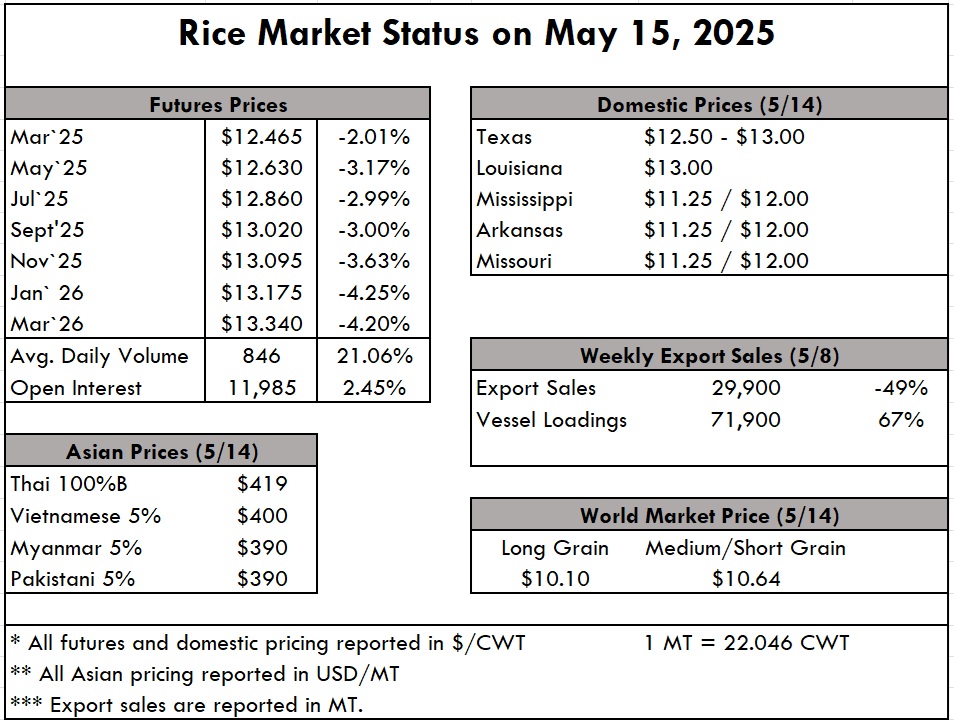 |


 |
“Maintaining the navigability of the channel is critical to ensuring ongoing vessel access and expanding export opportunities for SLRF rice,” stated Mark Pousson, USRPA board member and South Louisiana Rail Facility General Manager, following his visit to Washington, D.C. with the Port of Lake Charles delegation. “Advocating for consistent channel maintenance and dredging is essential to supporting the long-term success of our regional economy and agricultural exports. We’re grateful for the time and attention of House Speaker Mike Johnson, who took a moment to meet with us during our visit.”
Secretary Rollins Testifies before both House and Senate Appropriations:
This past week, U.S. Department of Agriculture (USDA) Secretary Brooke Rollins took to Capitol Hill and testified before both the Senate and House Appropriations Subcommittees on Agriculture, Rural Development, Food and Drug Administration, and Related Agencies. Generally, Democrats and Republicans alike agreed that the President’s fiscal year 2026 budget request must sufficiently fund the USDA to best support farmers, ranchers, and families in rural America. Members of the Subcommittee emphasized the importance of the USDA releasing the $20 billion in natural disaster relief funding that was appropriated through last December’s continuing resolution.
Republicans commended Secretary Rollins for prioritizing producers and facilitating efforts to eliminate wasteful spending within the Department. Additionally, Republicans discussed Supplemental Nutrition Assistance Program (SNAP) reform, expanding foreign market accessibility, and protecting domestic farmland from foreign ownership. Democrats argued that the FY26 request inappropriately cuts nutrition programs that support schools and foreign countries. Further, Democrats raised concerns about staff reductions, funding freezes at the USDA, and how the Trump Administration’s tariff policy has exacerbated financial hardships in rural America. You can watch the Senate Agriculture Appropriations hearing here and the House Agriculture Appropriations hearing here.
Trump Administration Releases Budget Framework:
Late last Friday, President Trump released the Administration’s budgetary framework, calling on Congress to cut non-defense programs by more than $163 billion while leaving defense programs relatively untouched. This FY26 spending framework furthers the Administration's goal to prioritize government efficiency and cut wasteful spending by making major cuts to many agency funds. In particular, this budget would bring $4.5 billion in cuts to the U.S. Department of Agriculture. Additionally, it proposes $500 million in support of the “Make America Healthy Again Movement”, which plans to operate in place of the current Commodity Supplemental Food Program. While the President does weigh in on budget-related decisions, Congress still holds the “power of the purse.” This means that while the Administration has made their initiatives known, members of Congress still have ultimate decision-making power in any upcoming budget decisions. You can find more details on the President’s simplified budget here.
Thousands of USDA Employees Resign:
Recently, it was reported that at least 15,000 USDA employees have resigned as part of the Trump Administration’s deferred resignation program (DRP). Roughly 800 USDA employees signed up for the program during the first DRP in January, while the recent program push received 11,305 resignations. The program allows employees to quit and be paid through September 2025, which has helped the Administration cut USDA’s workforce down by 15%. Of these resignations, 555 are employees at the Food Safety and Inspection Service, over 1,000 from Farm Service Agency county offices, 4,000 employees from the U.S. Forest Service, 1,300 from the Animal and Plant Health Inspection Service, 1,255 employees at the Agricultural Research Service, 78 employees from the Economic Research Service, 54 employees from the National Institute for Food and Agriculture, and 243 employees from the National Agricultural Statistics Service will resign. This is part of a larger initiative by the Trump Administration that aims to eliminate 30,000 jobs within the agency.
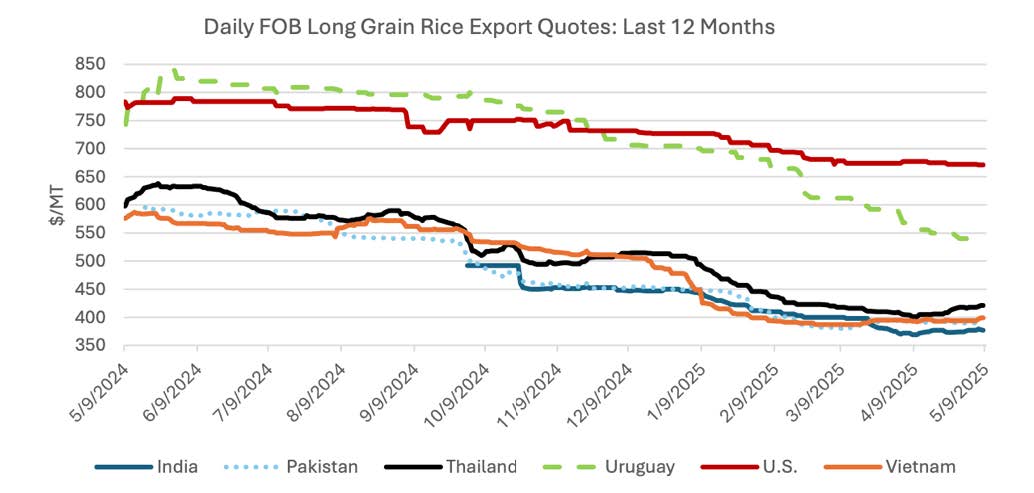
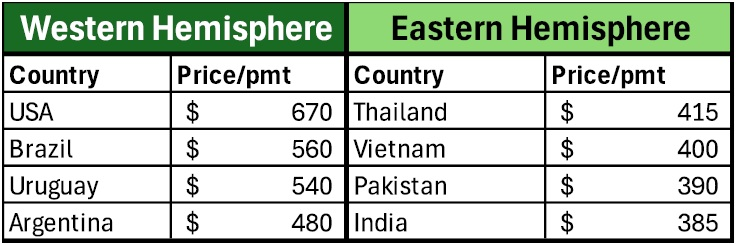
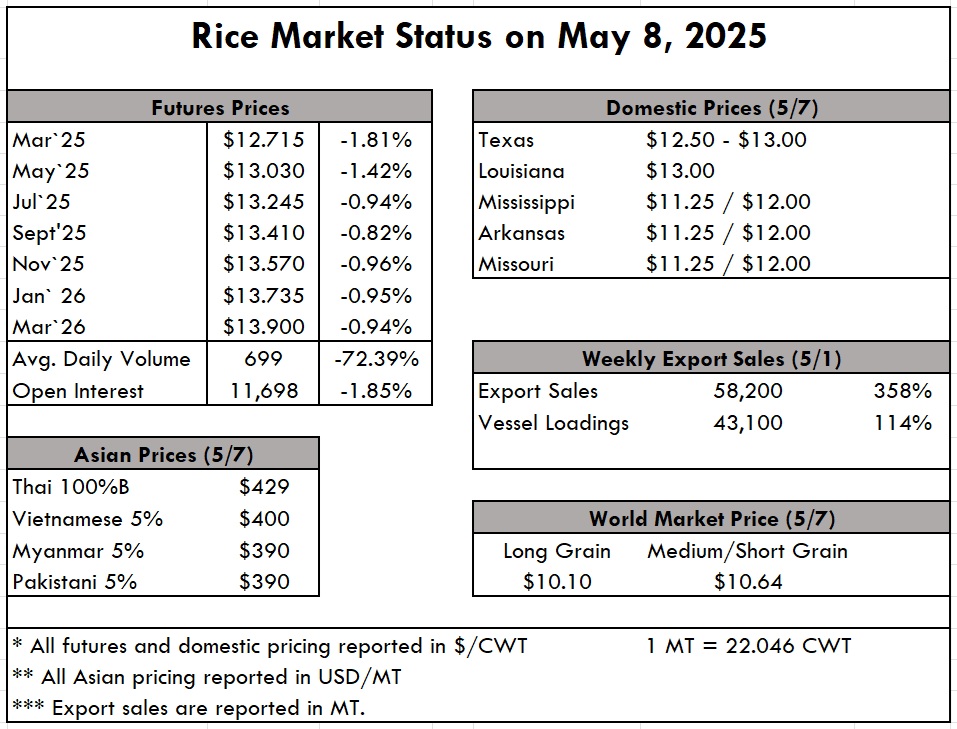
Rice markets are increasingly competitive globally, from the Americas to the Near and Far East. All origins are aggressively fighting for export share. U.S. milled white rice remains the most expensive globally at $670/MT, yet this is still 16% below last year’s price. Many Asian origins have seen price drops of over 30%. Newly announced U.S. tariffs on Thai rice are raising concern in Bangkok. At the same time, U.S. producers and marketers see a rare opportunity to grow domestic market share and possibly regain ground long term.
Domestically, a large crop is going into the ground, putting downward pressure on new crop price expectations. Yet the full impact of weather-related acreage losses and weak grower economics is still unfolding. As of May 4, the Crop Progress Report shows rice planting across the six major states is 73% complete, ahead of both last week (64%) and the five-year average (64%). Arkansas (77%) and Mississippi (74%) are ahead of average, while California trails at 35%. Emergence is also ahead of schedule nationally at 54%, compared to the 42% five-year average, with Louisiana (90%) and Texas (85%) leading. California has not yet reported emergence, consistent with its later planting window.
On-the-ground prices remain unchanged. Texas is holding at $12.50–$13/cwt, Louisiana at $13, and Mississippi, Arkansas, and Missouri between $11.75–$12/cwt.
Globally, the April FAO All Rice Price Index edged up 0.8% from March to 104.9, though it remains 22.6% below year-ago levels. The increase was driven solely by modest firming in historically weak Japonica and Fragrant rice markets. Indica prices were mostly flat, while glutinous rice slipped 4.1%.
U.S. weekly Export Sales reached 58,200 MT, up sharply from both the previous week and the 4-week average. Exports totaled 43,100 MT, up week-on-week but 15% below the prior 4-week average.
 |

25722 Kingsland Blvd., Ste. 203, Katy, Texas 77494
Phone: 713-974-7423
USRPA does not discriminate in its programs on the basis of race, color, national origin, gender identity, sexual orientation, religion, age, disability, political beliefs, or marital/family status. Persons with disabilities who require alternative means for communication of information (such as Braille, large print, American sign language, language translation, etc.) should contact USRPA at 713-974-7423. EEO.