| Getting in the fields was a top priority for Missouri farmers this week, as the weather turned favorable for planting conditions. Dodging tornadoes has become another challenge in the delta. This is a welcomed development, as Missouri is the only southern state that didn’t register on the crop progress report on April 3, though a close second was Mississippi with only 1% in the ground. Louisiana is showing 68% planted, but it would appear they are a bit beyond that at the time of writing. Arkansas is at 5% planting, on trend with the 5-year average, and Texas is at 35% planted, well below the 5-year average of 49% at this time of year. Though California is never planted this early, there has been zero field work done because of rainstorms that keep coming, along with cold, windless weather that is not conducive to drying out the heavy clay soil. With each new storm, speculation is that fewer medium grain acres will be sown because of prevented planting. Overall, the market is looking forward to a successful planting season with an increase of acreage in all states, except Texas where drought has handcuffed farmer planting intentions. There was a slew of USDA GAIN reports recently published, and we will summarize relevant information for the rice industry in Peru, Ecuador, and Mexico this week. We will look at Venezuela and Ghana next week. In Peru, grain production as a whole has been impacted by a prolonged drought in 2022, and now flooding in 2023. The rice area harvested is expected to decrease by 1.4% this year, down to 1.013 million acres. Rice is a staple food in Peru, with a per capita consumption of 163 pounds per year. Filling the gap from a decreased production figure will come in the form of more imports. Unfortunately, U.S. rice is not price competitive, so the additional rice is expected to come from Brazil and Uruguay, where the countries enjoy a market share of 57% and 41%, respectively. Just this week new sales from Brazil were noted for Guatemala, El Salvador, Mexico, etc. In Ecuador, rice is a staple food where nearly all 773,000 acres of harvested rice are consumed domestically, save for appx 100,000 acres that are reserved for export business. The primary export customers are Colombia and Peru. In Ecuador, the per capita consumption is 110 lbs per year. Rice imports are politically sensitive in Ecuador because rice self-sufficiency has been highly promoted by the government. The government has set farm gate prices at levels significantly higher than prices in the world market and neighboring countries to encourage plantings to achieve this goal, and ultimately export excess supplies. In Mexico, the post expects the import figure to remain at 800 TMT for another year, but with a larger percentage of that rice coming from non-U.S. suppliers because of anti-inflationary policies and the continued loss of market share in the region. Post does expect the planted area to decrease slightly in Mexico, however, because farmers are facing so many pressures. Domestic rice now competes with lower priced zero tariff rice under the anti-inflation programs, and with rising input costs, rice is not the preferred crop to grow that it once was. These issues will be an important focus of the Rice Market & Technology Convention scheduled to take place in Puerto Vallarta, Mexico, from May 31 through June 1. Go to www.ricemtconvention.com to register. In Asia, there was a significant announcement made by the government of Indonesia to import 2 million metric tons to replenish emergency stocks. While this doesn’t come as a complete surprise, it does provide more strength to an already firming market in the far east. Viet prices bumped again slightly to $470pmt, and Thai prices remain firm at $480pmt. There is chatter that India is perhaps relaxing their tariff, which could dampen any price rises that may come about from this announcement. |
 |
In This Issue:
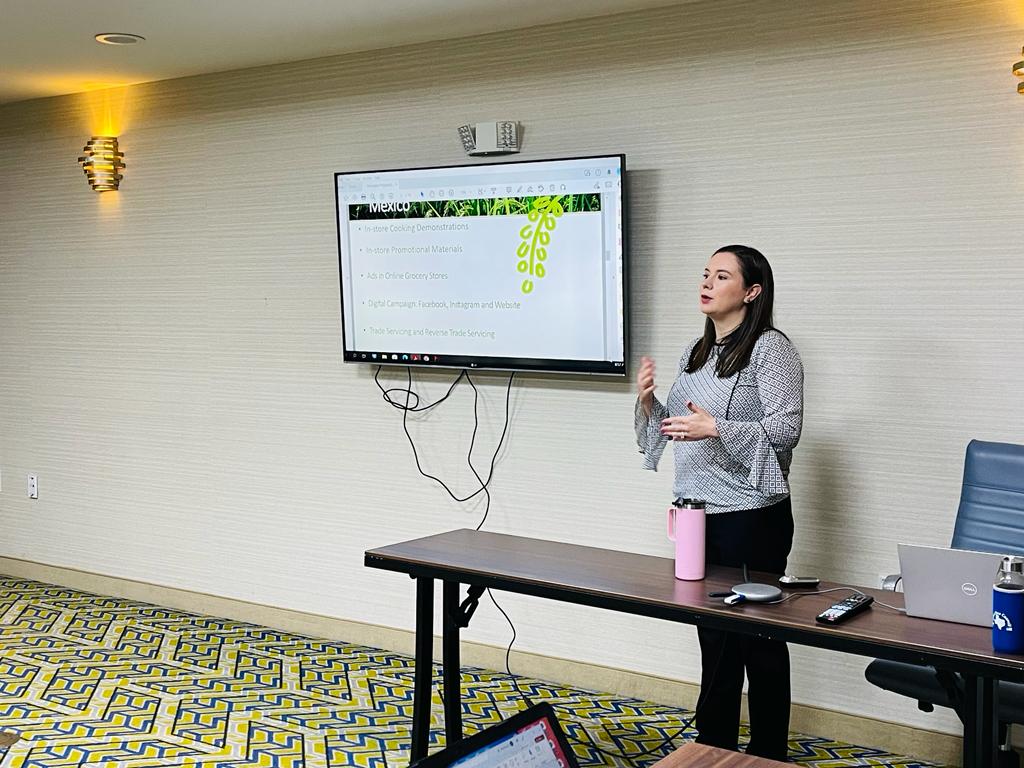
USRPA President & CEO, Marcela Garcia visited and spoke to the Rice Leadership Class in Katy, TX while they visit the Gulf Coast. The class consists of seven rice industry professionals: Christi Bland, Sledge, Mississippi; Justin Chlapecka, Portageville, Missouri; P.J. Haynie, Pine Bluff, Arkansas; Jarod Holzhauer, Gillett, Arkansas; Charles Payne, Lafayette, Louisiana; and Alex Struckmeyer, Arbuckle, California. Among the topics discussed were overseas markets, trade issues, and market enhancement strategies.


For the past few years our annual opening speaker, Dennis DeLaughter, has guided the conference participants through the world rice market and economic complications. Those upside-down situations and the market atmosphere were skillfully addressed by expecting the unexpected and looking at unintended consequences.
Where do we go from here? What is it that you may be missing today that you are not thinking about? Making market assumptions can lead rice farmers and mills down a crooked road. Assessing a number of factors can certainly smooth out a few bumps along the road to profitability.

USRPA signs on to support estate tax repeal
This week, USRPA signed on to a letter to Senator John Thune (R-SD) thanking him for supporting family-owned businesses and farms by introducing the Death Tax Repeal Act of 2023, which would eliminate the estate tax. A copy of the letter can be found here.
Senate votes to repeal WOTUS Rule
On Wednesday, the Senate voted to overturn the Environmental Protection Agency’s rule regulating the waters of the United States (WOTUS) on a 53-43 vote. Sens. Joe Manchin (D-WV), Jacky Rosen (D-NV), Catherine Cortez Masto (D-NV), Jon Tester (D-MT), and Kyrsten Sinema (I-AZ) joined the Senate Republican Caucus on the vote. The measure passed in the House in March and will now be sent to the President’s desk. President Biden is expected to veto the measure and the Senate will likely not have the votes to overturn the veto.
Secretary Vilsack testifies before Congress
This week, USDA Secretary Tom Vilsack testified before the House Agriculture Committee as it prepares for the upcoming farm bill. He also testified on President Biden’s budget request for the fiscal year 2024 before the House and Senate Agriculture Appropriations Subcommittees. Throughout these hearings, members questioned the Secretary on USDA’s reevaluation of the Thrifty Food Plan which resulted in increases in spending for nutrition programs. Members also emphasized the importance of a strong farm safety net and disaster relief.
| The United States Trade Representative (USTR) made it very clear this week that trade agreements and tariff cutting are not on the Biden trade agenda. While this news is not new, it is a stark abandonment of one of the most effective tools the rice industry and the entire U.S. agricultural complex can utilize to compete in a global market. This is especially poor timing given the expiration of the CAFTA-DR trade agreement that has been fundamental in the structure of the importation of U.S. rice into Central and South America. A report this week put to rest any hope the agricultural interests have when U.S. Trade Representative Katherine Tai stated, “At this moment we do not have tariff liberalization negotiations going on with a partner.” The USRPA still strongly believes that trade agreements need to be pursued, because “free trade” doesn’t mean “fair trade,” and when other governments are over-subsidizing rice production, it puts the U.S. industry at a disadvantage. The expiration of CAFTA-DR isn’t the only obstacle that the U.S. rice industry is facing, nor is it the only reason that exports have cratered nearly 40% this year. Another impact that has helped create this perfect storm is the policies many of our key export markets implemented to protect their citizens against soaring food inflation. These key markets in the Western Hemisphere, Mexico and El Salvador to name two, removed tariffs on rice imports to minimize the impact of food inflation, thereby putting the U.S. at a disadvantage. Add this to a politically volatile climate in Haiti, our key milled export market, and it’s no wonder exports have slumped. The smaller crop over the last three years has oddly helped this predicament, but with a new and larger crop expected this year, there is still hope for a positive outcome. Turning to that optimism and planting of the new crop, cold weather has slowed the progress of the Louisiana crop a bit, but not to a detrimental level. Texas is also moving ahead, probably just now crossing the halfway point of being planted. Mississippi is getting optimistic about the size of its crop (at least compared to last year) with 110,000+ acres being likely. Arkansas and Missouri are looking up as well, but the picture will be much clearer in a few more weeks. The strong domestic market is hoping for a stable growing season to produce high-quality rice with solid milling out turns, and exporters want the same because they are expecting that with a larger crop will come more competitive pricing. There are a lot of moving pieces at the moment, but things will settle once planting is complete. In Asia, prices rallied for a second straight week, specifically in Thailand where white 5% is now registering at $480 pmt, up from $465 pmt last week. Viet bumped as well, though not as much, up to $465 pmt from $460 pmt. There is strong demand in the eastern hemisphere, but the wild card will be India. Recall that we reported their rabi crop is much larger than expected—large enough to register another record crop. When these supplies come to market, the Indian government will have to re-evaluate its tariff program and its exportable supply. This could certainly shock the Thai and Viet prices, but until then, the market is firm. |
 |
In This Issue:
Senate EPW Committee Holds Hearing on EPA Budget Request
On Wednesday, the Senate Committee on Environment and Public Works held a hearing on the President’s Fiscal Year 2024 Budget Request for the Environmental Protection Agency (EPA). Senators questioned EPA Administrator Michael Regan about policy and funding priorities at the Agency, including regulation of waters of the United States (WOTUS). Administrator Regan acknowledged the Agency’s rule will be impacted by the Supreme Court’s ruling in Sackett v. EPA but reaffirmed that the Agency was operating within its authority in issuing the rule. A recording of the hearing can be found here.
As part of USRPA's international program to promote U.S. rice around the world, USA Arroz visited Escuela Oficial Urbana Mixta No. 810 Jornada Matutina Zona 1 in Santa Catarina Pinula in Guatemala. They gave a demonstration about how to cook U.S. rice and prepared rice to serve the students.
Santa Catarina Pinula is a town with a population of 70,982 and a municipality in the Guatemala Department of Guatemala, which includes Guatemala City and its suburbs.




25722 Kingsland Blvd., Ste. 203, Katy, Texas 77494
Phone: 713-974-7423
USRPA does not discriminate in its programs on the basis of race, color, national origin, gender identity, sexual orientation, religion, age, disability, political beliefs, or marital/family status. Persons with disabilities who require alternative means for communication of information (such as Braille, large print, American sign language, language translation, etc.) should contact USRPA at 713-974-7423. EEO.