| On May 5, USDA FSA announced it will begin sending prefilled applications to rice producers for the Rice Production Program (RPP), which will provide up to $250 million in assistance to rice farmers. FSA is using the information on file with the USDA Risk Management Agency, as reported by rice producers through their insurance agents. Producers need to complete their application and return it by Monday, July 10, 2023. Initially, FSA will make a payment to eligible producers at a reduced payment rate of one cent per pound, but if funds remain, a second payment may be issued. Funding for this program was included in the fiscal year 2023 omnibus appropriations bill passed in December 2022. |
| Planting continues to race forward in most states, as the entire complex is nearly 10% ahead of normal pace, while rice emerged is almost 15% ahead of the 5-year average. Louisiana continues to lead the pack with 94% planted and 88% emerged. Texas is just behind with 89/79, then comes Missouri at 85/61, followed by Arkansas with 79/56, Mississippi with 66/45, and California with 15/1. Conditions on the west coast have finally improved with warm weather on the horizon, and nothing impeding planting progress in the 10-day forecast. Turning to the market, things are stable at the moment. With very little old crop to source, executing any sales at sizable volumes is difficult. This isn’t a problem because exports have been so low this year, and the fresh demand from Haiti isn’t in portions large enough for additional upward pressure. What could put a strain on domestic business, however, is the Bud Light debacle with the Dylan Mulvaney promotion. The market loss in excess of $5 billion has been widely publicized in the news, but it’s important to remember that Anheuser-Busch is the largest domestic buyer of U.S. rice. If people stop drinking Bud Light and other AB products, AB stops procuring rice. This is a moral dilemma for some that we’re not here to help you through, but the facts are the facts, and poor sales of Bud Light hurt the rice industry. Today’s USDA supply/demand report is considered bullish with lower carryover numbers. The summer months are typically quiet by way of new sales for the U.S., but it will be important to track the intrusion of rice from new markets. We know Brazil into Mexico is a problem that was highlighted by the anti-food inflation policies that Mexico enacted. But a potentially more significant problem could be Southeast Asian rice. Current Asian values have risen, making business in Mexico reportedly “unfeasible.” However, bulk-milled rice from Thailand to Veracruz, Mexico that was purchased prior to the price increase is apparently on the water. Cheap rice from Pakistan to Cuba is also moving east to west, and paddy rice from Uruguay has won a tender in Costa Rica that was exclusively for Mercosur origin. None of this is good news, and the hope is that a larger U.S. crop at harvest will help gain back these markets. And as we all know, until the U.S. crop is harvested, dried, and stored, we don’t know what we really have to market. In Asia, firm pricing on strong demand prevails. Thai 5% is holding steady at $495pmt, with Viet just behind at $490pmt. India remains at $440pmt, and Pakistan at $540pmt. Exports from Thailand and Vietnam are both ahead of last year on strong demand, as India is keeping pace, indicating that Thai and Viet rice aren’t increasing at India’s expense. The weekly USDA Export Sales report shows net sales of 30,600 MT this week, down 34% from the previous week and 15%from the prior 4-week average. Increases primarily for Honduras (20,000 MT), the Dominican Republic (6,000 MT), Jordan (1,700 MT), Mexico (1,700 MT), and Canada (700 MT), were offset by reductions for Venezuela (200 MT). Exports of 8,500 MT were down 80% from the previous week and from the prior 4-week average. The destinations were primarily to Canada (2,800 MT), Mexico (2,500 MT), Jordan (1,700 MT), Saudi Arabia (600 MT), and the United Kingdom (400 MT). 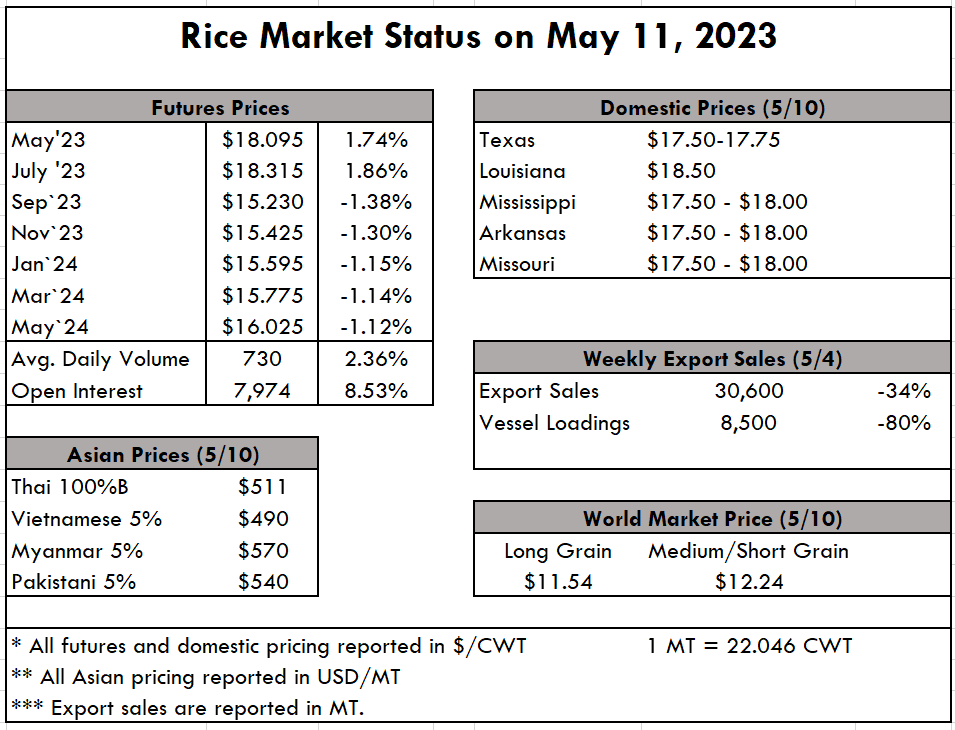 |
In This Issue:
USRPA President & CEO Marcela Garcia was on the road in Missouri this week, meeting with USRPA Chairman Alex Clark at his farm near Poplar Bluff and attending the monthly Missouri Rice Council meeting at the Council's research farm near Glennonville.

Senate Agriculture Holds Farm Bill Hearings
This week, the Senate Agriculture Committee held two farm bill hearings:
On May 2 they received testimony from producer organizations as well as representatives from the American Farm Bureau Federation and the National Farmers Union. Producers noted the need to improve crop insurance and the farm safety net. Other issues discussed include disaster support and support for young and beginning farmers. Representing rice, Rich Hillman discussed how rice is more susceptible to changes in market conditions, noting the impacts of increases in input costs and inflation. He advocated for increasing reference prices and adjusting program payment limitations.
The May 4 hearing included testimony from bankers and insurance interests.
| The crop continues to be sown nationwide, with Louisiana now showing 89% planted and 83% emerged. Texas is 83/69, and Arkansas is progressing nicely at 68/34. Missouri was able to get more rice in the ground much earlier than normal, but cold weather is keeping progress at bay; reports show 73% planted and only 31% emerged. Mississippi registered at 53/32 this week, and California finally got on the board at 5% planted with nothing emerged so far. In California, the concern has been realized as wet and cold weather has persisted, thereby slowing planting. There are reports of severe thunder cells opening up over rice regions on the west side of the Sacramento River; this will only put large farmers further behind and most likely result in a reduction of acreage come June 1. In light of the attention given the medium grain market this year, a GAIN report on Australia was released this week. Post estimates milled rice production at 500,000 MT for 2023/24, up 39% from the 2022/23 estimate. It’s important to remember that this is talking about a crop that will be planted in October 2023, assuming good conditions persist and ample water supplies remain. Australia has largely been out of the medium grain export game for the last five years, except for a few boats to California this year, and a return to 500,000 MT would be almost 40% more than the previous 10 year average and the largest crop since 2016/17. Perhaps the most significant news coming from the report is that 500,000 MT is expected to be on the top end of Australian rice production moving forward on account of increased competition by other crops and water resources in Australia. Post predicts that Australia will export just over half of their production at 280,000 MT next year. In Asia, prices remain buoyant on firm demand, though there are reports it may be weakening in the coming weeks. Thai 5% is holding at $495 pmt, while Viet 5% is at $485 pmt. Indian rice is quoted at $440 pmt, but there appears to be more sluggish demand in the current market environment when contrasted with the high activity from the previous weeks. Both Vietnam and Thailand are on track to equal last year's export numbers, but this small lull in demand may result in a game of catch-up in the coming months. The weekly USDA export sales report showed net sales of 46,600 MT for this week, down 10% last week and 7% from the 4-week average. Exports of 41,500 MT were down 48% from the previous week and 12% from the prior 4-week average. The futures market has seen some volatility in recent weeks, and seems to finally have settled down a bit. Average daily volume dropped 12% to 713, and Open Interest dropped just 1.5% down to 7,347. The upcoming Rice Market & Technology Convention in Puerto Vallarta, Mexico, May 30-June 1 will give a good indication of the outlook for U.S. exports to what has been the most important long grain markets. |
 |

In This Issue:

25722 Kingsland Blvd., Ste. 203, Katy, Texas 77494
Phone: 713-974-7423
USRPA does not discriminate in its programs on the basis of race, color, national origin, gender identity, sexual orientation, religion, age, disability, political beliefs, or marital/family status. Persons with disabilities who require alternative means for communication of information (such as Braille, large print, American sign language, language translation, etc.) should contact USRPA at 713-974-7423. EEO.