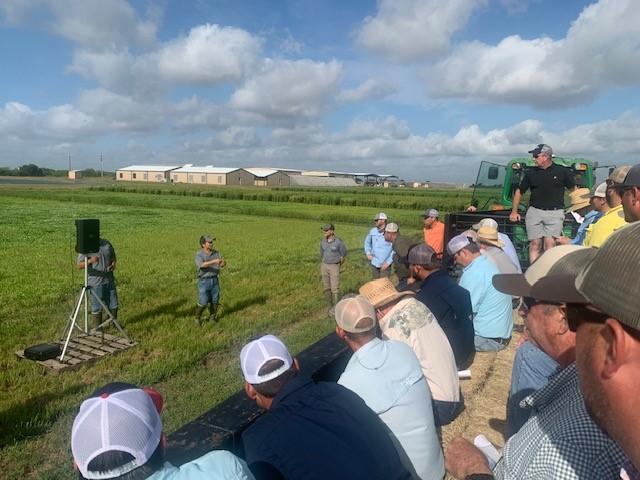
Dr Qiming "Doc" Shao and Scott Greenwalt describes Nutrien DYNAGRO rice varieties’ development, particularly hybrid trials, during a tour of the research station this week near El Campo, Texas.

Drone operation on hybrid seed production was presented by Ignacio Guevera from Nutrien.
Torres-Small Confirmed as USDA Deputy Secretary
On Tuesday, the Senate voted on an 84-8 vote to confirm Xochitl Torres-Small to be Deputy Secretary of USDA. This role, the second highest in the Department, has been vacant since former Deputy Secretary Jewel Bronaugh resigned in late January citing family reasons. Torres-Small most recently served as USDA Under Secretary for Rural Development. Prior to this role, she served New Mexico’s second congressional district in the House of Representatives. Throughout the nomination process, Torres-Small received bipartisan support from members of the agriculture community.
House Appropriations Committee Releases EPA pending Bill
On Wednesday, the House Appropriations Committee released the text of its FY2024 spending bill for the Department of Interior and EPA. The bill would provide a total of $6.173 billion in funding to EPA, a $3.96 billion decrease from the FY2023 enacted level. It also included a provision prohibiting EPA from enacting its rule regulating waters of the United States (WOTUS). The bill was marked up and favorably approved by the Interior and Environment Subcommittee Thursday afternoon. It will now go to the full Appropriations Committee for consideration. The Senate has yet to release its version of the bill.
House Ways & Means Committee Holds Hearing on Agriculture & Trade
On Monday, the House Ways and Means Committee held a field hearing to learn how agricultural producers are impacted by trade policy. In the hearing, which took place in Kimball, Minnesota, touched on agricultural labor challenges, enforcing trade agreements, and how to help keep American producers competitive in the global market. A recording of the hearing can be found here.
The U.S. Agricultural Export Development Council (USAEDC) held its annual Attache Seminar in McLean, VA this week, bringing together USDA cooperator organizations and USDA FAS staff from around the globe. Grace Wang and Mollie Buckler represented USRPA at the seminar and met with post staff from Guatemala, Morocco, Brazil, China, and Peru on Wednesday afternoon. In his FAS Update during Thursday's plenary session, FAS Administrator Daniel Whitley noted that for every $1 FAS spends on market development programs, $25 comes back to the U.S.

USRPA staff members Grace Wang and Mollie Buckler with incoming Morocco attache Ben Rau during attache consultations
| International news rules the day for this issue of the Advocate, as India is now considering banning most rice exports, including non-basmati varieties, because of soaring domestic prices. This is huge news for the global rice complex, as India is the largest exporter in the world at approximately 22 million metric tons, whereas Thailand and Vietnam fluctuate between 7-9 million metric tons in vying for second place. If India truly follows through with this drastic measure as a result of troublesome El Niño weather patterns, it could send reverberations through the market reminiscent of the 2008 food crisis. While global food security is a primary focus of any rice producer, a shock to the supply side of the equation as significant as India banning exports will certainly find its way into the western hemisphere and support U.S. prices in the coming marketing year. In other international news, Mexican importers visited Pakistan to inspect rice mills, ports, farms, and facilities to investigate the possibility of lifting the export ban imposed on Pakistan. This would be a significant change in the market dynamic, and another barb in the already complex relationship that is being navigated to maintain our largest trading partner in Mexico. Pakistan has recently made inroads into Haiti, creating a problem for U.S. exporters, and intrusion from Pakistan into our core Mexican market will be another point of contention moving forward this year. Recent results of the Panama tender and crop damage caused by El Niño in various Andean markets along with Central America and Mexico indicate that many buyers’ eyes are on the U.S. harvest. The first fields are being cut in Texas and Louisiana. As we all know, until it's cut, dried, and stored we don’t know what we have in the way of quality, especially for good milling yields and minimum chalk. Turning now to the WASDE report that was just released, it appears that the USDA has raised world stocks by 3.6 MMT when China is excluded. The reports lowered the 22/23 carryover number by 1 million cwt down to 15.8 million cwt, which is where they estimate the carryover in 2023 to be as well. They also expect a production increase of 2.8 million cwt on revised acre reports filtering in. The average farm price was lowered $0.50/cwt to $14.50/cwt. In Asia, prices are still firming with Thai 100% now as high as $530 pmt, and Viet priced at $550 pmt. India is approaching $500 pmt, but we will see what the weather dictates moving forward and how it may shape the export policy of the globe's largest rice shipper. Daily volume dropped 13% this week down to 470, while open interest stayed flat at 8,484. It was another bad week in the USDA Export Sales Report. Net sales of 4,000 MT for were down 32% from the previous week and 66% from the prior four-week average. Increases were primarily for Mexico (2,000 MT), Canada (1,700 MT), and the Bahamas (200 MT). Exports of 4,800 MT were down 91% from the previous week and 89% from the prior four-week average. The destinations were primarily to Mexico (3,200 MT), Canada (1,100 MT), Japan (100 MT), Saudi Arabia (100 MT), and Bahamas (100 MT). |
 |
In This Issue:
| Ready to celebrate the Fourth of July at the US Embassy in Guatemala! US Rice Producers Association participated in the Embassy's annual Fourth of July Celebration. |
 Paella preparation in full swing Paella preparation in full swing |  ARROZGUA Director Roberto Wong with U.S. Ambassador to Guatemala William Popp ARROZGUA Director Roberto Wong with U.S. Ambassador to Guatemala William Popp |
| House Committee on Ways and Means to Host Field Hearing on Trade in America: Agriculture & Critical Supply ChainsHouse Committee on Ways and Means Chairman Jason Smith (MO-08) announced that the Committee will hold a field hearing titled “Trade in America: Agriculture and Critical Supply Chains – Kimball, Minnesota.” The hearing will take place at 2:30 PM on Monday, July 10, 2023, at Schiefelbein Farms in Kimball, Minnesota. Members of the public may view the hearing via live webcast available at https://waysandmeans.house.gov. The webcast will not be available until the hearing starts. |
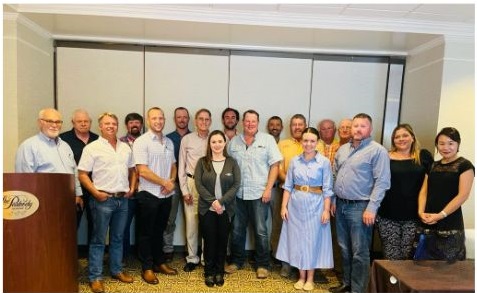
USRPA's Board of Directors met at the historic Peabody Hotel in Memphis this week for their summer board meeting. Every rice-growing state was represented at the meeting, which included updates on international programs, governmental affairs and international trade, and planning for 2024. Thanks to our board members for their commitment to strengthening the U.S. rice industry.
| Harvest is almost underway just as the June acreage report is released, providing early signals of market activity for the coming months. Most crop reports from our on-the-ground sources are coming in with an optimistic tone, and those who will be first in Louisiana are eager to take samples and get the harvesters moving. But first, let’s examine the June acreage report that the industry has been anticipating for weeks now. There are a few ways to break down the report, so we will start by looking at the total crop size increase over last year, and then we will look at the long grain and medium grain acres individually. On the whole, a total of 2.687 million acres of rice were planted this year, a 21% increase over last year’s 2.222 million planted acres. This increase is largely on account of a return of the California crop on the west coast, and a significant increase of acres in Arkansas. Looking directly at the long grain plantings, the report shows 1.991 million acres, up 10% from last year’s 1.802 million acres. Medium grain acres have the largest change, with a total of 663,000 acres, up a whopping 70%. Of the 663,000 acres of medium grain, 435,000 acres are in California (excluding short and long grain), while the balance of 228,000 acres comes from Arkansas (160k), Louisiana (60k), Missouri (5k), and Texas (3k). The story here continues to be one of convergence; for medium grain, it’s that the high-priced old crop must converge with lower new-crop pricing on account of increased supply. For long grain, it’s that U.S. price must converge with South American suppliers like Brazil, Paraguay, and Uruguay in order to restore balance in the Western Hemisphere rice export complex. While convergence may be a nice way to say “the price will drop this year,” it is essentially restoring the balance after climate-driven production shocks to both U.S. medium and long-grain rice severely distorted typical supply chains. This inherent climate risk is increasingly becoming a factor in the Western Hemisphere rice trade; i.e.: climate impacts now extend beyond the monsoon rains in India or weather catastrophes in Indonesia. Water, and lack thereof, is having a significant impact on crop decisions, crop availability, farm bill measures, and ultimately the reliability of supply. It is important to maintain perspective here and remember that the 1.9 million acres of long-grain rice, and the 663,000 acres of medium grain are simply a return to a normal U.S. crop. However, multi-year consecutive decreases in both long and medium grain supplies resulted in our export markets adjusting and finding supplies from our competitors. Having a full crop creates an opportunity to recapture these markets, but also a challenge to market at levels positive to the industry as a whole. On the ground, prices in Texas are reported at $17.50-$17.75/cwt. Louisiana is being reported at $19.75/cwt, and Mississippi, Arkansas, and Missouri are all $19-$18.50/cwt. In Asia, prices continue to firm this week with Thai prices now at $525 pmt, and Vietnamese rice at $510 pmt. |
 |
In This Issue:

25722 Kingsland Blvd., Ste. 203, Katy, Texas 77494
Phone: 713-974-7423
USRPA does not discriminate in its programs on the basis of race, color, national origin, gender identity, sexual orientation, religion, age, disability, political beliefs, or marital/family status. Persons with disabilities who require alternative means for communication of information (such as Braille, large print, American sign language, language translation, etc.) should contact USRPA at 713-974-7423. EEO.