| During the month of July, promotions in Guatemala gained national attention, featuring the use and consumption of U.S. rice in different activities. One of the most important was the Fourth of July celebration at the American Embassy in Guatemala, where a giant Jambalaya was cooked for 1,500 guests. The rice-based Cajun dish included chicken, ham, and shrimp as well. In the 4th of July celebration, the southern flavor of the U.S. was highlighted and it was shown how rice is abundant, rich, and very economical to use. USRPA has participated hand in hand in the local activities of the U.S. Embassy through its local partner in the promotions of American rice. USRPA has also continued with visits to schools to promote the use and consumption of U.S. rice in the School Nutrition Program, serving to date more than 50,000 children, training about 1,600 teachers and about 82,000 housewives who are the mothers of the students who attend these schools. USRPA ensures that cooking classes always focus on the nutrition, affordability, and versatility of U.S. rice. |
 |  |
 Neal Stoesser Chairman Raywood, TXAt the Summer Board of Directors meeting earlier this month, the board elected new leadership for the upcoming two year term. Neal Stoesser is the new Chairman of US Rice Producers Association. Stoesser is a fourth-generation farmer, growing rice, soybeans, milo, and hay and raising cattle along the Texas gulf coast. He had the pleasure of growing up watching his father, the late Ray Stoesser, advocate for the rice industry and now proudly follow in his footsteps. Stoesser’s love of farming began very early in his life and at the age of 8 when he started actively helping his father’s farm by driving the cart and has not stopped since. He farmed his first solo crop at the age of 18 and now farms a minimum of 6,000 acres of rice per year. He has continuously adapted and innovated to meet the current demands of farming. Stoesser, continuing the long-established custom that has been passed on from one generation to another, is joined on his farming operation by his wife, Meredith, and two sons; Nate, age 14, and Wes, age 10. According to Stoesser, "The rice industry feeds a bunch of the world; we are just trying to do our part to help." Also elected were Vice Chairman Chris Berry of Poplar Bluff, Missouri, and Secretary-Treasurer Dustin Watkins of Welsh, Louisiana. Thanks to these gentlemen for their commitment to their fellow U.S. rice producers.  Chris Berry Vice Chairman Poplar Bluff, MO  Dustin Watkins Secretary-Treasurer Welsh, LA |
House Delays Consideration of Ag-FDA Appropriations Bill
This week, the House was scheduled to consider the Military Construction and Veterans Affairs (Milcon-VA) appropriations bill as well as the Agriculture and Food and Drug Administration (Ag-FDA) appropriations bill for FY2024. Although the House, in one of the last votes before recess, was able to pass the Milcon-VA bill on a close 219-211 vote, with two Republicans voting with every Democrat against the bill, consideration of Ag-FDA appropriations has been delayed. The Milcon-VA bill is the first FY2024 appropriations bill to be passed by either complete chamber. Earlier in the week, the Rules Committee had met but did not report out a rule for floor consideration of the Ag-FDA bill. The appropriations bills for FY2023 expire at the end of September. Future consideration of the Ag-FDA appropriations bill is expected in September. Both the House and Senate are scheduled to be on recess throughout the entire month of August.
| The typical headlines this time of year focus on harvest, potential yields, and a crop outlook that is getting clearer by the day. However, the excitement continues to come from India as the reverberations of their export ban of non-basmati rice shakes its way to consumers. Even here in America, panic buying not seen since the food crisis of 2008 or toilet paper purchases in the pandemic has found its way to urban centers. As expected, an over-reaction was the first reaction, but it is our hope that cooler heads will prevail. It has been widely reported in the last week that India is responsible for 40% of the global rice trade, and therefore assumed the ban was all encompassing. While it’s true that India does account for 40% of global exports, their ban on white rice actually accounts for approximately 15% of the global rice trade. The policy change is significant by all standards, but the following numbers will help to break down the situation and hopefully quell the developing hysteria. India typically exports approx. 20 million metric tons of rice per year (40% of global rice trade). Of those exports: Basmati: 4-5 million metric tons (approx. 9% global rice trade) is still exportableParboiled: 7-8 million metric tons (approx. 15% global rice trade) is still exportableBrokens: 3-4 million tons (approx. 7% global rice trade) has seen tariff/ban since Q3 2022; ie: the market has already adjusted to not having this supply available.Impacted White Rice: 7-8 million metric tons, or approx. 15% of the global rice trade, is being taken off the market…unless the Indian government exercises its option to make G2G deals with other nations. A 15% reduction in global supply is an enormous shock to the rice trade, but it’s important to know we aren’t talking about a 40% reduction that is assumed based on headlines. The supply reduction has certainly found its way to Asian pricing, as Thai prices shot up nearly 10% this week, almost touching $600pmt, while Viet prices bumped only 4%, holding closer to $550 pmt. We expect these prices to continue firming as India’s primary customers in West Africa, Indonesia, and the Philippines scramble to secure supplies in the near term, all while competing against the steady business Thailand and Vietnam already possessed without India’s customers. All of this panic buying and scrambling for supplies in the far east is good for us in the Western Hemisphere. The large crop we are about to harvest is no secret, and inquiries are already being made as to availability and supplies. While many of these inquiries are rather obscure and may not have “legs,” the real test will be Iraq. Iraq honored its MOU with the U.S. last year but at the same time procured significantly more and cheaper supplies from Thailand to fill out their demand. With Thai prices skyrocketing, and many Thai buyers void of a U.S. relationship, a shift of supply from Thailand to the U.S. is a very rational pivot for Iraq. This is great news for the overall market to scoop up additional demand amid rising prices, but has the potential to further constrict paddy supply. This could therefore firm up paddy prices to an already strained South American market. With all the unknowns there is one thing for sure: this is lining up to be an exciting year for the U.S. crop and the global rice complex as a whole. Looking at the USDA Crop Progress report from July 24, we see that 73% of the Arkansas crop is in good to excellent condition, 100% of California is in good to excellent, 58% for Louisiana with 40% in fair, 75% good to excellent for Mississippi, 79% good to excellent for Missouri, and 85% good to excellent for Texas. Combines have been in the fields in both Texas and Louisiana for several days now and with a weather prediction of hot dry days ahead, the harvest will gain strength by the day. This paints an overall rosy picture for the ensuing harvest, with over 75% of the crop showing good to excellent. Where this optimistic crop analysis would have placed an ominous expectation on price only weeks ago without the development of India’s ban, the solid-looking large crop only bodes well for the entire U.S. rice complex .  |
In This Issue:
| Missouri producers and industry members are invited to join the Missouri Rice Research and Merchandising Council on Thursday, August 17 at the Missouri Rice Research Farm for the Council's annual Field Day. 8:00 a.m. - Registration (Coffee & Donuts provided)8:30 a.m. - Tours11:30 a.m. - Complimentary Luncheon catered by Tasteful Creations |
 |
 |  |
House announces intent to consider agriculture funding bill next week
The House Rules Committee has announced that it may meet the week of July 24 to provide for floor consideration for the FY2024 appropriations bill for USDA and FDA. This week, members were required to file their amendments to the funding bill. 142 amendments to the bill have been filed. The bill was approved by the Appropriations Committee on June 26 following a long and contentious markup.
The Senate Appropriations Committee approved its version of the USDA and FDA appropriations bill on June 22; Senate leadership has not announced when the full chamber will consider its bill. The FY2023 appropriations bill expires on September 30.
USDA partners with state attorneys general to address competition in agriculture
On Thursday, USDA announced it was partnering with the attorneys general of 31 states and Washington, DC, to improve competition in the food and agriculture markets. The initiative will focus on competition in three main areas: intellectual property in seed markets, consumer choice, and price gouging in the food retail and agriculture industries. With regard to competition in seed markets, USDA announced it had established the Farmer Seed Liaison initiative to increase transparency in the industry. More information on the initiative can be found here.
Agriculture hearing on rural water systems this week
On Wednesday, the Senate Agriculture Committee held a hearing on rural water systems. A recording of the hearing can be found here.
Rumor has turned to the fact in a big way this week, as India has officially banned the export of non-Basmati white rice, making Basmati and Parboiled rice still available. This is jaw-dropping news for rice buyers around the globe who rely on cheap rice prices courtesy of India’s break-neck production and exports of the grain. Last year, India exported 17.8 million metric tons of non-Basmati rice, where nearly 7 MMT was white rice. The Indian government is saying, however, that white rice exports will be allowed with permission to countries who are working to meet food security needs. This news will certainly shake the market, and these government-to-government food security agreements will likely take too long to execute without recognizing some sort of price increase. Estimates from the trade are saying that long grain prices around the globe could rise by $100 pmt shortly, but that remains to be seen. India is the world’s leading exporter, handling more than 40% of the global rice trade. The implications for the U.S. rice industry and rice trade in the Western Hemisphere are clear: This is good for U.S. long grain as it returns to a normal size crop and can viably compete in the export market in the coming year. India has been the global low-price leader for years, and removing their supply will inevitably increase prices out of Thailand, Vietnam, and Pakistan. The greatest fear the U.S. rice trade has is the intrusion of cheap rice from these far-east origins into our core-market strongholds like Mexico, Haiti, and South America. This development will help secure the increased U.S. acreage as the primary source for rice in the Western Hemisphere in the coming year, at prices higher than anticipated. Additional news out of Ecuador, Venezuela, Peru, and other regions indicate El Niño weather conditions have caused significant damage to production and will result in increased import needs. The July FAO Rice Price Index showed a drop of 1.2% from May to June to 126.2 points, which is still 14% above last year. The drop was largely on account of medium grain and aromatic varieties seeing price decreases as supply wanes and expectations for a large new crop (for medium grain) are weighing on the market. We expect to see this trend reverse immediately for the August FAO report with India’s export ban. In Asia, we have been reporting firm pricing out of both Thailand and Vietnam based on strong demand, with FOB prices exceeding $515 pmt for both origins. Now with the largest exporter in India exiting the market, this firmness is all but guaranteed to jump in the coming weeks, with some calling for prices in excess of $600 pmt. We do hope that the market won’t react like it did in 2008 when India announced an export ban; it would appear that India has learned how to quell an overreaction with the allowance of Parboiled and Basmati exports, along with G2G food security exports with permission. The bottom line here is that domestic prices in India will drop sharply, which is the purpose and goal of this ban, and export prices will increase sharply, which is a fundamental byproduct of the decision. Harvest has just begun in some regions of Texas and Louisiana, with optimism high but no real yields or milling qualities to show for it. Outside of isolated rain pockets and weather systems, things are good. Mills are sitting on pins and needles waiting to get new crop running through plants to take advantage of these new pricing opportunities afforded by India’s exit. Perhaps we will see a reversal in the dismal Export Sales report by this time next year, as the current report shows net sales of only 2,800 MT, down 32% from last week and 74% from the prior 4-week average. Exports of 21,400 MT were up noticeably from the previous week, but down 37% from the prior 4-week average. In Missouri, most rice fields are heading or close to it and in good condition despite some weeds and grass, similar to reports coming out of northeast Arkansas. Weather during the next two weeks is critical as fields are flowering and pollinating. This picture of DG263 near Neelyville was taken by Mitch Thomas this morning.  |
In This Issue:
Texas A&M AgriLife Research and the Texas A&M AgriLife Extension Service hosted their 75th annual Rice Field Day on July 13 at the Texas A&M AgriLife Research and Extension Center at Beaumont. This year’s theme was "Innovations in Texas Rice Irrigation".
The program included morning and afternoon tours , reseach displays and in the general program; AgriLife Research: Developing Solutions Today for Agricultural Challenges in the Future – G. Cliff Lamb, Ph.D., director of AgriLife Research, Bryan-College Station; Maximizing Water Management through Farm Design – Ryan Frey, irrigation specialist, Smart Acre Solutions LLC., Ferriday, Louisiana; Irrigation Conservation Practices Used by Mid-South Rice Producers – Joe Massey, Ph.D., U.S. Department of Agriculture – Agriculture Research Service research agronomist, Jonesboro, Arkansas.
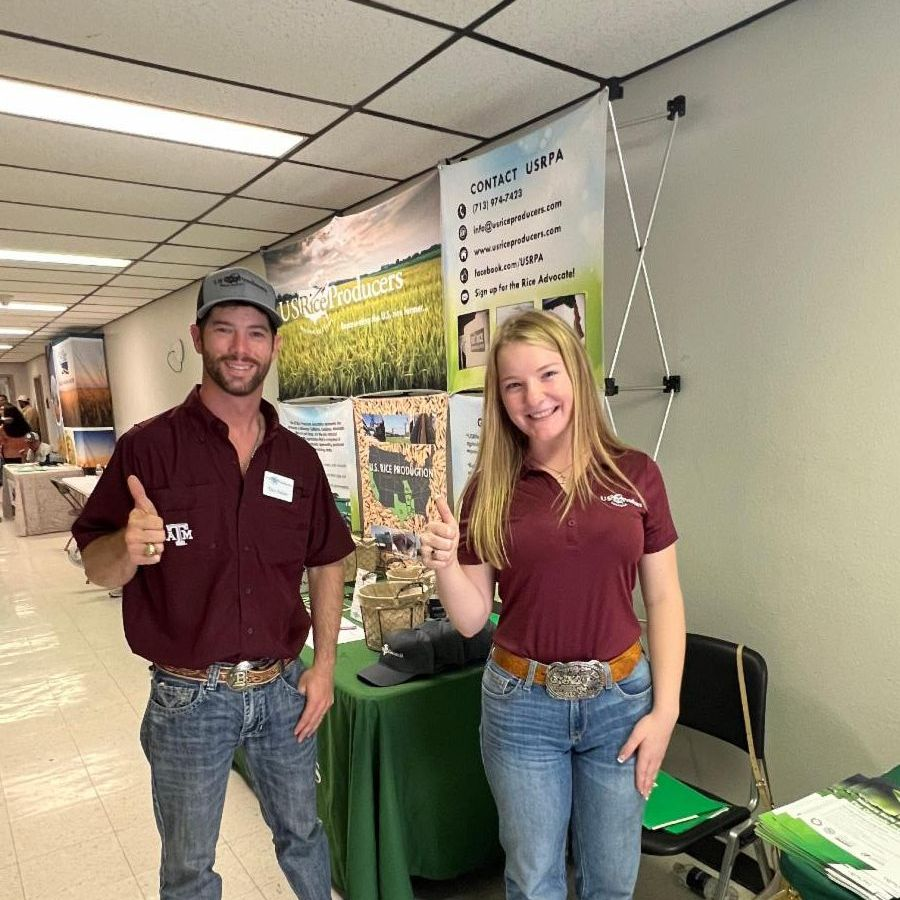
USRPA President and CEO, Marcela Garcia, staff members Iris Figueroa, Trey Barker, and USRPA Stoesser Scholar Gayla Rose represented USRPA at the event.
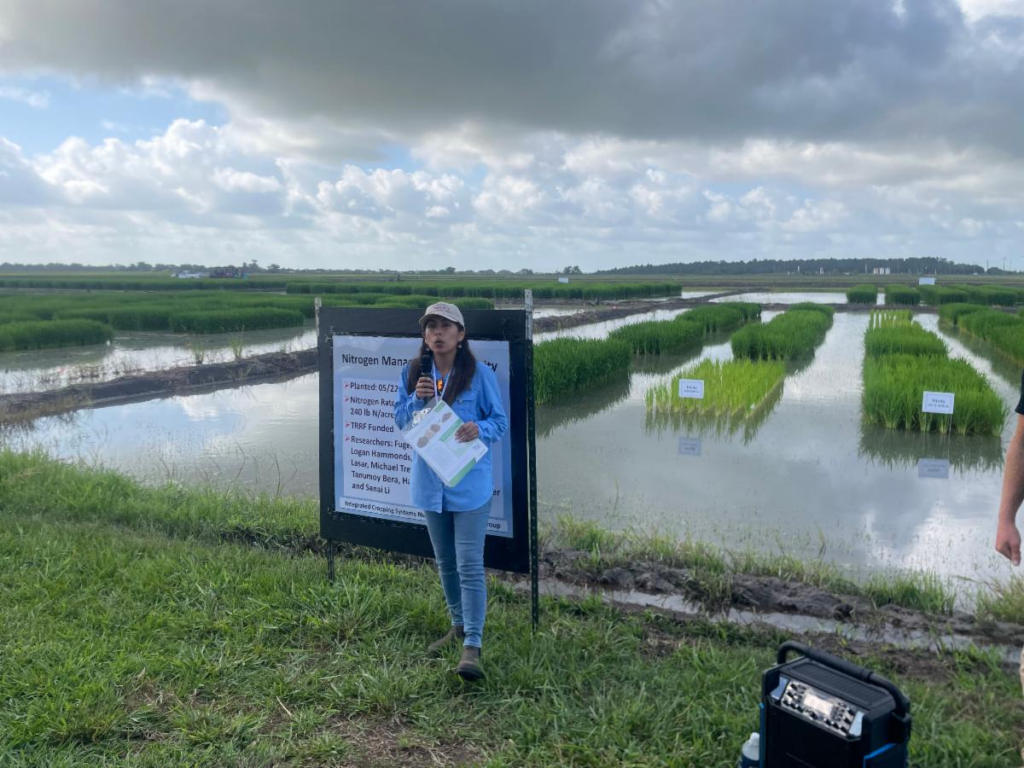
Lina Bernaola, Ph.D., assistant professor in theTexas A&M AgriLife Research Department of Entomology
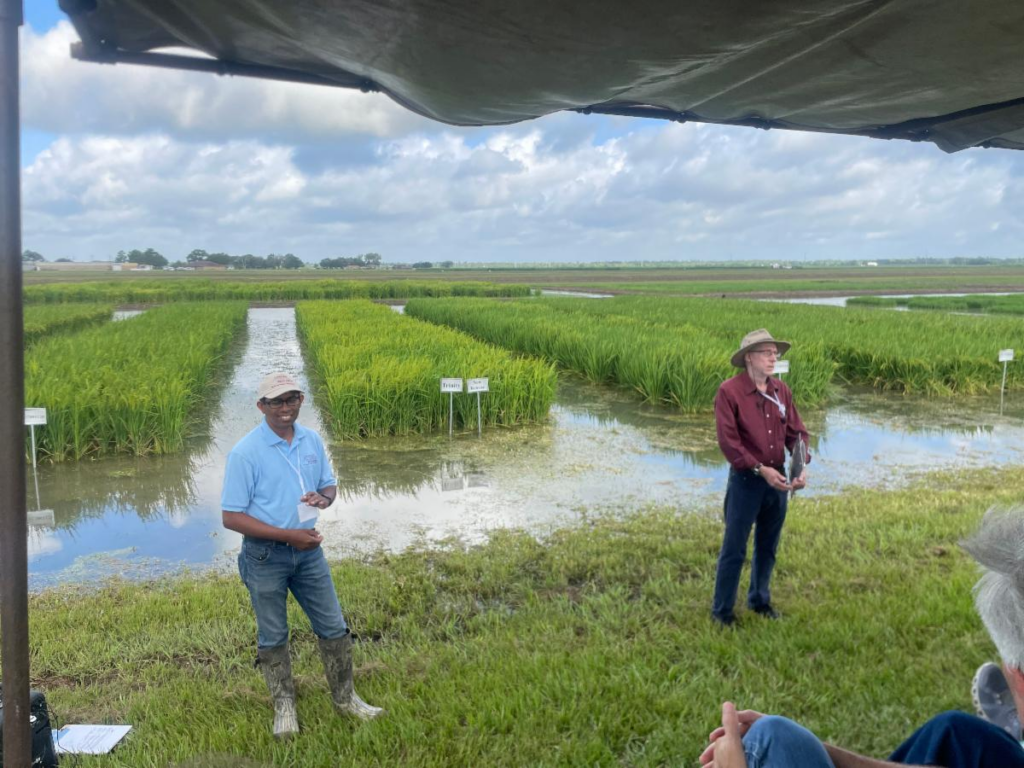
Assistant professors in the Texas A&M AgriLife Research Department, Shyamal K. Talukder, Ph.D., and Lee Tarpley, PhD., on Physiology & Inbreed Breeding
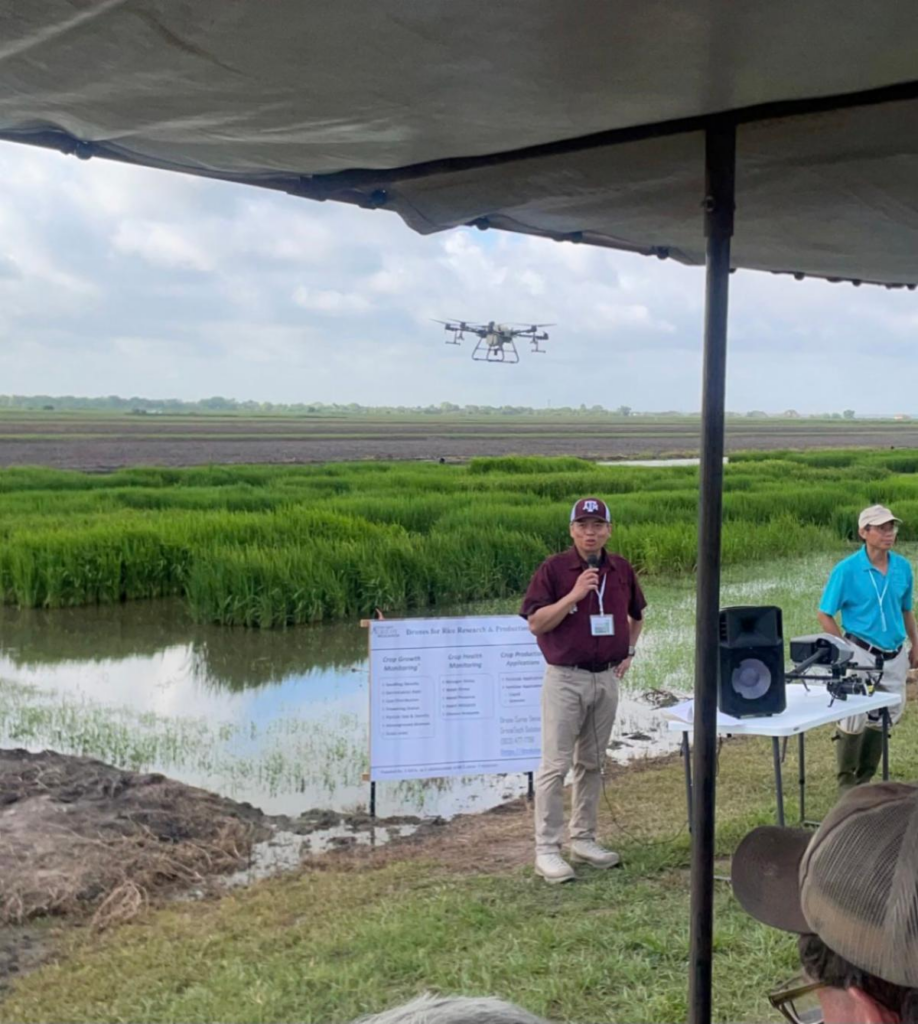
Xin-Gen (Shane) Zhou, PhD., assistant professor in the Texas A&M AgriLife Research Department on Pathology.

25722 Kingsland Blvd., Ste. 203, Katy, Texas 77494
Phone: 713-974-7423
USRPA does not discriminate in its programs on the basis of race, color, national origin, gender identity, sexual orientation, religion, age, disability, political beliefs, or marital/family status. Persons with disabilities who require alternative means for communication of information (such as Braille, large print, American sign language, language translation, etc.) should contact USRPA at 713-974-7423. EEO.