Pictured is an important delegation representing the Ecuador rice milling industry led by Juan Pablo Zuniga, President of CORPCOM, the rice milling organization of Ecuador. The importance of rice to the diet of Ecuadoreans cannot be overstated due to a per capita consumption of 100 pounds per year. Since 1997 Ecuador has been self-sufficient and many years produced a surplus of rice; however weather related conditions have changed production efforts like many markets including the United States. Recent imports of milled rice from Uruguay are being used in order to maintain stability with consumption demands.
The delegation spent the week meeting with farmers, merchants, exporters, FGIS, research, and others in order to gain an understanding of how rice is grown, handled, and marketed in the U.S. The USRPA has maintained a strong relationship with both CORPCOM and Ecuador rice producers since its formation in late 1997 with visits over the years and participation in conferences and meetings in Guayaquil, the main port city on the Pacific coast and the center of the country’s rice production.
Next week’s Rice Advocate will have more details of the group’s visit from St. Louis through to New Orleans.
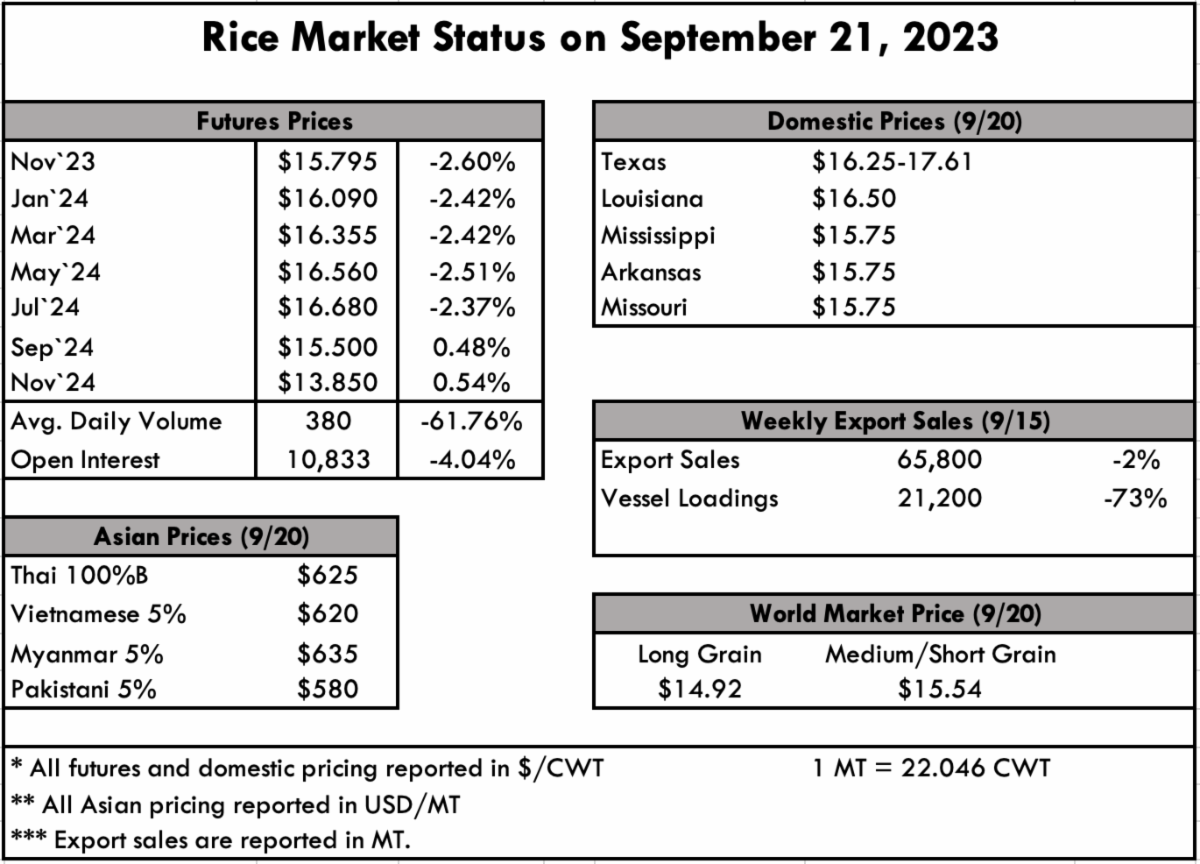
| Is the story for this marketing year already written for the U.S. long-grain crop? One could argue that it’s all but over before harvest is even finished. Every year has unique features, and this year is punctuated by the Indian ban and the resulting scramble that has gobbled up a bumper crop, and all but made a bearish WASDE report that increased paddy by more than 6 million cwt a mere speed bump in the wake of strong demand. Last year when prices were steady at $680pmt for the back half of last year’s short crop, the expectation was that this year’s large crop would make U.S. long grain more competitive, and prices would drop to converge with South American exporters. However, a strong market in Iraq and Haiti, bolstered by steady domestic business, has firmed prices even further, while South American export prices race upward to converge with U.S. prices — now finding rest at a minimum of $700pmt. We can confirm one sale of Uruguayan milled rice at $760/ton FOB Montevideo destined for Peru. We would contend that the dust is settling from the Indian situation, and we have a steady market moving through the first quarter of 2024 at this juncture. We know that export prices are firm, and cash prices are looking the same. Texas is seeing cash prices of $16.25-$17.61/cwt based on preferred variety and quality of milling yield. Louisiana is looking at $16.50/cwt, while Mississippi, Arkansas, and Missouri are at $15.75. The crop progress report shows steady movement toward completion, with California finally underway in a meaningful way, though still at only 6%. Arkansas is now 15% above the pace for the 5-year average, crossing the halfway point and sitting at 58%. Louisiana and Texas are at 93% and 90% respectively, while Missouri is at 27% and Mississippi is at 74%. The weather is favorable, and much still depends on milling yields to determine just how far this crop will go. Early milling yield reports continue to be very inconsistent, “mostly in the low 50s.” Prices are settling significantly in Asia, where only weeks ago they exceeded $650pmt, but are now reported at $625pmt for Thai rice and $620 for Viet rice. Myanmar and Pakistan are at $635pmt and $580pmt respectively. A recent GAIN report on Vietnam shows rice exports surged to 656,869 tons in August, with the primary markets being the Philippines, Indonesia, Ivory Coast, Ghana, and China. The Philippines jumped 45% from the previous month and accounted for 36% of all of Vietnam’s exports. This surge could be in response to the Thai government encouraging its rice farmers to plant less water-intensive crops as El Nino is impacting the moisture cycles. The weekly Export Sales report registers net sales of 65,800 MT, down 2% from the previous week, but up 24% from the prior 4-week average. Increases were primarily for Mexico (28,100 MT), El Salvador (12,000 MT), Honduras (10,000 MT), Saudi Arabia (8,600 MT), and Israel (4,000 MT). Exports of 21,200 MT were down 73% from the previous week and 58% from the prior 4-week average. The destinations were primarily to Saudi Arabia (8,800 MT), Guatemala (5,500 MT), Mexico (4,900 MT), Canada (1,600 MT), and the Bahamas (100 MT). |
 |
| Senate hits snag in agriculture appropriations billsOn Thursday, the Senate voted on a bipartisan 91-7 vote to open debate on the Senate floor on the first package of spending bills for fiscal year 2024; however, shortly after the vote, some Republican senators began pushing for the three spending bills to be considered individually, bringing the process to a standstill. This package included three bills including the one for the Department of Agriculture and Food and Drug Administration. The current spending bills expire September 30. Department of Labor proposes new rule for H-2A programThis week, the Department of Labor released a proposed rule to expand employee protections for workers in the H-2A temporary farm worker program. Among the proposed changes are requiring new disclosures on recruitment, making new wage rates applicable sooner, allowing workers to access representation in disciplinary cases, and preventing employers from confiscating workers’ travel documents. The proposed rule has not yet been published in the Federal Register. Once published in the Register, interested parties will have 60 days to comment on the rule. The proposed rule can be found here. |
| Washington, D.C. Update |
| Senate hits snag in agriculture appropriations billsOn Thursday, the Senate voted on a bipartisan 91-7 vote to open debate on the Senate floor on the first package of spending bills for fiscal year 2024; however, shortly after the vote, some Republican senators began pushing for the three spending bills to be considered individually, bringing the process to a standstill. This package included three bills including the one for the Department of Agriculture and Food and Drug Administration. The current spending bills expire September 30. Department of Labor proposes new rule for H-2A programThis week, the Department of Labor released a proposed rule to expand employee protections for workers in the H-2A temporary farm worker program. Among the proposed changes are requiring new disclosures on recruitment, making new wage rates applicable sooner, allowing workers to access representation in disciplinary cases, and preventing employers from confiscating workers’ travel documents. The proposed rule has not yet been published in the Federal Register. Once published in the Register, interested parties will have 60 days to comment on the rule. The proposed rule can be found here. |
| The USDA published a bearish WASDE report this week with the outlook for the U.S. showing an increase of supplies, exports, domestic use, and ending stocks. Carryover was increased 23% from 19.6 million cwt up to 24.1 million cwt. Supplies bumped on account of stocks being raised 5.7 million cwt, and production being raised by 17.3 million cwt. The average yield for this year’s harvest is up, pegged at 7,751 lbs/acre. This is good news, but we need solid milling yields in order to provide a quality product to our customers. The new season average farm price has been moved to $16.80/cwt, down $.90/cwt from last month. Apparently the trade believes the demand side but the supply assessment has some questions as the market has gone up $.77/cwt since the report. Some in the trade feel there may be some double dipping since the new crop harvest was earlier due to the hot weather, meaning new crop contributed to old crop carryover. There is an effort to clarify this point. The global rice outlook from the WASDE calls for reduced supplies, consumption, trade, and stocks based on detrimental weather patterns and trade policies that are restricting exports. Despite this, global supplies only dropped 4.4 million tons, but the real news is the reduced global trade. This month, the expectation is a reduction to 52.2 million tons, down only 1.5%. Expect to see this number increase as the fullness of the export ban is realized in the coming weeks and months. The September FAO Rice Price update unsurprisingly jumped 9.8% in August, reaching 142.4 points, or 31.4% higher than last year. Prices have not been this high since the 2008 food crisis, which also was predicated by an Indian white rice export ban. But as more news comes out about climate risk, drought, and production problems, the export ban seems to be more of just the first domino to fall. Thailand has suffered poor rains that have impacted rice production, the Philippines have renewed imports after a multi-year hiatus, and several other countries are left scrambling to secure supplies moving into the fourth quarter of the year. |
| Attracting less attention in the global market, but more important to our locale, is the 10-12% price jump in South America. Recall that earlier in the year, price convergence of U.S. to South American prices was to mean that the U.S. long grain price would fall; global events now declare otherwise. The chart here tells the story and you can see that convergence in the current climate means that Argentina, Brazil, and Uruguay have all shot up to nearly $700 pmt to meet the U.S. export price, which is excellent news as harvest is underway. |  |
| Iraq, quickly becoming one of our most important customers, has renewed restrictions on their rice production due to water shortages. Harvested area is expected to be only 20,000 acres; the rest is being imported. The price chaos in India, Thailand, and Vietnam has sent them straight back the U.S., where we are excited to field the business and compete on the world stage again. For a quick glance at harvest, Arkansas has jumped to almost 50% harvested this week, with 71% showing in good to excellent condition. Initial yields are strong, which will help offset disappointments in Louisiana and Texas. Mississippi bumped up to 53% completed from 32% last week, and Missouri is officially underway now over 15% completed. Some of the earliest fields are being harvested in California with mixed results on yields, which can be normal this early. Because of the late planting in California and the relatively cool growing season, the crops are not maturing as fast as normal, and yields are expected to be off. In Asia, prices are settling down now that the panic is subsiding and a “new normal.” Thai prices are reported down to $625pmt, and Viet prices at $620pmt. Pakistan is still sub-$600 at $580pmt. The export sales report this week shows net sales of 67,200 MT, up noticeably from last week and 58% from the prior 4-week average. Exports of 79,000 MT were up 67% from the previous week and up noticeably from the prior 4-week average. |
 |
Senate Agriculture Leadership Urges USDA to Invest in Trade Promotion and Food Assistance
On Wednesday, Senate Agriculture Committee Chairwoman Debbie Stabenow (D-MI) and Ranking Member John Boozman (R-AR) sent Secretary of Agriculture Tom Vilsack a letter encouraging USDA to invest in trade promotion and global food assistance under the Department’s Commodity Credit Corporation (CCC) Charter Act authority. In the letter, the Senators noted the importance of trade promotion programs, which include MAP and FMD, in opening new markets and strengthening presence in existing markets for American producers. They also say the war in Ukraine is affecting supply chains and perpetuating humanitarian crises, elevating the need for increased in-kind food assistance. A copy of the letter can be found here.
Senate Announces Plans to Consider Agriculture Funding Bill
On Wednesday, Senate Appropriations Committee Chair Patty Murray (D-WA) and Vice Chair Susan Collins (R-ME) announced plans to move the first package of fiscal year 2024 appropriations bills to the Senate floor as early as next week. This package will include the funding bills for the Department of Agriculture and the Food and Drug Administration, Military Construction and Veterans Affairs, and the Departments of Transportation and Housing and Urban Development.
OMB Identifies the Farm Bill as Needing to be Extended
The Office of Management and Budget (OMB) sent Congress a list of bills expiring at the September 30 end of the fiscal year in anticipation of the possible consideration by Congress of a continuing resolution. Included in OMB’s list is the extension of the entire 2018 farm bill, which OMB says needs to be extended or included in any continuing resolution unless the current farm bill is extended or a new farm bill is passed before September 30. To date, no new farm bill has been introduced or considered by either the House or Senate Agriculture Committees. For context, in 2018 the House and Senate Committees had both reported their versions of the farm bill, and these bills had passed both the House and Senate by late June. OMB’s full list of expiring authorities can be found here.
EPA and USACE Release Updated WOTUS Rule
The Environmental Protection Agency (EPA) and the U.S. Army Corps of Engineers (USACE) issued a final rule to amend the definition of waters of the United States (WOTUS). EPA and USACE were directed to update the WOTUS definition to conform with this spring’s Supreme Court decision on Sackett v. EPA from this spring. The new definition eliminates the “significant nexus” test, which had allowed streams and wetlands adjacent to larger bodies of water to be covered by Clean Water Act regulations. It also clarifies that wetlands must have a continuous surface connection to navigable waters to be protected under the Clean Water Act. The new rule revises the standard EPA and USACE released in January 2023. More information on the new final rule can be found here.
Despite rice producers being in the craziness of harvest, the market is experiencing what could be described as a calm before the storm. Truckers, driers, and farmers are dealing with the constant stress of getting the crop in the barn while the market is in a “wait and see” mode with significant global events swirling in the distance. The industry is well aware of the Indian export ban and red-hot Asian prices, but the direct impact of these food security concerns leaking into the Western Hemisphere is yet to be realized.
A significant reality that has snuck under the radar thus far, though, is that the South American crop is largely sold at this point — leaving the U.S. as the only origin for supplies in the Western Hemisphere for the next six months in a market desperate for available supplies. Mercosur, our largest competition in recent years, is essentially sold out. There are even rumors of Brazil booking a cargo of U.S. rice at the end of this calendar year! It has seemed unfathomable to consider sending rice to Brazil because in recent years of the small crop size to start, but also because Brazil has been the beneficiary of U.S. loss in market share to our core markets. How a year can change the dynamic (or the expected dynamic because nothing has technically happened to us yet in the Western Hemisphere). Things are setting up to be quite exciting. Even now, paddy quoted FOB NOLA at $415 when the price was expected to be $380 at this time. This can certainly be an answer to the higher cost of inputs the war in Ukraine has imposed on producers in the two most recent crop cycles.
With Arkansas now largely underway and reported at 24% harvested, all hopes are hanging on better field and milling yields than what we’re getting out of Texas and Louisiana. The hope was that a large crop and high yields would result in a significant supply of competitively priced rice. Unfortunately, those acres (at least from Texas and Louisiana) aren’t translating into the quality of milled rice the optimists were hoping for, thereby cutting the effective acreage expectations. Louisiana is at 86% harvested and Texas is at 80%. Mississippi is now beyond 30%, while Missouri is only at 5%. Harvesters are just getting in the fields in California for some of the specialty varieties and early-maturing medium grains. 70% of the crop is in good to excellent condition this week, down only 3% from last week. The rice industry will be looking for next week’s USDA WASDE report, scheduled to be released on Tuesday, September 12 at 12:00 pm Eastern Time. In the August WASDE report the 2022-23 carryover was raised a million hundredweights to 16.8 million. The report estimated the carryover for 2023-24 up three million at 19.6 million.
A quick summary of Asia tells us that Thai rice is settling around $650 pmt, with Viet rice very close—maybe closer to $645 pmt. El Niño is creating problems in Thailand, where dry conditions are forcing farmers to plant alternative crops to rice and the government is encouraging them to do so. The United Arab Emirates has suspended rice exports for the next four months, as has Myanmar. Indonesia has announced its desire to increase its buffer stocks but will be difficult to do because so many countries are closing up. Climate risk is becoming a significant factor in food procurement strategies for countries that rely on food imports. Domestic food inflation is a key factor as well. Right now, we see these two phenomena working together in the East and the West to create a tenuous market dynamic that will require creativity, government intervention, and cooperation to overcome.
| In partnership with the US Rice Producers Association, the Stoesser family is offering a $5,000 scholarship to one deserving high school senior or current college student who is interested in or is currently pursuing a career in an agriculture-related field. In addition to the monetary award, the selected recipient will serve as a student ambassador for USRPA in 2024 with an expectation of participating in at least two activities during the calendar year. The recipient will be invited to participate in various USRPA activities, including but not limited to Field Days, legislative activities, Texas Rice Council meetings, conferences, and more. Specific criteria for selection:Applicants should have the intention of pursuing a career in an agriculture-related field. Applications will be accepted from high school seniors, college students, and/or college graduate students.In addition to completing the online application form, applicants should submit a self-produced video no longer than 5 minutes answering the following questions: What is your vision for the next generation of the U.S. rice industry? Please cover topics relevant to the future of the U.S. rice industry, such as food security/safety, sustainability, etc. |

25722 Kingsland Blvd., Ste. 203, Katy, Texas 77494
Phone: 713-974-7423
USRPA does not discriminate in its programs on the basis of race, color, national origin, gender identity, sexual orientation, religion, age, disability, political beliefs, or marital/family status. Persons with disabilities who require alternative means for communication of information (such as Braille, large print, American sign language, language translation, etc.) should contact USRPA at 713-974-7423. EEO.