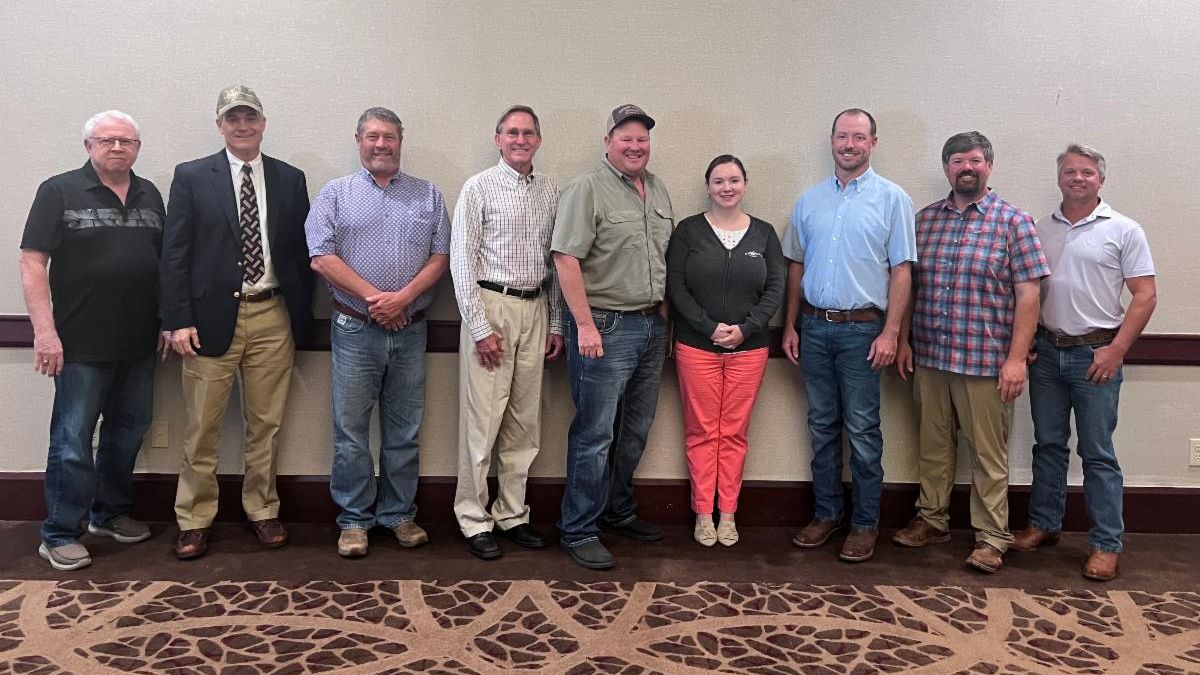
USRPA Board Meeting in Texas Welcomes LIRPA as New USRPA Members
Left to right: Dennis DeLaughter, Texas, USRPA Board Member; Vernie Hubert, Cornerstone Government Affairs; Mark Pousson, Louisiana, USRPA Board Member; Tommy Turner, Texas, USRPA Board Member and President of the Texas Rice Council; Neil Stoesser, Texas, Chairman USRPA; Marcel Garcia, President & CEO USRPA; Alex Clark, Missouri, USRPA Board Member; Mitchell Thomas, Missouri, USRPA Board Member and Dusting Watkins, Louisiana, LIRPA President.
This week, Board members and staff braved the effects of Hurricane Beryl to conduct the summer board meeting of the US Rice Producers Association in Houston, Texas. State reports, DC updates, market commentaries, financials, program reviews, strategic planning, and bylaws discussions were all a part of the two-day meeting. Even when the power flickered, the commitment of those assembled never wavered. Along with being a meeting conducted, literally, within a hurricane, this meeting has historical context with the inclusion of the Louisiana Independent Rice Producers Association as an Association member. With LIRPA standing alongside the Missouri Rice Research and Merchandising Council, and Texas Rice Council, USRPA is as strong as ever in representing U.S. rice farmers. "I am very excited and proud to welcome the Louisiana Independent Rice Producers Association (LIRPA) as a full association member of the USRPA. Having shown dedication and commitment as an associate member for years, it's wonderful to see the hard work of numerous producers recognized as we enter this new collaboration with Louisiana. The inclusion of LIRPA enhances the USRPA, and their joint leadership will play a vital role in steering our industry through research and promotion in the years ahead." Alex Clark, Missouri producer, and USRPA member. "I am so pleased to welcome the Louisiana Independent Rice Producers Association (LIRPA) to USRPA. Their alignment with our organization is perfect, and they will be a valuable asset as we progress." Dennis DeLaughter, Texas USRPA member. "For fifteen years now, we have watched a group of farmers from Southwest Louisiana strive to provide better prices for their farmers", stated Tommy Turner, President of the Texas Rice Council and USRPA Board Member. It has been amazing watching the Louisiana Independent Rice Producers Association start with only a dream and today have a rail facility, a port facility, and market millions of barrels of rice annually. USRPA is proud to have assisted them every step of the way. Their tenacity, perseverance, and grit exemplify the spirit of the US Rice Producers Association as they, and we, represent rice farmers in America. "We are thrilled to announce our full membership with USRPA. This achievement has been a long time in the making, and USRPA has been a fantastic supporter throughout our journey. We are excited for what the future holds." Dustin Watkins, Louisiana Independent Rice Producers Association (LIRPA) President and Louisiana producer.
Invited by FECARROZ President Kamal Dieck, the USRPA participated in the Central American meeting prior to the conference. Marcela Garcia and Dwight Roberts, shown here with leadership, represented the only U.S. rice organization presenting.
Kamal E. Dieck, president of FECARROZ extends a special thank you to the USRPA for their long history of support for Central America.
Earlier this week USRPA supported Texas rice producers at Eagle Lake Field Day hosted by Texas A&M AgriLife Research and Extension. The program focused on critical subjects including rice research and farm policy that benefit the Texas rice industry.
This week the Texas Rice Producers Board met and elected Josey Dishman (Chairman), Neal Stoesser (Vice Chairman) and Kenneth Hlavinka (Secretary). Pictured with Josey is the TRPB administrator Vicky Rao, CPA, Katy, Tx.
Senate Agriculture holds a hearing on drought
On Wednesday, the Senate Agriculture Subcommittee on Conservation, Climate, Forestry, and Natural Resources held a hearing in Colorado to discuss the threat of drought to western states. Witnesses described how drought impacts soil health and leads to aquifer depletion and noted the need to improve climate-smart practices to help sustain western agriculture. A recording of the hearing can be found here.
House Appropriations marks up FY2025 EPA funding bill
On Thursday, the House Appropriations Subcommittee on Interior, Environment, and Related Agencies Appropriations Act released the text of its FY2025 appropriations bill, which includes the funding for the Environmental Protection Agency (EPA). The proposal includes a 20% decrease in funding for the EPA compared to last year’s enacted levels. It also includes a provision directing the EPA and Army Corps of Engineers to provide a documentation on how the two agencies are implementing regulations for waters of the United States (WOTUS). Early Friday morning, the Subcommittee marked up the bill, which was approved on a party-line vote. It now moves to the full Committee. The full Committee is currently intending to mark up both this bill and the USDA funding bill the week of July 8. Bill text for the EPA funding bill can be found here and a recording of the Subcommittee markup can be found here.
The spot market throughout the delta was largely unchanged once again this week. This has been the case now for three to four weeks, which is to be expected given the tight supplies and the fast-approaching new crop. Price spreads between old and new crop in Texas and Louisiana remain at $2-3 per cwt or barrel, respectively. Harvest for other grains has already started in Texas, and rice isn’t too far behind. According to the USDA, Texas is 54% headed, up from the normal 22% for this time of year. Louisiana is also ahead of schedule at 41% harvested. This week’s hot and dry weather will speed up crop maturity. Initial field reports from growers are optimistic and an early harvest bodes well for crop quality. As harvest nears, old and new crop prices should converge to the middle for both states, while Arkansas and may see more convergence to old crop pricing. The July contract has slid roughly 8% from its high back in May but may be stabilizing in the weeks ahead. When open interest is increasing, prices are sliding and volume is rising, which usually that means new short positions are being opened and bearish sentiment is on the horizon. However, in this climate, weekly open interest is falling, prices are softening, but volume is rising — signaling the shorts are now covering their positions and potentially preparing for a rally or at least some stability. With only a few more weeks left in the 2023/24 marketing year, export demand is looking relatively dialed in, and quite impressive. Mexico clearly steals the show in terms of year over year increases as shipments are up 400% year over year, but other destinations have certainly aided the market with more than 200,000 MT of paddy having shipped to Venezuela. New crop recently traded at $375 CIF NOLA basis to Central America, a sizable drop from where rice was trading a few months ago. In other words, the market appears to have largely accounted for the acre increase. Moving into the new marketing year, U.S. long grain will look for continued success in Mexico, Venezuela, and Iraq. Should these markets remain at the door for the U.S., the long grain balance sheet should remain in a healthy state and market conditions relatively favorable. However, if the demand wanes to these destinations or is slower to develop, prices could erode a little further. At present, the USDA forecasts a 25 million cwt carryout, and that is without really adjusting export or domestic demand for the larger crop. It is probable to see the USDA total use decrease by another 1-2 million cwts in the months ahead, which would bring carryout back to roughly 23 million cwts, just slightly over the 5-year and 10-year Olympic averages.
Attendees at the recent Rice Market & Technology Convention enjoyed a series of impressive presentations that significantly contributed to the event's success. Economist Dennis DeLaughter's thought-provoking presentation on "What Could Possibly Go Wrong Now?" captured everyone's interest. V Subramanian from SS Rice News in SE Asia discussed how global markets have reacted and are still responding to export restrictions from India. Tiago Barata from SINDARROZ-Brazil faced a significant challenge in presenting the current market situation in Brazil after a historic flood disrupted the Western Hemisphere market the previous month. Various country reports provided timely insights into additional market issues concerning supply/demand, grain quality, and variety development.
The technology-focused presentations by several related industries showcased upcoming advancements and attracted a large audience to the exhibit area during coffee breaks.
Colby Branch, International Trade Specialist from the USDA's Foreign Agriculture Service, meets with Trey Barker (USRPA field representative) and his wife Jordan at a conference reception. Colby's attendance this year is highly valued.
The Western Hemisphere market was covered thoroughly at the RMTC, where the situation in Brazil was dissected, analyzed, and discussed on the stage and over coffee. Paraguay will send all of its exportable supply straight there, as will most other countries with excess. The U.S. will have much better luck at landing paddy in the flood-stricken region than milled rice, which will help in the disappearance of a large crop that is coming along nicely.
All states are fully planted — including California — where the USDA Crop Progress report shows the west coast medium grain producer is 85% emerged, compared to last year at 88%, and a 5-year average of 91%. The report also shows that overall rice states, 16% of the crop is in excellent condition, 67% in good condition, and 14% in fair condition. These numbers are trending in the right direction, as last year only 56% was good and 29% was fair at the same point in time. Right now, only Louisiana and Texas are showing emergence, with 25% and 31% respectively.
On the ground, new crop offers are beginning to surface, though action has been relatively light as of now. With so much yet to develop in Brazil and the overall demand situation, many producers are adopting a “wait and see” attitude for the next few weeks. Iraq and Haiti are not bright spots in the milled market, while Mexico and Brazil offer a counterbalance of positivity in paddy exports. In Asia, the persistent spread between Thai and Vietnamese prices is the main news. With Thai rice holding a nearly $50 pmt premium to Viet rice for weeks now, we expect to see demand shift to the cheaper origin in the coming days. Right now, Thai rice is $620 pmt, while Viet is still sub-$600 at $575 pmt. Pakistan is in the mix with prices at $590, and the primary concern with a shipment to Haiti, which will impede U.S. exports.
The WASDE report released last week calls for reduced supplies, even domestic use and exports, with slightly lower ending stocks in the U.S. The stocks were reduced as a result of a 1 million cwt increase in long-grain exports. The 2024/25 season average farm price held firm at $15.60/cwt. From a global perspective, the WASDE points up on most points with increased supplies, consumption, trade, and ending stocks. Most of the increase in supply comes from India and Pakistan, with India also accounting for increased ending stocks.
With the excitement of the RMTC, we are bringing the FAO Rice Price Update to you a little later than normal. The FAO Rice Price Index averaged 127.3 points for the month of May, up 1.3% from April and 7.5% above last year. Long grain prices out of Thailand accounted for the increase, where they continue to hold firm at prices well in excess of $610 pmt. The strength in this market can be attributed to the continued demand for Indonesia’s BULOG, and Brazil now searching out Asian rice.
This year is shaping up to be quite interesting, and is perhaps best framed by a series of questions: Thai rice to Brazil? Pakistani rice to Haiti? Is U.S. rice unable to ship to Iraq? Will there be a new Farm Bill? Will U.S. prices be competitive with the value of the dollar in an election year? These are all exciting topics that we will navigate day by day, while we look forward to a full crop for the first time in years. One final note: India’s Commerce Ministry will take up the issue of rice export curbs with a government panel. Read More Here.
USRPA does not discriminate in its programs on the basis of race, color, national origin, gender identity, sexual orientation, religion, age, disability, political beliefs, or marital/family status. Persons with disabilities who require alternative means for communication of information (such as Braille, large print, American sign language, language translation, etc.) should contact USRPA at 713-974-7423. EEO.